DCIM Data Population From Design Models at Project Handoff
Mapping BIM to operations keeps data current from design through handoff.
What operations teams inherit at turnover, and why it is rarely what they need
By the time operations gets the keys, the handoff package is usually a nightmare of PDFs and spreadsheets, and the as-built information buried inside it is already stale. That's what happens when nobody owns the data thread running from design through construction. No single team is at fault. The process just never assigned ownership, so the gap fills itself with manual re-entry and guesswork.
What operations actually needs is specific, and it's not a mystery: current as-built drawings, single-line diagrams, equipment records, warranties, test results, asset data, vendor contacts, and working access to the BMS, EPMS, and monitoring platforms. Add one more thing most handoffs skip: a clear answer on which records are final, and who owns each item still open.
Large data centers monitor something like 70,000 control points. Every input and output on that list needs physical verification: someone has to check the alarm label, check the routing, check the escalation logic, and confirm who actually has access. A system can run fine on paper and still carry real risk if the alarm context is wrong, or if the logic behind it only lives in the head of the vendor specialist who built it and never wrote it down. Uptime Institute's 2025 Annual Outage Analysis found a 10-percentage-point jump in human-error outages tied to failures to follow procedure. That's the direct cost of a handoff built on stale, re-typed data. Teams end up making capacity, power, and cooling calls off a model that drifted from reality before a single server got racked.
Why BIM contains the right raw material but is built to the wrong specification for operations
BIM is the backbone of data center construction, and nobody serious argues otherwise. It handles clash detection, MEP coordination, and prefabrication support, and it earns its keep because system density makes conflicts expensive to catch late.
The trouble starts with what BIM was built to do. It carries detailed geometric and spatial data sized to satisfy the architect's deliverable. DCIM needs something narrower and different: physical asset records, spatial relationships, power topology, and connectivity, formatted at a level of detail that supports day-to-day operational management. That gap between the two specs is wide, and it does not close on its own.
Not every BIM attribute matters to operations. Not every DCIM field can be filled straight from BIM data, either. Somebody has to decide, ahead of time, which fields transfer automatically, which get entered by hand during commissioning, and which come out of equipment submittals or manufacturer documentation. Facilities and IT operations need to review that mapping together, because the two groups don't need the same data and don't tolerate the same gaps. None of this works if the underlying model is weak from the start: a BIM thrown together fast, with placeholder geometry and thin system data, won't support a clean handoff no matter how good everyone's intentions were. The real limit on BIM at handoff traces back to one decision nobody made early enough: what BIM needs to carry, and for whom.
How the absence of schema alignment before construction turns handoff into a data reconstruction exercise
On federal builds where nobody defines the BIM-to-DCIM handoff spec until construction is already underway, the integration team runs into the same discovery every time: the BIM was built for the architect, not for operations. Fixing that after the fact is a slower, more expensive job than building it right from the start, and it rarely produces the same result.
Schema alignment and a shared asset identifier strategy have to exist before construction begins, not after commissioning wraps. Wait until the building is ready for occupancy to start configuring DCIM, and there's no way left to capture as-built conditions as they happen. By then the construction team has demobilized, the submittals are scattered across a dozen folders, and the window to grab accurate data has closed for good.
Design-to-as-built reconciliation needs to run as a formal workflow, with acceptance criteria written down in advance, not an informal walk-through at closeout. Skipping that structure means the asset parameters, power paths, and connectivity already defined in the design model get keyed back in by hand, field by field, into the operational system. Keying data back in by hand, field by field, introduces drift and error before the facility ever goes live. Retrofitting integration after handover costs a lot more, and even then it's rarely complete.
The technical answer here isn't unsolved. Pairing explicit EPMS, BMS, and DCIM integration plans with a defined MAC (moves, adds, changes) workflow is a known reference point that teams can apply today. What's missing almost every time is the discipline to apply that answer early, before the schedule pressure makes it someone else's problem.
What a continuous data thread from design through construction into DCIM requires
Sensor data and asset tags set up during construction should flow straight into DCIM, not sit in a separate system waiting for someone to reconcile it later. Do that well, and virtual commissioning becomes possible: a digital replica of airflow, power distribution, and cooling capacity exists before a single server gets racked.
For most federal builds, the realistic setup is hybrid. DCIM becomes the operational backbone, holding the authoritative record for physical assets, spatial relationships, power topology, and environmental monitoring. BIM stays on as the design-of-record reference for geometry and spatial context, but it stops getting updated continuously once handover happens. That means the DCIM platform has to be provisioned and partly configured before construction wraps. Integration belongs in the construction phase. It is not a task that starts after the ribbon gets cut.
Sensor and telemetry validation during commissioning is the step that actually turns a static model into a live digital twin. Skipping it means the model can't support real operational decisions no matter how detailed it looks on screen. EPMS catches millisecond-level electrical events far faster than BMS alone can, and when BMS, EPMS, and DCIM share data over open protocols, an alarm in one system carries context from the other two automatically. At high rack densities, that kind of integration becomes the only thing standing between a fault and a cascading outage, because a fault at that density can escalate before a person can react.
Ownership of model accuracy has to transfer explicitly, too, from the construction contractor to the operations team, with responsibilities written down and a sustainment plan for ongoing change control. Get that right, and a well-structured model plus its digital twin becomes the source of truth for EPMS, BMS, change control, and capacity planning long after the ribbon-cutting. Get it wrong, and none of that happens, regardless of how clean the data exchange architecture looked on paper.
DCIM data quality governance when structured handoff is treated as a first-class requirement
Before anyone measures data quality, they need to agree on what quality actually means for their specific DCIM setup. That means picking which dimensions matter for the operational use cases at hand and setting thresholds that separate acceptable data from data that needs fixing.
Five dimensions tend to matter most: completeness, accuracy, timeliness, consistency, and auditability. Each one maps to a different way handoff goes wrong in practice. Completeness gaps appear in fields that need manual entry during commissioning, or in values that only exist in equipment submittals, and someone needs to flag those and assign an owner before construction starts, not discover them after turnover. Auditability means every RFI answer, design decision, and equipment parameter traces back to what supports it. Without that trace, there's no way to tell a field that's accurate from one that just never got corrected because nobody looked.
The facilities management system should be integrated with DCIM, BMS, and EPMS, so that alarms can generate and route work orders automatically, without a person translating one system's language into another's. Governance has to cover those operational workflows as well as the underlying data fields. Power and cooling are linked closely enough that a power event turns into a thermal event within minutes, so a data quality problem in one layer doesn't stay contained. It occurs everywhere the systems are supposed to talk to each other.
Why DCIM's maturity as a platform raises the cost of arriving at it with bad data
Gartner's Hype Cycle for Data Center Infrastructure Technologies puts DCIM on the Plateau of Productivity. That's a specific claim: the technology is proven, adoption is mainstream and accelerating, and implementations follow a repeatable pattern now. DCIM stopped being an emerging category a while ago.
The market reflects that shift. Global DCIM software was valued around $3.8 billion in 2025, and it's projected to hit $8.9 billion by 2034, growing at roughly 16.2% a year. North America alone accounts for about $1.46 billion of that, or 38.5% of the global share. AI workloads, rack densities climbing past 30 kW, distributed sites, and rising energy costs are pushing adoption further into 2026, and at those densities there's basically no margin left for human error in power management.
Uptime Institute places DCIM inside a broader Data Center Management and Control framework, where a set of specialized tools work together across a complex environment, with DCIM sitting at the center of that framework. That hub is only as good as the asset data it got handed at turnover, full stop. Organizations running modern DCIM report real cost savings, capacity gains, and sharp drops in manual work, and the most mature ones are wiring DCIM into broader toolsets to build a single pane of glass and push toward automation. Accurate, complete asset records underneath produce those results: without them, DCIM cannot deliver the cost savings, capacity gains, or drops in manual work described above. Arriving at a mature, proven platform with incomplete or hand-rebuilt data gives up most of what the platform was built to deliver, and it's a bad trade every time it happens.
Where the design-to-DCIM data thread breaks in practice
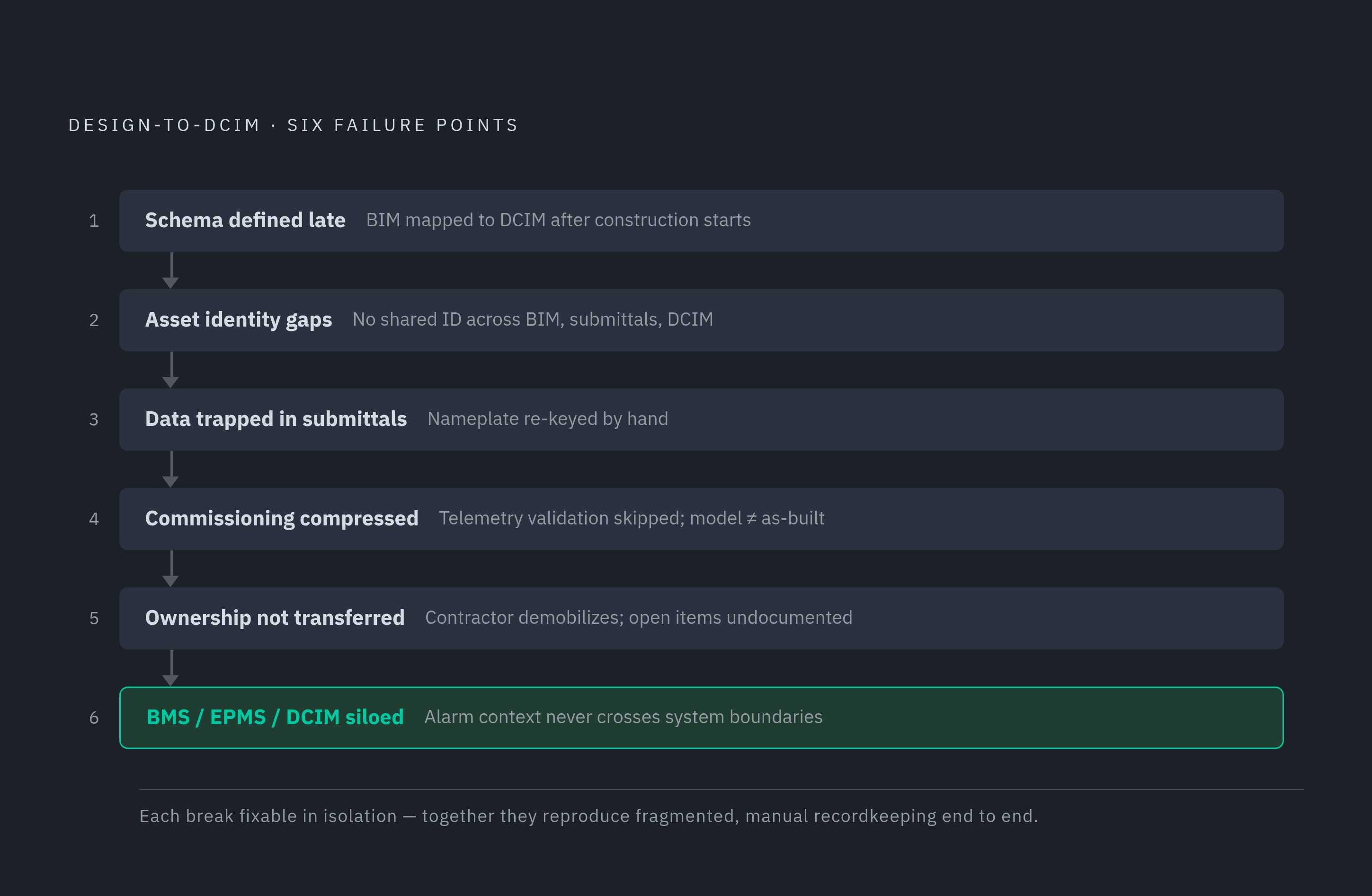
Six places tend to be where things go wrong, and each one carries its own price tag.
Schema defined late: BIM attributes don't get mapped to DCIM fields until construction is already underway. The integration team discovers, again, that the model was built for the architect and not for operations. Manual reconstruction starts at closeout, exactly when there's the least time and information available to do it well.
Asset identity gaps: no shared identifier strategy gets set before construction starts, so the same physical piece of equipment ends up with different IDs across the BIM, the construction management platform, the equipment submittals, and DCIM. Reconciling that after the fact is manual, slow, and prone to error at every step.
Equipment data trapped in submittals: spec parameters from manufacturer documentation never make it into the model or into DCIM fields, so operators end up re-keying nameplate data by hand after turnover, one piece of equipment at a time.
Commissioning skipped or compressed: telemetry and sensor validation get treated as optional, so the model keeps reflecting design intent instead of as-built reality. The digital twin starts drifting from the actual facility before operations even begins.
Ownership not transferred: the construction contractor demobilizes without a formal handover of who owns model accuracy going forward, and operations inherits a model with no documented owner for open items and no clear path for change control.
BMS, EPMS, and DCIM not integrated: alarm context doesn't cross system boundaries, so a power event stays invisible to the cooling team and capacity decisions get made against a partial picture.
Each of these is fixable on its own. Together, they reproduce the same fragmented, manual-recordkeeping outcome even on a site running modern platforms end to end. The tools were never the actual problem.
A connected design-to-DCIM workflow structured from the start
A workflow that holds together runs in five phases, and skipping any one of them reintroduces a break point from the list above.
Pre-construction comes first: define the DCIM handoff spec, map BIM attributes to DCIM fields, and set up shared asset identifiers. Decide which fields transfer automatically, which need commissioning-phase entry, and which come from equipment submittals, and get both facilities and IT operations to sign off on that mapping before anyone breaks ground.
Design and coordination carry structured data (rack parameters, power topology, cable routing, cooling paths) inside the model from day one. Automate the cascade so a rack move updates power, cooling, cable, and documentation together, instead of triggering a manual redo across four separate drawings by four separate people.
Construction is where the DCIM platform gets set up and partly configured before the project wraps. Capture as-built conditions as they happen, not after the fact, and pull equipment submittal data straight into model fields instead of leaving it buried in a PDF folder somewhere. Treat design-to-as-built reconciliation as a formal workflow with real acceptance criteria.
Commissioning runs sensor and telemetry validation as a required step. This is the step that turns a static model into a working digital twin, and it's what makes virtual commissioning of airflow, power, and cooling possible before a single server gets racked.
Handoff, at that point, becomes a validation event: confirming the structured data is complete and accurate, rather than rebuilding it from scratch under deadline pressure. Model accuracy ownership transfers explicitly from the construction contractor to operations, with documented responsibilities and a sustainment plan attached.
Across all five phases, BMS, EPMS, and DCIM stay connected over open protocols, so alarms carry context across domains and the facilities management system routes work orders without a human translating between them. Archil Labs, a data center design automation platform that runs layouts, critical-systems coordination, documentation, RFIs, and structured ops handoff inside a single connected workflow, fits into this by applying automation deterministically where precision can't bend and flexibly where judgment still matters. That's what keeps structured data moving continuously from design through construction into DCIM instead of getting rebuilt at every handoff. It's the only way a well-structured model and its digital twin end up as the real source of truth for EPMS, BMS, change control, and capacity planning long after the ribbon-cutting, and that outcome depends on building the data exchange into delivery from the start, not patching it in after the keys change hands.