Construction Document Management Systems for Critical-Facility Projects
Poor document control turns construction delays into permanent financial losses for data centers.
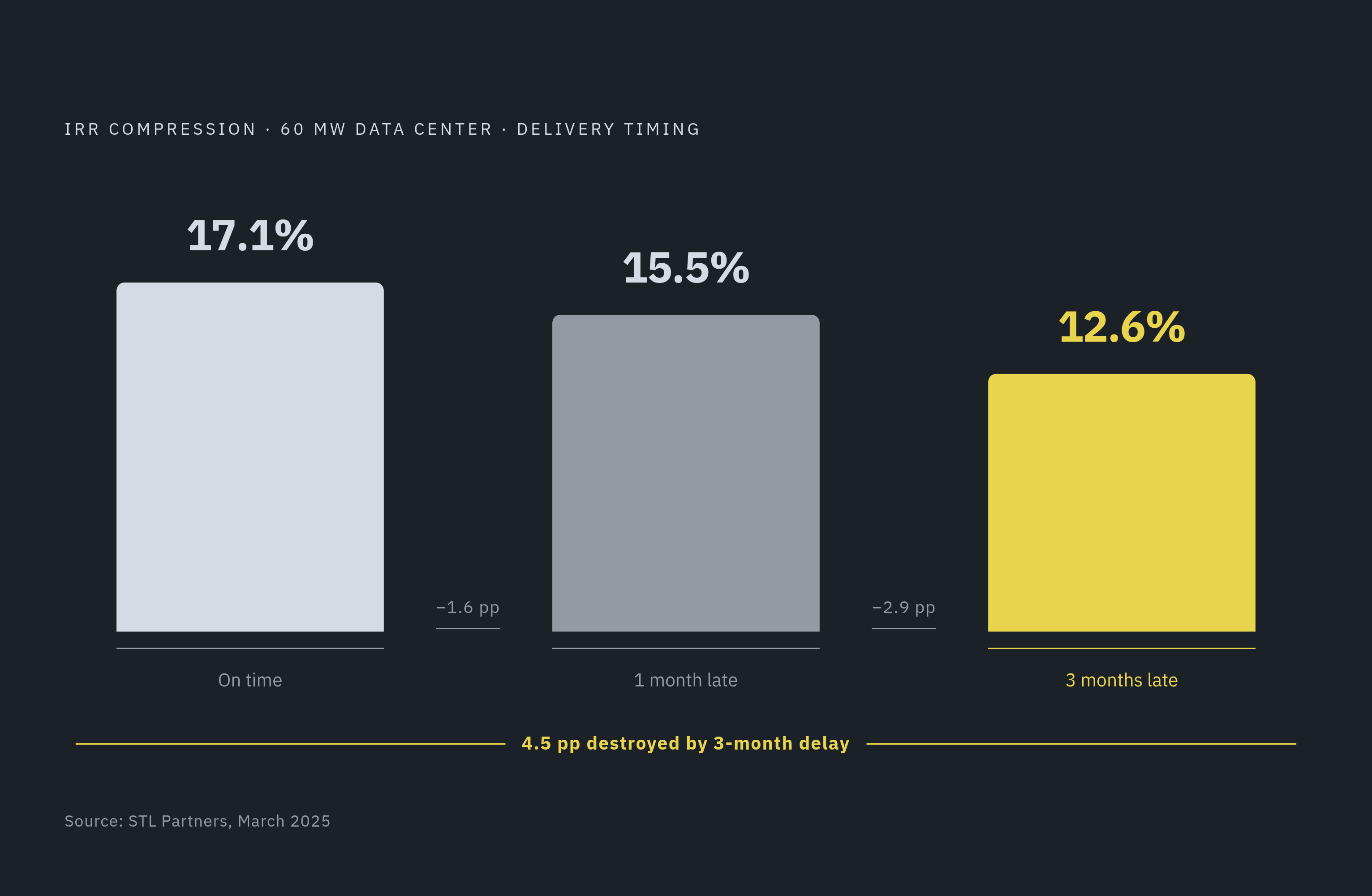
Delays on a typical 60 MW US data center run developers about $14.2 million a month, according to STL Partners research from March 2025. The number that should worry an investor more, though, sits in the return: internal rate of return on a project delivered on time runs around 17.1%. Slip a month and it drops to 15.5%. Slip three months and it falls to 12.6%. Delay here isn't a scheduling headache, it's a return-on-investment problem, and it shows up on the exact line item investors watch closest.
The root cause traces back to something almost mundane: a lag between when a problem shows up and when anyone actually notices it. Fragmented, manual reporting causes that lag. Document control fails first, and the delay follows behind it, quietly, until someone finally checks a number against another number and finds they don't match.
Take a scenario that mirrors real incidents reported around Charlotte in 2025, per ABC Carolinas research. A 300,000 square foot data center hit a snag when a Rev D budget export didn't match what the ERP system showed. That mismatch delayed generator procurement by 45 days, drove 8% cost inflation on that package, and put the owner within range of liquidated damages set at $10,000 a day. Nobody poured a bad slab or wired a panel wrong, and the generator itself was fine. The documents describing its cost and timeline simply disagreed with each other, and nobody caught it in time.
Fragmentation doesn't cause the conflict. It delays detection of the conflict, and that's the part worth sitting with. By the time the mismatch surfaces, procurement is already committed and crews are already on site. Fixing it after the fact costs far more than catching it early would have, and the stakes don't stop at turnover either. Power, cooling, and cabling failures rooted in construction-phase decisions, decisions that were often poorly documented at the time, account for most data center outages. A document error during delivery doesn't stay a paperwork problem. Once the facility goes live, it becomes an operational one, and it stays that way for as long as the building runs.
The six document categories that must be structured on a critical-facility project, and what breaks when any one is not
ABC Carolinas' 2026 research lays out six categories that need real structure on any major project: design documentation, project controls, field data, procurement records, communication records, and compliance documentation. Skip structuring even one, and the research draws a direct line to rework, claims, or regulatory exposure. There's no partial credit here. A team that nails five out of six is still exposed, and the sixth one is usually the one that gets skipped, because nobody thought it counted as "document control" in the first place.
Design documentation covers drawings, specs, the Basis of Design, and revision history. Most teams handle this one reasonably well in isolation. The trouble is keeping it in sync with the other five. Project controls, meaning budgets, schedules, and change orders, is exactly where the Charlotte generator scenario went sideways: the moment this category drifts from the ERP system, dollars start disappearing into gaps nobody's watching.
Procurement records deserve particular attention given lead times running 25 to 100 weeks on major equipment. A submittal that's gone stale, still referencing a spec that changed three revisions back, can hold up a generator order for months. Communication records (RFIs, design decisions, owner directives) tend to leak into email threads instead of living in the official system of record. That builds a second, unofficial trail running parallel to the real one, quietly contradicting it.
Field data, meaning daily reports, inspection records, and installation photos, causes trouble when it's disconnected from design documentation. Deviations in the field go unrecorded, then surface later as commissioning problems nobody saw coming. Compliance documentation, permits, and inspection sign-offs decides, in the end, whether anyone can legally occupy and run the building.
On a critical facility, these six aren't six separate buckets sitting side by side. A single equipment substitution in procurement triggers a submittal review in communications, which triggers a drawing revision in design, which triggers a schedule update in project controls, which triggers a compliance re-check. One change, four ripples. Contractors running centralized, governed data environments report schedule reliability 20% to 30% higher than peers who don't, per Construction Executive research cited by ABC Carolinas in May 2026. That gain comes from treating the six categories as connected, not from managing each one a little better in isolation.
Where RFIs and submittals concentrate risk on data center projects
The Navigant Construction Forum studied many hundreds of projects back in 2013 and landed on a benchmark that still holds up: roughly 9.9 RFIs per $1 million of construction value. Run that math on a large-scale data center and the project is routing, tracking, and closing thousands of RFIs before it's done. Before a single change order even gets written, a mid-size commercial project can expect to spend a substantial sum just processing RFIs. On a data center, where the systems are more tightly coupled, that floor sits higher still.
Rework averages 4% to 6% of total project value industry-wide, and a widely cited FMI and Autodesk study attributed roughly 14% of all rework directly to bad data: information that was wrong, missing, or contradicted something else in the record.
The failure mode specific to critical facilities plays out in a predictable sequence. An RFI about a UPS configuration sits open. Field crews can't wait around for an answer, so they proceed on an assumption, and that assumption conflicts with the power distribution layout. Nobody notices during rough-in, because nobody's checking RFI status against field installation in real time. It surfaces at commissioning instead, which is the most expensive possible moment to find out.
Nobody should be running side spreadsheets and email threads to manage RFIs on a half-billion-dollar project. Yet most firms still use email as a secondary channel alongside their project management system, which produces dual-tracking and gaps in the record. Manual RFI tracking is a direct tax on staff the industry can't spare, especially with more than 85% of firms reporting labor shortages, per the AGC's 2024 Workforce Survey.
Submittals carry a wrinkle data center projects tend to underweight compared to general construction. A submitted data sheet for a power distribution unit carries power draw, heat load, weight, and cable termination parameters, numbers that need to flow into several downstream documents. A submittal approval that stamps the PDF and stops there, without pushing those parameters into the power schedule and cooling load calc, is quietly setting up rework down the line. Firms that standardize document workflows, including how RFIs get routed, consistently beat peers on closeout timelines, per ABC's 2024 industry research.
What BIM contributes to data center document control, and where it stops short
Building a data center without BIM is close to unthinkable at this point, per industry best-practices analysis. The model is where power, cooling, and cable routes get checked against each other in three dimensions before anyone pours concrete. That's real value: clash detection across systems, CFD simulation tied directly to the model for cooling validation, cabling and patching routes optimized before material gets ordered, and visualization that catches problems while they're still cheap to fix.
Organizations that combine BIM with real change management and training report productivity gains between 70% and 240%, according to analysis published on arxiv.org. That range is wide, and the width is the point: the gain depends on how mature the team's BIM practice actually is. A high-maturity team works from one shared, trustworthy model. A low-maturity team has a nice-looking 3D picture that no longer matches what's actually being built, and that's arguably worse than no model at all, because it hands people false confidence instead of honest uncertainty.
BIM has real limits as a document control system, and calling it one is where a lot of teams go wrong. The model is a spatial representation. It is not where RFIs, submittals, equipment data sheets, or procurement records live, and treating it as though it were means those records end up scattered somewhere else, unlinked to the geometry they describe. Even the most advanced automated approaches to extracting information from BIM models fall well short of the accuracy required to run unsupervised in a safety-critical workflow. Update the model, and the single-line diagram doesn't update itself. Neither does the cable schedule, the rack elevation, or the submittal log. Those stay manual, human synchronization tasks no matter how sophisticated the model gets.
BIM data that arrives at turnover incomplete, or disconnected from the systems that will actually run the facility, isn't BIM doing its job. The model's usefulness runs out at the construction boundary unless someone deliberately structures it for handoff before that point. AI-augmented BIM (generative layouts for cooling and power, automated compliance scans, predictive scheduling) extends what the model can do, and it belongs where flexibility is the point. But where a power circuit configuration has to match a validated spec exactly, the job calls for deterministic rules, not a probabilistic best guess. Who owns the connection between the model, the document record, and the systems that will run the building for the next twenty years? BIM doesn't answer that on its own, and treating it like the answer is where teams get burned.
How operations-ready handoff changes what document control must capture during construction
Most data center outages trace to power, cooling, or cabling failures that started during construction. Whatever caused those failures was documented, or should have been, somewhere in the construction record. DCIM, EPMS, and BMS systems all need structured asset data the moment a facility turns over: equipment identifiers, power circuit assignments, cooling zone assignments, cable termination records, firmware versions. That data exists somewhere in the construction submittals and equipment data sheets. It's rarely structured in a form the operations software can actually import.
The typical gap looks like this: the construction team hands over as-built drawings and a closeout binder, and the operations team rebuilds the asset registry by walking the floor with a spreadsheet, checking nameplates by hand. That process reintroduces exactly the kind of errors the construction record was supposed to prevent in the first place.
Equipment data locked inside a manufacturer's PDF during construction is intelligence going to waste. If those spec parameters got pulled out and fed into models, schedules, and validation rules during design, they're sitting there ready at handoff, no re-entry needed. If nobody extracted them, the operations team starts from zero. Traceability matters here for a reason that has nothing to do with satisfying an auditor: every RFI answer, design decision, and equipment parameter needs a clear line back to whatever justified it, because someone on the operations side will eventually need to know why a circuit got configured a specific way when they're planning a capacity upgrade five years out.
The bar a document control system should be built toward from day one is structured asset data that DCIM and BMS platforms can ingest without anyone manually rebuilding it. That means treating turnover as the actual finish line for document control, not a box checked after the real work is done. Projects that plan for that handoff early, tagging equipment consistently from the start, keeping parameter records current through every submittal cycle, keeping the as-built model actually current, cut out a category of post-turnover rework that never shows up as a line item in the construction budget. It just quietly costs the owner later.
What a construction document management system built for critical facilities actually requires
ABC Carolinas' 2026 analysis lists three functions any construction document management system (CDMS) has to deliver at minimum: standardizing how data gets created and stored, controlling access and versioning across a large number of parties, and giving real-time visibility into project conditions. None of that differentiates anymore. It's table stakes, the entry fee to even get considered.
A system built for critical facilities has to go further, and this is where most platforms on the market fall short. It needs to propagate interdependency: when an equipment parameter changes, every downstream document that references it (the power schedule, the cooling load calc, the cable schedule, the equipment tag) should flag or update automatically, not just quietly version the one source document. RFI and submittal handling needs to link answers to the relevant documents in the project record, not just log them and move on. Submittal review should produce a structured, machine-readable parameter record instead of a stamped PDF nobody can query later. The system should support structured asset data handoff at turnover, so the transition to operations is a defined output the system produces, not a manual assembly job done the week before occupancy. And every decision, revision, and approval needs a traceable link back to the information that drove it, by design, not bolted on after the fact.
Version control and document history matter, but they're not the whole answer. The real question isn't which version is current. It's what else changed the moment this one did. Mobile access and cloud storage are baseline expectations now, practically assumed everywhere. What actually separates systems built for critical-facility work is whether the platform understands the relationships between document types, or just stores them next to each other and calls it done.
The AI-versus-deterministic-rules distinction shows up here too, and it deserves precision rather than a hand-wave. AI-assisted drafting and search have a real place in the workflow. But circuit compliance validation and equipment parameter checking need fixed, reliable logic rather than probabilistic approximation. A system that blurs that line, applying probabilistic AI where a hard rule belongs, is building risk into the one place a data center project can least afford it.
How the leading construction document management platforms compare on features that matter for data center projects
KYRO targets small and mid-size builders, priced at $500 a month with unlimited users, according to kyro.ai's listing. It covers the general construction basics: centralized storage, RFI tracking, version control. The pricing and feature set reflect the broader construction market it's built for, not anything specific to critical-facility interdependency.
Procore sits at the enterprise end, running at a high per-user monthly rate per kyro.ai's listing. Its RFI and submittal workflows are genuinely strong and standardized, and it's become something close to a default baseline for large construction programs, with solid integration into scheduling and cost tools. Its architecture, though, is built for general construction. It doesn't carry data center-specific interdependency logic out of the box, and buyers who assume it does are in for a surprise mid-project.
Autodesk Docs runs $500 per user per year, per the same kyro.ai listing, and its clear differentiator is BIM integration, tying document management directly to model data. That makes it the strongest fit for a project where BIM coordination sits at the center of the workflow. Worth noting: linking documents to the model doesn't automatically extend to operations handoff or to tracking critical-systems parameters through to turnover.
SuiteFiles, covered in a source from suitefiles.com, positions itself as a centralized file hub with version control, mobile access, and workflow automation for both office and field teams. It fits firms after administrative document order more than deep engineering-system interdependency tracking. Document Logistix, covered via document-logistix.com, brings three decades of document management experience to the table, with a focus on compliance, version control, secure storage, and construction-specific document types including health and safety records and orders.
None of these platforms, on the evidence available, was built from the ground up around the interdependency problem that defines critical-facility work: the fact that a single rack move touches power, cooling, cable, and half a dozen sheets all at once. That's the gap worth watching as the data center pipeline keeps expanding, given JLL's projection of 97 gigawatts of new capacity between 2025 and 2030, and given that AI-ready facilities now run $20 million or more per megawatt against $10 to $12 million for a standard build. At that cost density, a document error doesn't stay small. It scales with everything else the project is trying to build.