From Submittal Receipt to Validated Model Object in One Deterministic Pipeline
A four-stage pipeline moves vendor specs into BIM without rekeying.

Getting manufacturer PDF specs into a data center BIM model without manual rekeying requires one connected pipeline. Controlled receipt establishes the asset identifier, AI extracts candidate fields, deterministic rules validate them, and an automated write creates the attributed model object.
Why the submittal-to-model gap is a structural problem, not a workflow nuisance
The break between vendor documentation and the design record is a systems problem. Vendor data arrives in PDFs, design data lives in a BIM model, and operations data belongs in DCIM, EPMS, and BMS. Those systems have different schemas, or ways of arranging fields, and nothing enforces a connection between them. People become the bridge between incompatible records. Each time someone translates a record by hand, a parameter, its source, or its link to another asset can be lost.
A drawing export can reproduce what appears on a sheet without preserving the structure an operator’s systems need. BMS centers on mechanical plant, EPMS on electrical topology, and DCIM on operational domains including racks, PDUs, cooling units, and connecting circuits. Without a shared identifier, the same asset must be described again in each system.
Teams have managed this way for years. That is the strongest defense of the existing approach, but it does not resolve the underlying exposure. Long-lead switchgear, chillers, and UPS systems have lead times of 30 to 80+ weeks. So an error in equipment data caught at commissioning rather than during submittal review can delay the schedule and add costs well beyond the time spent typing.
What makes data center submittals harder to process than standard construction submittals
A UPS or switchgear submission includes input/output voltage, fault current rating, maintenance clearance, weight, heat rejection, and connection schedules. These are not independent entries on a form. A misread value can corrupt decisions about power, cooling, cable, and structural layout, even when each discipline appears to have completed its own work correctly.
Vertiv’s 2024 360AI reference block with NVIDIA makes the need for consistent interfaces concrete. It describes a roughly 7 MW data hall at 130 kW/rack, with prefabricated power and cooling modules sized so electrical, mechanical, and structural interfaces repeat identically. Repeatability is part of the design itself. A deterministic pipeline can use those repeating interface rules, while a manual BIM process cannot enforce them the same way every time. The extraction target must therefore include equipment names and ratings and the parameters that define those interfaces.
AI does not remove the need for that discipline. A 2026 LLM-based BIM extraction study found that even the best LLM configuration fell well short of the accuracy needed for unsupervised deployment in safety-critical workflows. Cross-format generalization beyond IFC to Revit RVT, Archicad PLN, and similar formats remains untested. AI can read unstructured vendor text, but it cannot be treated as the authority that accepts the resulting engineering values.
Stage one — controlled receipt and intake that creates a traceable starting record
Receipt must establish provenance before anyone reviews the submission. The intake record needs the submitting party, submission date, revision number, associated specification section, and specific equipment tag covered by the submittal. These fields establish which submission the pipeline is processing and which asset its contents describe. Without them, even a correctly extracted value can lack a dependable connection to its source.
The shared asset identifier is assigned at receipt. It must connect the eventual BIM object to its drawing schedule, submittal, and DCIM, EPMS, or BMS record. That identifier cannot wait until the handover team begins assembling an asset register. Retrofitting it then requires reconstructing the earlier connections. Receipt is the first point where the asset becomes a traceable record across the project’s systems.
For projects pursuing operational BIM, the preparation starts earlier. The model format, asset tagging structure, and CMMS and DCIM data requirements need to be defined at project kickoff. Developers should require naming standards across BMS, EPMS, CMMS, drawings, and commissioning scripts. Intake then applies that standard to the first submission, rather than inventing a local name that downstream teams must translate. The starting record supplies both the source and the identity that extraction needs.
Stage two — how to get equipment specs from manufacturer PDFs into a BIM model without manual rekeying
AI extraction produces candidate fields. Its job is to turn unstructured vendor content into machine-readable values that fit the project’s schema and remain keyed to the identifier established at receipt. For UPS and PDU specifications, the destination is model attributes and the schedules that use them. Any field that cannot map to a schema position must be flagged. Otherwise, automation can make an incomplete record look finished.
Before an equipment purchase order is released, AI can also compare the submittal with the approved basis of design, specifications, drawings, and contract requirements. The useful output is a cited, requirement-by-requirement exception list. It gives the right human a way to resolve gaps before the wrong unit becomes an expensive delivery. The decision that the equipment meets the design belongs at the next gate.
The distinction answers the objection that AI will introduce bad data at scale. Extraction can still get values wrong, so those values must wait for approval until schema rules, range checks, and cross-discipline constraints test them. AI inference cannot itself be peer-reviewed or stamped. A rule that fires consistently, by contrast, can be traced, challenged, and updated.
Stage three — deterministic validation against engineering rules before any value enters the model
Validation is a machine-enforced gate. Review applies human judgment to information, while this gate tests extracted parameters before permitting them to enter the model. Everything upstream prepares candidates for that test. Everything downstream depends on its result. Calling a field “validated” means it has passed defined requirements.
The gate checks schema conformance, including whether every required field is present. It also checks naming conformance against the project’s asset-tag standard and tests submitted values against specification tolerances. Heat rejection must be consistent with the cooling load model, weight must remain within structural capacity, and fault current must be within the switchgear rating. A value can be legible and correctly extracted yet still fail an engineering constraint.
AI can classify an RFI by trade, system, location, drawing reference, specification section, responsible party, and urgency, while distinguishing an information request from a scope change, substitution request, or latent design conflict. But classification is not resolution of the issue. For a data center, the classification must account for critical systems including medium-voltage service, low-voltage distribution, generator plant, UPS, cooling, fire protection, controls, security, and commissioning. Those labels route the question without deciding its engineering answer.
The gate must also preserve the basis for acceptance. Every rule that fires, every failed field, and every overridden exception must be logged with the reviewer’s identity and the basis for the decision. At commissioning and Tier certification review, that audit trail supports a testable link between the accepted equipment parameters and the certified design.
Stage four — writing the validated object into the model as a fully attributed, identifier-linked record
The write operation must be automated and schema-driven. The approved field set maps straight to the model object parameters, so no one has to copy values from the validation result into the model. That removes the retyping step where information can be transcribed incorrectly or incompletely. The output is an addressable, updateable record of the equipment and its engineering parameters.
That record includes the equipment tag matching the shared identifier, all validated submittal parameters, revision history, and the source submittal record. It also includes cross-links to the power schedule, cooling load model, and cable schedule. Those links make the object useful beyond its shape. A reviewer can connect a model parameter to the submission that supplied it, while downstream design records use the same attributed object.
The connection must hold when the design changes. A rack move or equipment substitution must cascade into power, cooling, cable, schedules, and sheets from the same change to the model object. If each domain still needs separate manual edits, the write stage has not truly connected the design record.
Why the pipeline must be non-negotiable in sequence, not a menu of optional stages
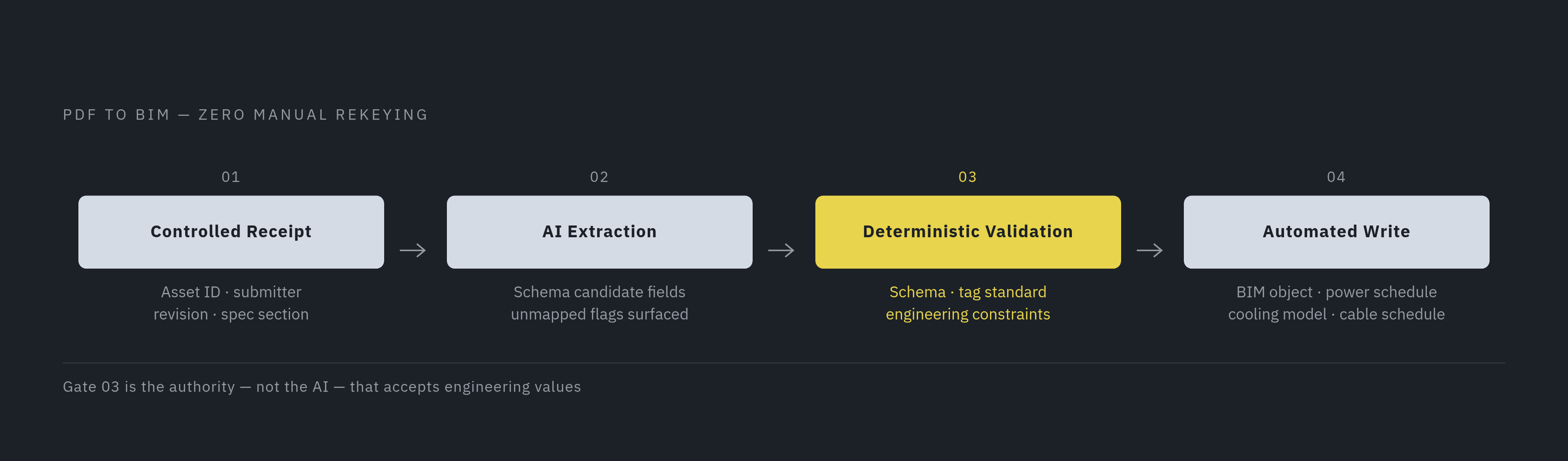
Extraction can cut the time spent reading, validation can catch errors, and automated authoring can cut the work of entering data into the model. But those local gains do not establish an unbroken chain of custody. Receipt gives the asset its identifier, extraction creates candidates keyed to it, validation provides an approved field set and audit log, and writing creates the attributed object. A manual handoff between them separates the final record from the controls that made its inputs trustworthy.
A naming standard enforced only at commissioning can produce correctly named objects whose parameters remain unverifiable. The same weakness applies to commissioning reports stored only as PDFs. A report that cannot be traced back to the submittal supporting the equipment’s parameters remains a disconnected document.
A full pipeline can sound too rigid for real submittals. Judgment belongs at the validation gate, where a cited exception list and logged decision make it explicit. When people make judgment calls as they copy, rename, and enter data into the model, those decisions are harder to check because they are not logged in a consistent way. The unbroken sequence is therefore the mechanism by which every RFI answer, design decision, and equipment parameter remains traceable to the information supporting it.
What operations-ready handoff looks like when the pipeline has run end to end
The operator receives a structured asset record. Each model object is linked to its submittal, commissioning outcome, and operational system identifier, ready to load into DCIM on day one. The shared identifier connects records without pretending that DCIM, EPMS, and BMS organize assets identically. Handoff succeeds when those systems can consume the record.
Commissioning must add its outcomes to that record. When a script writes pass/fail results back to the model object under the same asset identifier, the results become attributes of the equipment and stay linked to it as evidence. Tier certification review depends on complete, traceable construction documentation that matches the certified design, including RFIs, submittals, change orders, inspection records, and commissioning test reports.
Archil Labs, an AI teammate for Revit and AutoCAD built first for data center design, is one option for treating manufacturer PDFs as inputs to models, schedules, and validation rules. Extracted UPS or switchgear parameters become attributes on native Revit objects, placing extraction at the start of a connected workflow.
Power orchestration platforms coordinating EPMS, DCIM, and intelligent PDUs depend on consistent asset identifiers to enforce rack- and outlet-level power caps. That dependency begins in design and runs through commissioning. When the identifier and validated parameters survive the whole sequence, the operator’s systems can use the equipment record.