Closing the PDF-to-BIM Gap With Automated Spec Extraction Pipelines
AI reads the vendor PDFs while fixed rules decide what enters the model.

Automated spec extraction closes the PDF-to-BIM gap by turning manufacturer PDFs and submittals into structured equipment data, validating it, and writing it directly into BIM objects and schedules. AI handles interpretation and classification, while deterministic rules control what gets written to the model. A missing pipeline forces teams to rekey the same values from existing documentation from design through operations handoff.
Why equipment data trapped in PDFs becomes a liability as data center density rises
AI rack power densities are reaching the 40–100+ kW range, while the broader industry average remains around 27 kW. Cooling strategies are also moving from air displacement to direct-to-chip fluid dynamics. That changes the stakes of a misplaced equipment value. Weight, footprint, thermal envelope, and connector type begin in vendor PDFs or specification sections, but they must reach the model before they can govern layout, power, or cooling decisions. A document can contain the right value while the design still uses the wrong one.
BVP Atlas reports 190 GW of announced hyperscale capacity across 777 projects, a scale at which manual spec transfer cannot keep pace. The exposure grows with each handoff. A value moves from a manufacturer PDF into a BIM object, from a BIM schedule into a submittal, and from an approved submittal into a DCIM import. Each time someone copies a value, there is another chance of error or version drift. When BIM-to-DCIM requirements remain undefined before construction, the model can satisfy architectural deliverables yet arrive at handoff without the structured asset data operations needs.
How the PDF-to-BIM gap is actually structured — and why it is a pipeline problem, not a documentation problem
Teams commonly treat BIM authoring, spec review, submittal management, and DCIM configuration as separate jobs completed in sequence. Each tool receives a handoff, but the data connection stops at its boundary. The next team types in information that a team before it has already captured. A better-organized PDF archive does not, by itself, connect an approved equipment parameter to the model field and operational asset record that need it.
The pipeline has three conceptual stages, beginning with PDF ingestion. Manufacturer documents arrive as human-readable pages rather than records shaped for the receiving model, so OCR and layout parsing provide the entry point. Entity extraction and classification then turn that text into equipment attributes, including dimensions, weight, power draw, thermal load, and connector type, assigned to the correct BIM object type. Model injection and validation complete the connection. The values must reach BIM objects and schedules in a form that DCIM, EPMS, and BMS can consume without re-entry.
The receiving model introduces its own inconsistencies. Hellin et al. at TU Munich describe IFC heterogeneity across 37 real-world models, where the same properties can have different attribute names depending on the authoring tool, modeling convention, or language. A cooling unit’s thermal output therefore cannot always be found through one fixed property name. An end-to-end workflow sends structured data to the next stage, while a standalone extraction script or plugin leaves someone else to work out what its output means.
Where AI belongs in the extraction pipeline — and what it can and cannot reliably do
Manufacturer documents use different words and layouts to describe equipment, so rigid extraction rules are hard to use across all of them. Transformer-based natural language processing can classify text despite that variation. The Texas mid-rise digital-twin study shows how this works by mapping unstructured contract text to standardized cost and classification items. Equipment extraction applies the same kind of language mapping to power, cooling, dimensional, and other attributes, rather than treating every vendor’s wording as a separate manual task.
The TU Munich study uses an LLM-based agent that executes code iteratively to discover each IFC model’s actual structure at runtime. Adaptive exploration outperformed static query approaches across all configurations tested on its 37-model benchmark. The Yonsei/KAIST spatial data extraction study also shows how LLM-generated descriptions can make extracted attributes understandable to people who cannot write structured queries, giving them a way to review the results before injection.
An LLM can produce a plausible parameter absent from the source, and a confident answer does not make that value real. It also cannot adjudicate a conflict between a graphic and a text schedule in a redlined document. Geometry requires a separate check as well. The appropriate output is therefore a confidence-scored mapping for review, with uncertain mappings flagged and approval gates before model writes.
Where deterministic rules are non-negotiable — validation, compliance, and schema enforcement in the pipeline
Once a value has been extracted and classified, the next question is whether it is permissible in the receiving model. Deterministic rules check engineering constraints, classification standards, and schema requirements before injection. Confidence cannot stand in for those checks. Power draw feeds redundancy and UPS sizing, weight and footprint govern raised-floor load compliance, and cooling loads constrain CRAC/CRAH or DLC system sizing. Asset names and identifiers face a different but equally exact requirement, because DCIM imports depend on matching the required schema.
The compliance framework published in Advanced Engineering Informatics in September 2026 demonstrates how structured standards can become executable checks. It generates machine-interpretable SHACL validation rules using the ISOProps ontology, applies them to IFC models, and produces structured compliance reports. The rules themselves need a reliable source. The same framework identifies manually formalized rules derived from non-machine-readable standards as a barrier to scale and adaptation when regulations change. Extracting equipment data automatically does not solve that separate bottleneck if every compliance rule still requires manual re-encoding.
Information Delivery Specification, or IDS, defines what information the BIM model must contain. Ishigaki-IDS tackles the writing of those formal specifications as part of automated validation, because checks can only be trusted when the requirements are well formed. As of 2026, no jurisdiction accepts AI output as a substitute for professional seal and review, making deterministic audit trails a delivery requirement. The division of labor is clear, with AI extracting and classifying while rules validate and gate.
How do equipment specs get from manufacturer PDFs into a data center BIM model without manual rekeying?
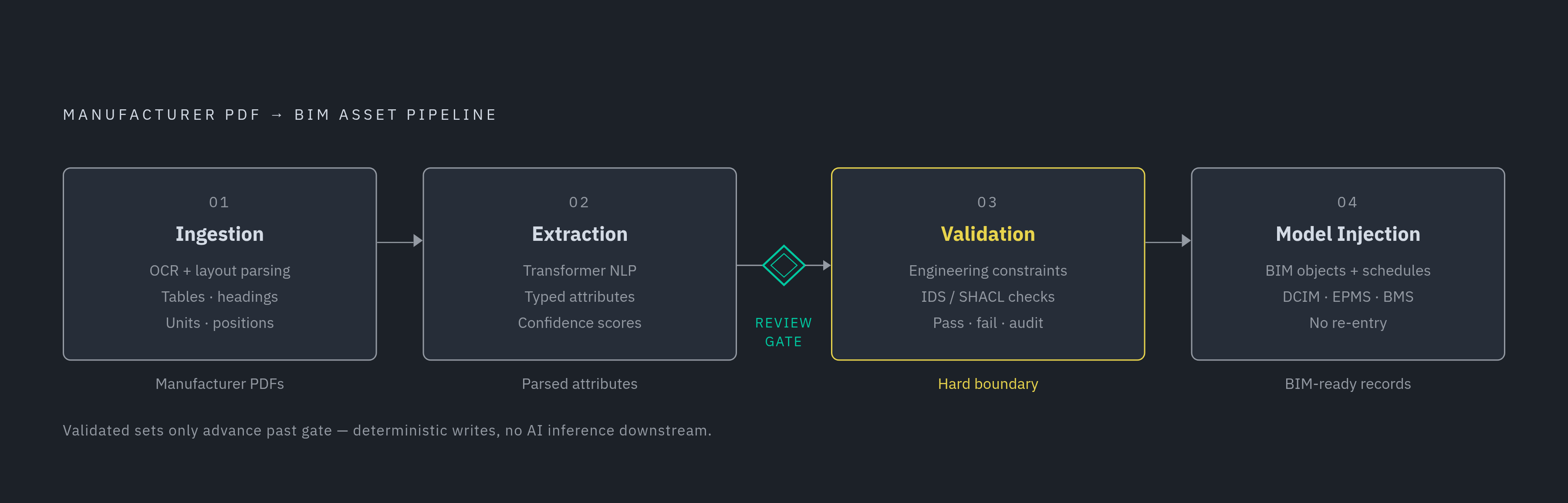
In practice, the conceptual pipeline becomes four operational stages, with validation separated from injection so that checking precedes any model write. Ingestion takes manufacturer PDFs, specification sections, and submittal packages through OCR and layout parsing. Page structure must survive that conversion. Table structure, section headings, and unit labels provide context for the extracted text, so positional metadata stays with it.
Extraction and classification turn the parsed content into typed attributes for power, weight, thermal performance, dimensions, and connectivity. Transformer-based NLP assigns those types and generates confidence scores for the mappings. Results that are unclear or have low confidence scores must go through estimator-in-the-loop review before they can move on. For UPS and PDU datasheets, this is the step that turns prose and tables into the equipment fields needed by the corresponding objects and load schedules.
Validation then checks the proposed attributes against engineering constraints and IDS requirements. SHACL-style reports show which values passed, which failed, and why, so there is an audit trail before injection. Only validated attribute sets move into BIM objects and schedules. Consistent asset identifiers let downstream DCIM, EPMS, and BMS schemas consume those records directly. For that reason, BIM-to-DCIM schema alignment and a shared identifier strategy must be established before construction.
Anchor Defense describes the federal practice of entering approved dimensional and weight data into a DCIM asset record before equipment is scheduled for delivery. A connected pipeline automates that transfer, eliminating another transcription task. For records requiring relationships as well as fields, the Graph-RAG IFC extraction approach uses a graph of IFC relationships for LLM-assisted queries, providing a retrieval architecture for connections such as a PDU serving a specific row or a cooling unit connected to a specific manifold.
Where the pipeline breaks down in practice — the conditions that require human judgment and system design choices
A conflict inside a source document requires a decision about which information governs. When a manufacturer PDF’s graphic contradicts its text schedule, the pipeline can flag the disagreement, but a qualified engineer must adjudicate it. Automation does not create authority to choose. Hand-annotated drawings, scanned paper documents, and image-only PDFs pose a different problem because the quality of the source limits how faithfully data can be extracted. The practical response is to concentrate human review at those points rather than spread it across hours of routine re-entry.
Correct attributes also do not prove correct placement. The BIBIMBAP benchmark tests 100 create, read, update, and delete tasks across IFC models, with the best results reaching only 50.2% on Text-to-BIM CRUD operations. It reports that constraint preservation and spatial reasoning often fail. A weight or power value can therefore be extracted correctly even when the object it belongs to is put in the wrong place. Validation must check relationships as well as values, especially when an equipment record’s meaning depends on what it serves or connects to.
Model selection introduces another practical tradeoff. Domain-specific BIM retrieval research finds that fine-tuning on equipment terminology improves classification over a general-purpose LLM, but requires investment in labeled training data for the equipment categories handled. That cost belongs in the system design decision. So does the response to hallucination, since even fluent output needs confidence-scored mappings, human review gates, and deterministic validation before it can be written to the model.
What operations teams receive at handoff when the pipeline has run — and what they receive when it has not
Without structured transfer during construction, operations inherits another data collection project at closeout. Anchor Defense describes DCIM imports where teams must also recover information from submittals and shop drawings kept in a construction management platform that the operations team cannot access after project closeout. The building is ready, but its records are not. Incomplete asset data, inconsistent naming, and disconnected controls leave a physically complete facility operationally blind. Manual population of asset records then becomes a prerequisite to using the systems intended to run it.
When the pipeline has run, operations receives validated attribute sets in BIM objects that DCIM import schemas can consume without re-entry. Consistent identifiers connect BIM, DCIM, and EPMS records, while structured outputs support BMS integration. Developing the as-built record during construction removes the need to reconstruct it after commissioning. Each equipment parameter also has an audit trail back to its source PDF and the submittal that approved it. That is a different handoff from an archive of documents that someone must reopen, reconcile, and transcribe.
A rack move, capacity upgrade, or equipment replacement can be checked against the rules that governed the original design because the relevant values are live in the model. Faster design is not the ultimate payoff. The goal is to have the data needed to run the facility ready when the operator takes over, without teams having to translate approved information by hand again to create asset records they can use.
Sources
- BIM Information Extraction Through LLM-based Adaptive Exploration
- auto-bim data-extraction for analyzing spaces & ai training: ...
- BIBIMBAP: A Benchmark for Instructional BIM-Based Automated Programming
- Ishigaki-IDS: An Open-Weight Verifier-Aware Model for Information Delivery Specification Drafting in Building Information Modeling
- LLM-assisted Graph-RAG Information Extraction from IFC Data
- Domain-Specific Fine-Tuning and Prompt-Based Learning: A Comparative Study for developing Natural Language-Based BIM Information Retrieval Systems
- Integrated 4D/5D Digital-Twin Framework for Cost Estimation and Probabilistic Schedule Control: A Texas Mid-Rise Case Study
- A BIM-based framework for automated building code extraction and compliance checking - ScienceDirect