Platform Selection Criteria for Automated BIM-to-DCIM Asset Record Conversion at Closeout
Five platform tests decide whether closeout data arrives DCIM-ready.
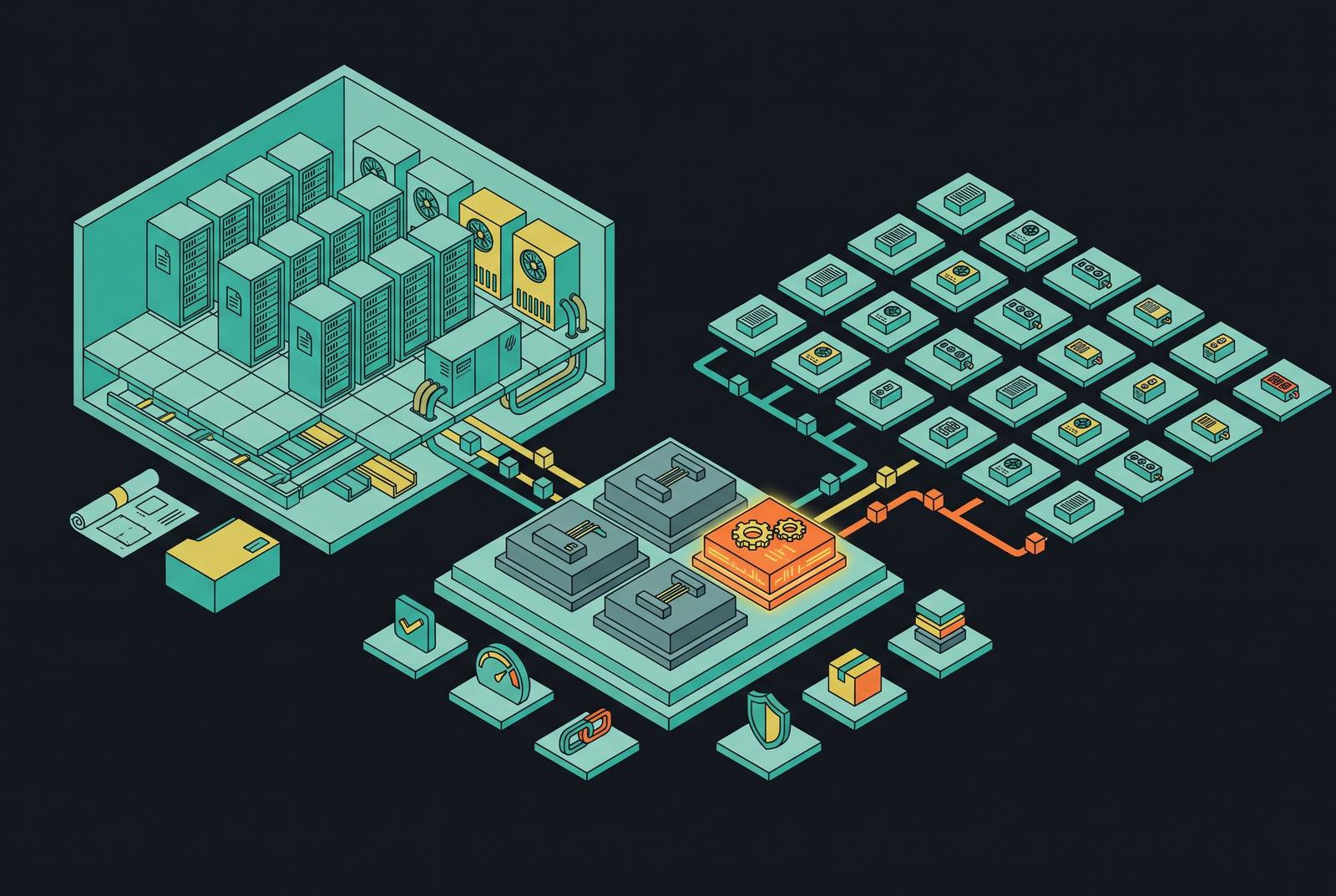
A DCIM-ready BIM handoff from design models to operations depends on five platform capabilities for automated conversion: persistent asset identifiers, aligned data fields, continuous construction updates, a clear split between rules and AI, and traceable source records. A platform that fails any one of these tests pushes manual rework back onto the team at closeout.
Why BIM-to-DCIM conversion breaks at closeout — and what actually causes it
A drawing-compliant BIM export can show detailed duct routing while providing none of the structured records that data center infrastructure management needs. The standard BIM-to-PDF pipeline was built to produce drawings. It was not built to populate operational systems. Rated capacity, maintenance intervals, firmware versions, and monitoring point identifiers can all be absent from a model that satisfies its architectural deliverables. That gap is a workflow mismatch.
The consequences extend beyond missing equipment details. A wrong DCIM baseline feeds errors into capacity planning, change management, power budgeting, and asset lifecycle tracking. Operations can inherit a technically complete facility without a reliable digital account of what is installed or how it connects. Commissioning delays can also cost a large data center millions per month in lost revenue. The financial scale is directional, but the underlying risk is clear.
More work at turnover cannot reliably fix information that was never structured or kept up to date during construction. By then, the team must reconstruct relationships across models, submittals, schedules, and installed equipment. The conversion platform therefore has to support both the work that produces the record and the export that delivers it. DCIM quality is decided before operations begin.
The five structural criteria a platform must meet — and why failing any one of them recreates the manual rework
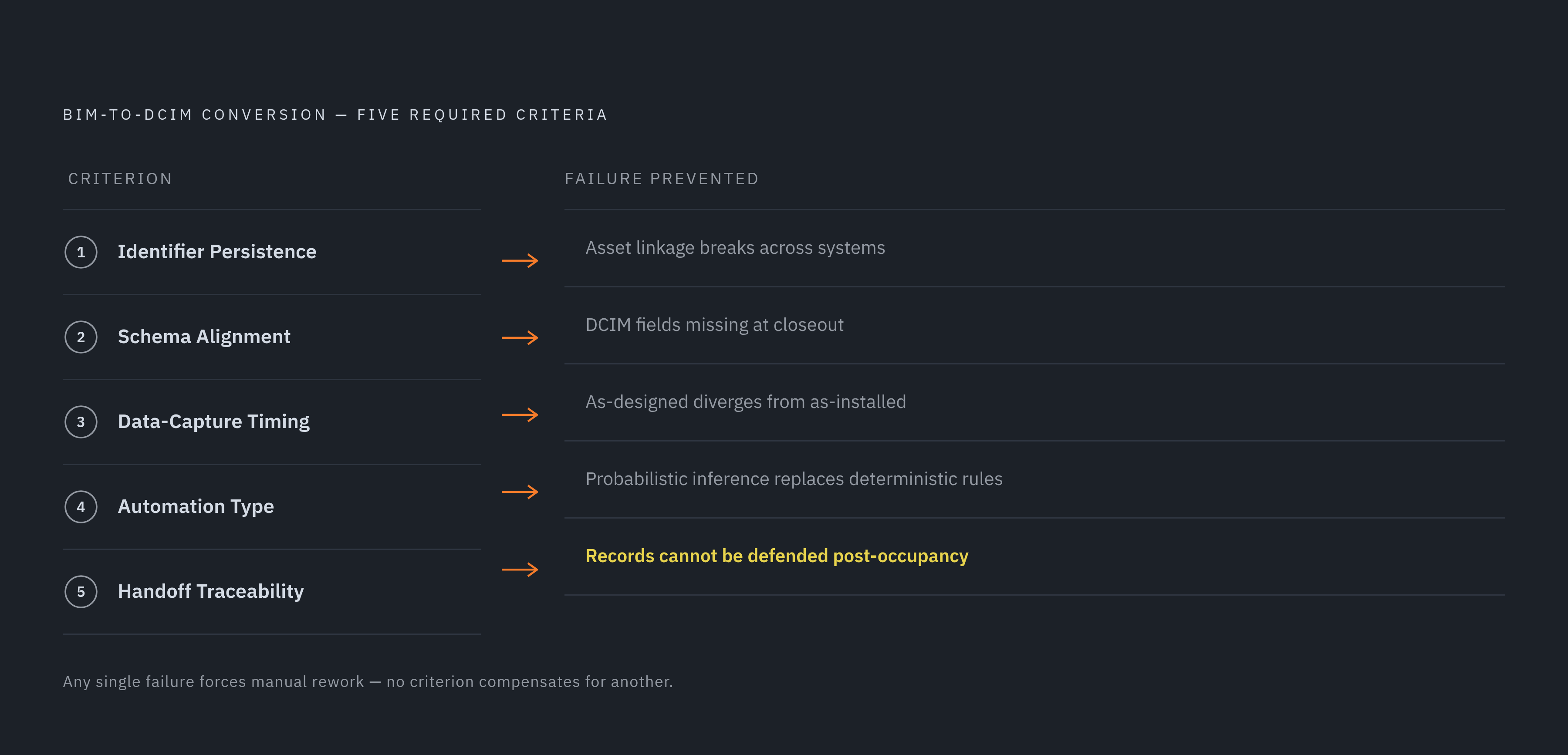
The five criteria are identifier persistence, schema alignment, data-capture timing, automation type, and handoff traceability. In plain terms, the asset needs a stable tag, the right fields, current installation data, suitable automation, and links to its supporting evidence. These are responses to specific failure modes. They form a diagnostic lens for any platform under evaluation.
Correct fields attached to an unstable identifier still require someone to rebuild the asset linkage. Even with stable identifiers and complete fields, the baseline will be wrong if the records never include changes made during construction. Each criterion gets its own treatment below because a strong result in one cannot compensate for a broken connection elsewhere.
Identifier persistence: the thread that must survive every system boundary
A single asset identifier must connect the BIM object to its drawing schedule, submittal, and operational records. Without that thread, someone has to work out which records describe the same equipment in each downstream system. A good schema is of little use if the platform cannot reliably link those values to the right installed asset.
Naming convention chaos makes this problem concrete. One contractor might label racks by row-letter and unit number, another might use names that describe them, and a third might use sequential integers. Before those records become operationally useful, someone must normalize the conventions. Defining the identifier in the project execution plan avoids leaving that reconciliation until closeout, when divergent names are already embedded across the work.
Serial numbers, model numbers, and asset tags must map unambiguously between the digital record and the physical equipment. A consistent naming scheme cannot substitute for that correspondence. Both are needed to establish that the record belongs to the asset actually installed.
For platform selection, the test is whether the identifier survives layout, cable, power, documentation, and export without manual remapping. Conflicts should be flagged at data entry.
Schema alignment: why DCIM fields must be defined before construction, not reverse-engineered at closeout
A persistent identifier cannot supply fields that were never authored. BIM-to-DCIM schema alignment must happen before construction, with the operational requirements mapped before model authoring begins. Geometry is not a substitute for equipment data. A model can describe where equipment fits while omitting rated capacity, installation firmware, maintenance intervals, monitoring point identifiers, or thermal zone classification.
The mapping is harder because the operational systems organize equipment differently. BMS covers mechanical and environmental plant, while EPMS covers the electrical path from utility incomer to rack. DCIM covers the IT assets, the rack space, the power capacity, and the network connectivity. Each system needs its own view of the assets. The BIM schema must support all three rather than leaving the handoff team to reconcile their requirements at turnover.
File formats do not resolve missing content. PDF/A-3 allows structured asset files to sit inside a drawing document, but that capability does not populate them. IFC coordination views also cannot supply parameters that were never in the model.
The practical evaluation should therefore focus on pre-mapped templates for DCIM, EPMS, and BMS, plus required-field validation during authoring. Missing fields need to be found before construction begins. Manufacturer PDFs have a similar gap because equipment specifications can stay in documents without being added to model parameters. A platform that extracts submittal specifications into those fields removes a step otherwise performed manually, inconsistently, and late. The source of each extracted value also needs to be kept so the value can be traced back to it.
Data-capture timing: why continuous capture during construction beats a closeout data dump
Even a model with the right structure becomes unreliable if it no longer matches what is being built. Equipment substitutions come in during procurement, racks move, and power circuits get re-routed. Meanwhile, submittal data can accumulate in project files without reaching operational records. Small deviations add up across the facility. At turnover, the as-designed model may no longer describe what operations must manage.
Progressive capture tied to construction milestones keeps track of that drift while contractors are still on site and responsible for the work. It makes deviations part of the working record rather than a reconstruction exercise after occupancy. Deferring DCIM population until construction is over reverses that advantage. Errors then need attention after the contractors who can explain them have demobilized.
Procore’s August 2026 Asset Register launch shows how continuous capture works in a commercial platform. It links inspections, warranties, manuals, RFIs, and as-built drawings to installed assets as work progresses. The closeout package becomes a continuing record of construction. BIM visualization is available in the UK and Ireland, with broader availability planned for fall 2026. That regional distinction belongs in an evaluation of the available workflow.
A platform in this role should support installation-event updates, an audit trail through handover, and a distinction between as-designed and as-installed states. A final export alone proves none of those capabilities. When data is captured also affects downstream AI used for capacity planning, thermal optimization, or change management. If the data used to train that layer contains construction errors, the AI inherits them. Continuous validation supplies the foundation that operational intelligence depends on.
Automation type: where deterministic rules must govern and where AI genuinely helps
Rules and AI address different failures in the conversion process. Deterministic logic belongs on requirements that cannot bend, including redundant power paths, clearances, separation mandates, cable tray fill limits, naming conventions, and schema completeness. Probabilistic inference is the wrong basis for compliance. A rules engine can validate N+1 compliance against defined inputs and requirements, while an AI estimate cannot replace that check.
Equipment substitutions through RFIs, manufacturer PDF metadata, submittal patterns, and gaps between systems require flexible interpretation. AI-assisted extraction can surface a substitution and flag downstream effects before a rules engine validates the result. Rules alone are brittle in that setting. A rules engine does not self-initiate an investigation simply because new equipment information has arrived.
The 2026 arXiv framework gives a concrete example of useful inference. Changes at the IT equipment, rack, ACU, or room-layout level trigger immediate estimates of cabinet inlet temperatures. That gives near-instant thermal feedback for interactive design studies and fast capacity planning.
The buyer’s test is whether the boundary is explicit and auditable. Compliance checks need deterministic logic with traceable outputs, while AI-assisted steps need to produce evidence that a rules validator can consume. Black-box conclusions do not meet that need. A common split puts AI on creative and responsive work and deterministic rules on precision and compliance. As with any platform, the evaluation must establish whether its architecture enforces that distinction or leaves it to user discretion.
Handoff traceability: why every asset record must be traceable to the information that produced it
A DCIM record can look complete yet lack the evidence needed to defend it. Rated capacity should lead back to its submittal, an equipment substitution to its approving RFI, and a circuit record to its commissioning result. Those links become critical when discrepancies between the record and installed equipment are found after occupancy. Without them, operations has a value but no reliable account of why it belongs in the record.
RMF assessors find differences between documented configurations and physical installations in federal builds. A populated field does not settle which account is correct. The team needs the decision or evidence that produced it. Otherwise, resolving the discrepancy requires reconstructing a chain that should have survived handover.
Start and end dates, service providers, contract numbers, manuals, installation firmware versions, and service intervals should be linked within the DCIM record and traceable to the supporting submittal. Scattered contractor documents make that reconstruction difficult after closeout. Naming the reconciled DCIM model as a contract deliverable and operational baseline gives the handoff a defined role, but its records still need supporting evidence.
For platform evaluation, traceability must survive export to DCIM, EPMS, and BMS. Operations should not need access to the construction management platform to follow the chain. A platform that meets the other four criteria but loses those links delivers records that appear complete yet cannot be defended when post-occupancy discrepancies emerge.
How do you test a platform for a DCIM-ready BIM handoff in practice?
The five criteria work best as one connected stress test. A buyer should ask the vendor to trace a single rack identifier from the layout model through its cable schedule, power path, and DCIM export. A format change that requires manual remapping fails the identifier test. The demonstration should then show whether required DCIM, EPMS, and BMS fields are validated during authoring. Catching missing fields only at export preserves the last-minute scramble.
The same record should show its construction history and final state. Evidence of field updates tied to installation milestones establishes whether capture happens while work progresses. The audit trail should show the asset’s state at several points during construction. For automation, the vendor should document which checks use deterministic rules and which use AI inference.
Traceability needs a connected demonstration too. The buyer should ask whether an RFI changing an equipment parameter updates the DCIM record and logs the change with a link to the RFI. A manually entered link leaves the chain vulnerable precisely where the change occurs.
Procore’s Asset Register captures asset-linked construction information as work progresses. That capability alone does not establish that all five criteria are met across the proposed workflow.
UFGS-01 33 16.00 10 (August 2026) sets an external minimum for the federal submission. It calls for IFC Coordination Views, PDF/A-3 for embedded-file support, geo-referenced final drawings, and a formal Design Quality Control Plan before design can go ahead. Those requirements establish the submission floor. A platform that cannot support them falls short regardless of its DCIM conversion capabilities, while compliant outputs still need the five structural connections that make the handoff usable in operations.