Replacing the Vendor PDF Copy-Paste Loop With an Automated Spec Ingestion Workflow
AI extracts the vendor specs, and engineering rules decide what enters the model.
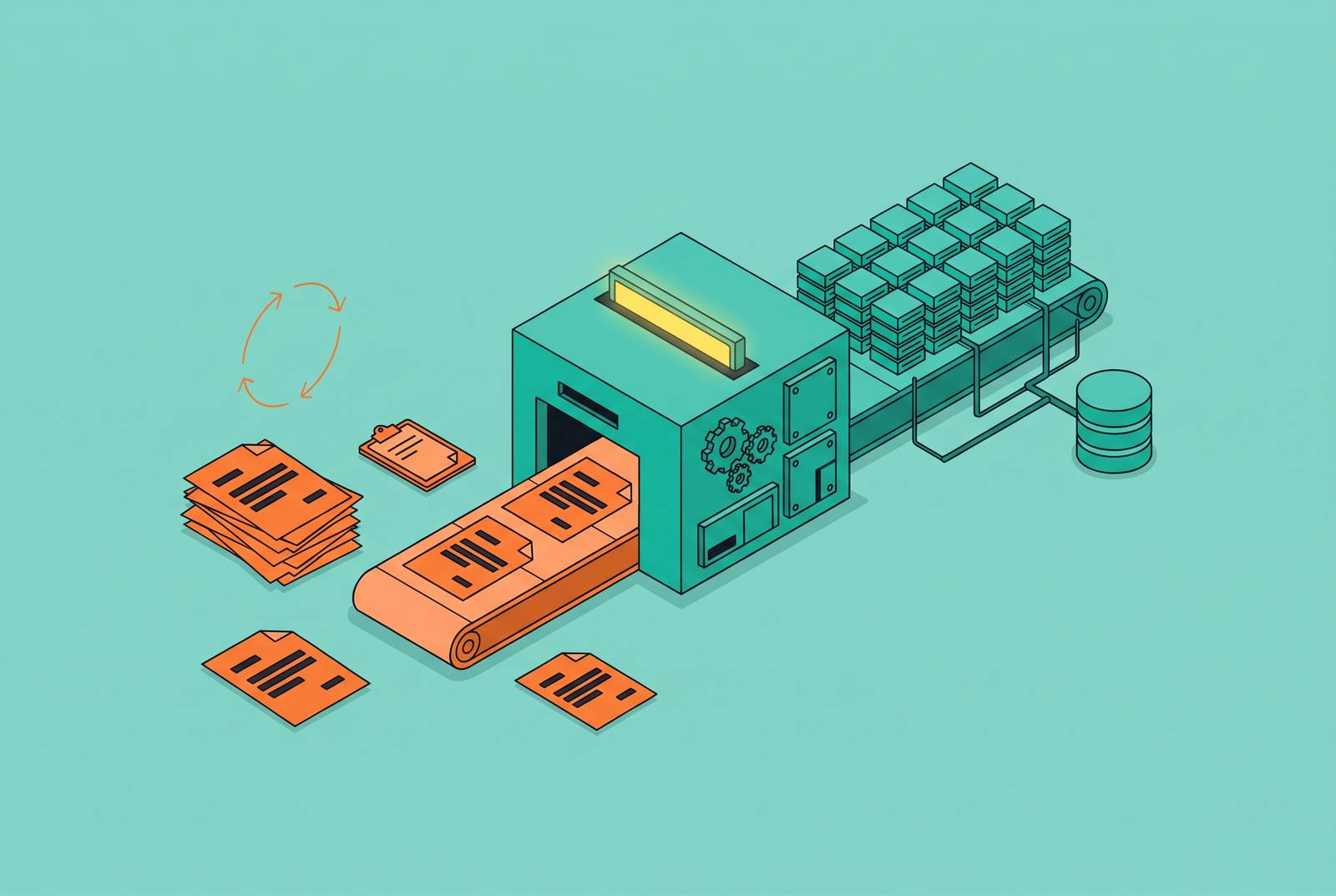
Automated spec extraction from manufacturer PDFs and submittals into data center design models needs two layers that work one after the other. AI reads the unstructured documents and produces candidate parameters, while deterministic engineering rules validate those parameters before they enter models, schedules, or BOMs. To replace the vendor PDF copy-paste loop, both layers must connect to every downstream destination, and a persistent asset identifier must link the spec record to the model and operations.
Why vendor PDF copy-paste persists despite its obvious costs
Vendor information arrives as a PDF, but the delivery chain needs structured data. In the standard workflow, no tool automatically bridges that gap, so people become the interface between the document and each design artifact. Each discipline types in what another discipline has already typed. The loop persists because project delivery leaves the conversion work to whoever needs the information next, even when teams recognize its cost.
Design usually comes before teams plan for automation, so extraction happens during procurement, submittal review, and model population. Those tasks happen at the same time, with pressure to stay on schedule. A person working on an equipment schedule needs the value now, while another person populating the model needs the same value for a different task. Neither task can wait for a data workflow that the project has not established.
Voltage, weight, heat rejection, dimensions, breaker frame, and cooling connection size move from the vendor PDF into a BIM object, a schedule, a BOM, an RFI response, and an operations handoff package. Each transcription creates another chance for drift. Even when each person reads the source with care, there is no shared, computable record for all those destinations to use.
Song Difei’s Engineering as Code paper traces this to a broader cause in engineering design. Current CAD/BIM systems tie design logic closely to geometric representation, which leaves quality assurance until late in the process, when fixes cost the most. The missing foundation is data that machines can consume, check, and version directly. Manual transcription is one visible consequence of that structural gap across engineering design.
What a two-layer ingestion pipeline actually replaces
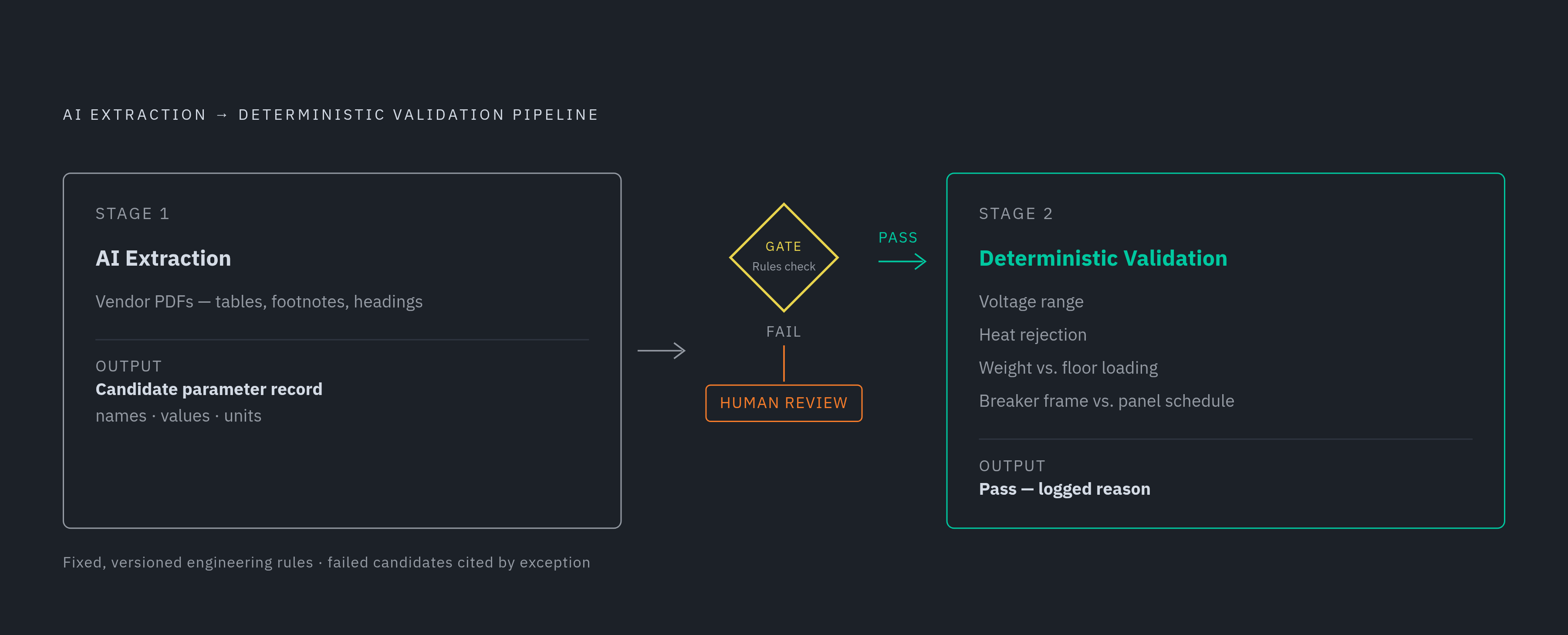
A two-layer ingestion pipeline takes over the work people do to turn the vendor document into engineering data for downstream use. Its first layer uses AI to read unstructured PDF content and return named parameters. Its second layer uses deterministic rules to check those parameters before they reach a model, schedule, or BOM. The split is the core of the workflow.
The layers solve different problems and are not interchangeable. AI reads source material that varies from document to document, while rules decide whether the extracted values can be used in engineering. Without extraction, a human still has to retype the data. Without validation, a plausible but wrong value can enter the model and spread into other artifacts.
What the AI extraction layer does and where it is limited
The AI layer reads the document as a document. Vendor PDFs contain embedded tables, footnote conditions, inconsistent headings, and terminology that changes across manufacturers and model lines. The task needs context as well as text capture. The output is a structured set of named parameters, each with a value and unit that the next layer can check.
From an equipment datasheet, the extraction layer might return an input voltage range, kW capacity, dimensions, weight, and heat rejection. Those names give the text copied from a page a place in the candidate record. But the word “weight” is not enough. A shipping weight and an operating weight serve different purposes, and confusing them changes what the record says about floor loading.
Footnotes pose a similar problem because they can qualify the figure shown in a table. A number may be easy to extract while the condition governing it is easy to miss. The resulting record can look complete and still be wrong. Other failures include selecting a value from the wrong table or missing a unit conversion. Correct formatting proves only that the output has the expected shape.
Abdo and Brom’s gated spec-driven workflow study documents an analogous limit in coding agents. Agents can overstate what they completed, making their reports claims. An extraction agent’s output is a claim about what a PDF says. It is not, by itself, proof that the parameter is suitable for the design.
The output must therefore stay a candidate record. Calling it a finished model object would treat reading a source as acceptance of its contents for engineering use. The AI layer has completed its task when it supplies structured input for validation. A workflow that writes those values directly into the model skips the separate decision that makes the write defensible.
What the deterministic validation layer does that AI cannot
Deterministic validation uses fixed engineering rules to check the candidate record. Does the extracted voltage fall within the range specified by the design? Does heat rejection match what the cooling model assumes? Does the equipment weight exceed the floor loading budget for its zone? Each question has a set pass-or-fail test that takes the decision out of the AI’s hands.
Engineers author these rules, and the rules are versioned. For the same input under the same rule version, they produce the same result every time. That repeatability is essential to the division of work. Whether a PDU’s breaker frame matches the panel schedule is an engineering check.
The Engineering as Code paper describes an automated rule engine that uses Engineering Static Analysis to check design declarations before they become completed geometric artifacts. This brings compliance checks into design generation, ahead of tail-end review. In a spec ingestion workflow, the structured parameter record supplies the declaration to inspect. The check can happen before the value becomes part of the model, without depending on geometric clash detection.
Validation also produces a record of the decision. An extracted value either passes its rule with a logged reason or fails with a cited exception that goes to a human for resolution. Unresolved values do not enter the model. Here, “validated” means that the parameter has passed the defined engineering checks. The audit trail shows the basis for acceptance rather than substituting an AI explanation for a test.
The same gating principle appears in Abdo and Brom’s study. A reviewer checked artifacts against a fixed, stage-specific defect list, while a file-inventory check detected undeclared changes and left written traces. Those software controls illustrate why an explicit gate differs from an agent’s assurance. Deterministic rules need extraction to supply structured input from the vendor PDF, so both layers are required.
How do validated equipment specs reach BIM models, schedules, and BOMs without re-entry?
Once a parameter passes validation, the pipeline can write it to a BIM object attribute, an equipment schedule row, or a BOM line without another person typing it. The write follows the engineering decision. Its traceability comes from the preceding steps. The audit log records the extracted candidate and the validation result, giving the downstream artifact a basis that manual entry alone does not provide.
A confirmed CRAH unit spec makes the required reach clear. The same validated equipment record should populate the BIM object, fill the equipment schedule row, update the cooling load model, and feed the BOM in one operation. If the pipeline updates only the BIM object, the schedule and BOM still depend on people repeating the work. That is a partial solution.
The BW Design Group and Rockwell Automation Data Center Automation Framework identifies fragmentation between design and automation as a foundational problem. When system integrators are not engaged as early design partners, automation strategies cannot align across the project, leading to rework and delay. Multi-destination output addresses that fragmentation at the data level. The more artifacts that receive the validated record, the fewer places people have to re-enter the data by hand.
The write also needs to establish the link used at turnover. A shared asset identifier on the BIM object ties it to the validated spec record and gives DCIM, EPMS, and BMS a way to receive the equipment data without a re-survey. This is more than another equipment attribute. It is the link between the design record and the asset that operations must find later.
Where the pipeline breaks without a shared asset identifier tying spec to model to operations
A validated spec record can reach the right BIM object yet remain disconnected from the operational system’s asset record. Without a persistent identifier to join those records, the data is there but has no link for a direct handoff. People must perform the matching or re-entry that ingestion was supposed to eliminate.
A drawing export makes the distinction easy to see. It can reproduce what appears on a sheet without preserving the structure an operational system needs to ingest equipment data. Geometry and correct attributes are not enough. A BIM object becomes a usable operational asset record only when the receiving system can identify which asset it represents.
The paper locates a related problem in CAD/BIM naming dependencies, which can lead to costly model reconstruction. At handoff, the practical failure is a system that cannot match the BIM object to its own asset record by a stable identifier. The shared identifier must therefore be assigned when the validated spec record is written to the BIM object. Adding it at closeout creates another manual matching exercise at the point when the pipeline should already have preserved the connection.
What separates a real ingestion workflow from a fragile workaround
A real ingestion workflow has four structural properties. Extraction creates candidate records, deterministic validation checks them before every write, multi-destination output saves people from re-entering data in downstream artifacts, and persistent identifiers link spec records to operations as soon as they are written. A PDF parser or a tool that fills one schedule can be useful without meeting that standard.
The distinction becomes sharper under project pressure. Abdo and Brom’s study found that written gates and checks helped keep execution within declared files and catch undeclared changes. When the orchestrator judged its own checks without an external gate, it stopped work in only a fraction of the cases where the stop rule required it. An AI extractor asked to validate its own output is still judging itself.
The engineering framework sets out a design principle that fits here. Engineering declarations should be machine-readable, with automated rule engines, version control, and package management serving as quality gates. Under that principle, the extraction agent cannot decide for itself whether to accept a value. A failed or unresolved parameter cannot become acceptable merely because the extractor presents it confidently or because the schedule is tight.
Is extraction kept separate from validation, and must values pass validation before they are written? The destinations and identifiers then show whether the accepted record reaches the full delivery chain. Asking only whether a tool uses AI checks how it reads. Asking what prevents an unvalidated value from entering the model tests whether it is a pipeline or a workaround.