Deterministic Rule Engines for Electrical Compliance in Data Centers
Rule engines automate electrical code compliance without the guesswork of AI.
Electrical infrastructure eats up 40 to 50% of total construction cost on a data center build, which makes it the single most expensive place to get compliance wrong. This piece is about the tool built specifically for that job: the deterministic rule engine, and why it has to stay separate from anything AI is doing on the same project.
The code stack governing this work is deep and it does not forgive shortcuts. NEC (NFPA 70) is the base layer, with specific articles written for data center installations. Stack on top of it NFPA 70E for workplace electrical safety, NFPA 70B for equipment maintenance, NFPA 75 for IT equipment fire protection, plus NFPA 72 and NFPA 13. NEC 2026 added arc-flash labeling requirements under Section 110.16, meaning incident energy data now has to sit on the equipment label itself, not buried in a study binder. That's a hard problem in data centers, where oversized overcurrent protective devices, put in place for future load growth, can push incident energy far past what a standard assumption would predict. Europe adds its own layer: EU Regulation 2024/573 phases out fluorinated-gas switchgear by voltage class on a fixed schedule, and the EU Data Centre Code sets PUE targets of 1.08 to 1.12 for hyperscale sites and 1.4 or below for new Tier III facilities.
What ties all of this together is that none of it is a matter of opinion. A design meets NEC 310 ampacity requirements or it doesn't. There's no "probably compliant" checkbox. And the failures that show up in the field mostly aren't failures of knowledge, since the codes are published and available to anyone. Human error contributes to roughly 70% of reported outages, according to Uptime Institute, cited in Data Center Geeks, 2026, and most of that traces back to gaps in training, missing risk assessments, or safety plans that exist on paper but never get followed on-site. The problem is consistent, traceable application of known rules across thousands of decisions on a single project. That's the environment that decides what kind of automation actually belongs here, and what doesn't.
What deterministic rule engines actually are, and how they differ from AI inference
A deterministic rule engine runs a set of explicit, human-written IF-THEN conditions against structured design data, and it gives back the same answer every time for the same input. No probability. No training data. No model weights adjusting themselves in the background.
The anatomy is simple once you break it down:
- A rule repository holding human-readable conditions that encode code requirements, engineering standards, or a specific project's own constraints
- A fact base, which is the actual design data the rules run against: equipment parameters, circuit loads, routing paths, protective device ratings
- An inference engine that matches facts to rules and fires the ones that apply
- An output that's a pass or fail, with a trail showing which rule fired, on which object, against which value
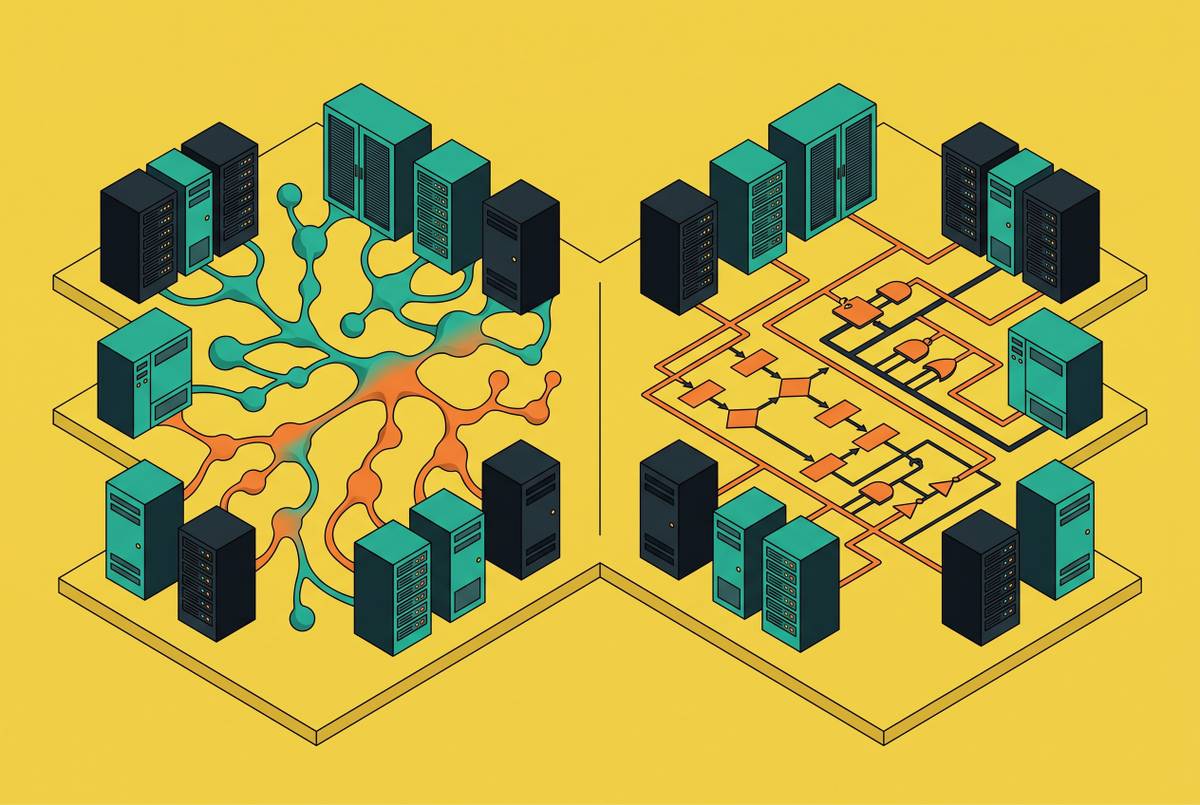
That's a different animal from how a large language model or a machine-learning classifier works. AI inference gives you a statistically likely answer based on patterns it picked up in training, and that's the right tool when the answer space is open-ended or depends on context that shifts case by case. Deterministic rules give you a provably correct answer based on logic someone wrote down on purpose, and that's the right tool when the answer space is closed and the conditions are already codified in a standard somewhere.
This isn't a stylistic choice between two similar tools. It's architectural. A rule engine can't hallucinate, because it has no way to reach past the conditions it was given. An AI model can't promise repeatability, because being non-deterministic is baked into how it's built. Ask "does this circuit's conductor ampacity meet NEC 310 for the connected load," and you're asking a deterministic question with one right answer. Ask a model to summarize the coordination strategy for a switchgear lineup, and you're asking a language question, one with room for phrasing and judgment. Compliance automation breaks down fast when people blur those two together.
There's a governance piece worth sitting with too. Every rule that fires is a named artifact you can point to: the engineer who wrote it, the code section it encodes, the exact object it flagged on the drawing. AI has nothing like that built in.
The specific electrical checks that rule engines are built to enforce
Conductor sizing sits at the top of the list, governed by NEC Article 310. The rules check that a conductor's ampacity clears the connected load once you adjust for ambient temperature, conduit fill, and derating. This matters more than it used to, because rack loads that sat around 5 to 8 kilowatts a few years back are now running 15 to 50 kilowatts in AI-ready facilities, and a small sizing mistake multiplied across hundreds of circuits stops being small.
Overcurrent protection coordination is next. Rules verify that upstream and downstream protective devices are set up so a fault clears at the correct device, without tripping the wider distribution system unnecessarily. This is where the payoff of getting coordination logic right shows up in real numbers: multi-terminal differential protection schemes using dynamic inrush restraint have cut false trips by 90%, saving over $250,000 in avoided downtime costs, according to Keentel Engineering's 2025 findings. That kind of result depends on exact coordination math, not a rough guess.
Arc-flash incident energy compliance, under NEC 2026 Section 110.16, means rules calculate incident energy at every working point and check that the label matches the equipment as actually configured. Data centers run hot on this risk because oversized protective devices, common where a facility was built with room to grow, push incident energy well past standard assumptions.
Dedicated branch circuits and EPO verification, under NEC and NFPA 75, check that IT loads run on their own circuits and that EPO coverage and activation paths are unambiguous. Cable tray fill and routing compliance, under NEC Article 392, checks fill ratios, bend radius, and separation between power and signal cabling, catching the kind of violation that a visual walk-through in a dense routing environment will miss every time. Grounding and bonding continuity rules trace the path from equipment enclosures all the way to the grounding electrode and flag any break in that chain. And on the facility side, PUE and load-density targets from the EU Data Centre Code, or an owner's own internal capacity rules, can flag a design that clears NEC but still blows past an efficiency target the operator cares about.
Every one of these categories shares the same shape. The rule fires or it doesn't. What the engineer gets back is a specific, named violation, not a percentage.
How a single rack-load change cascades through the electrical rule set
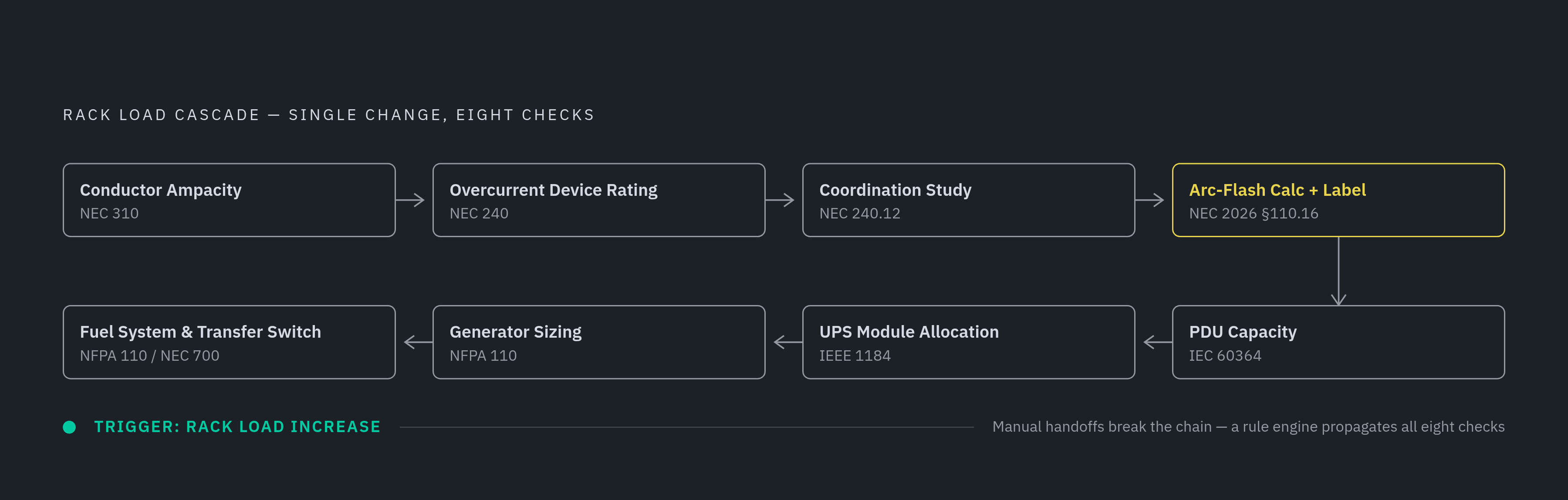
Density is climbing fast enough that cascade behavior isn't a theoretical concern anymore. Average rack loads moved from around 8 kilowatts in 2024 toward 15 kilowatts in 2026, and AI-ready designs are targeting 25 kilowatts by 2028, per Mordor Intelligence's 2026 numbers.
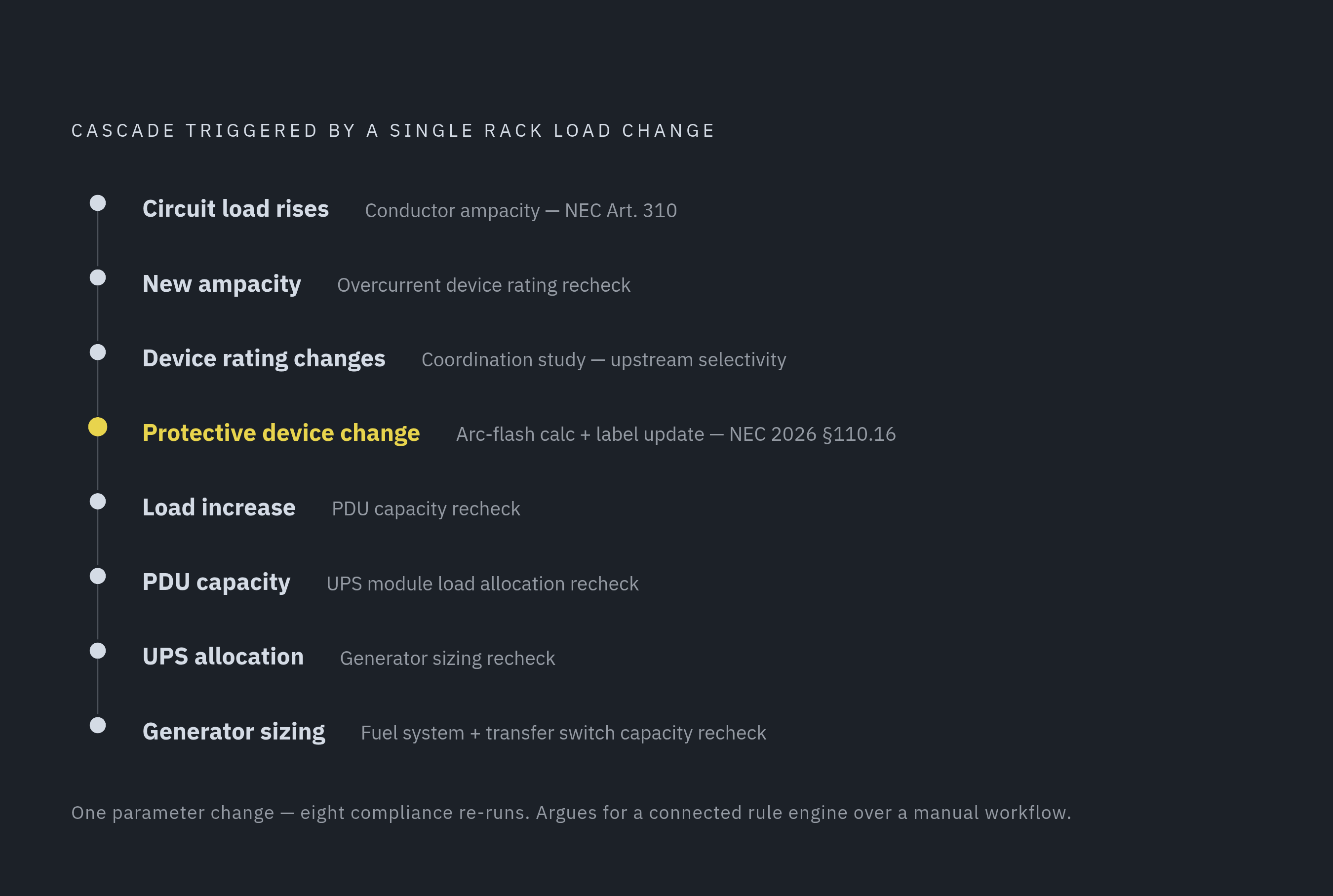
Here's the thing about a rack load increase: it's never really one number changing. It's a chain.
- Circuit load goes up, which forces a conductor ampacity recheck under NEC 310
- New ampacity forces a recheck on the overcurrent device rating
- New device rating can knock the whole coordination study out of alignment, since upstream devices may no longer coordinate correctly
- Any protective device change forces a fresh arc-flash calculation, which changes the label under NEC 2026
- The load increase forces a PDU capacity recheck
- PDU capacity feeds into UPS module load allocation, which has to be rechecked
- UPS allocation feeds generator sizing
- Generator sizing feeds fuel system and transfer switch capacity
In a manual workflow, each one of those is a separate task, often sitting with a different engineer or a different discipline entirely. The gap between those handoffs is exactly where mistakes live. A rule engine connected to a live data model handles this without anyone remembering to ask for it: change the rack load parameter once, and every downstream rule tied to it re-runs against the updated numbers automatically.
It doesn't stop at electrical, either. A rack load jump also touches cooling, since liquid cooling retrofits run $1.5 million to $2 million per megawatt once you cross certain density thresholds, and it touches cable routing, since fill ratios shift with it. Which is really the argument for treating this as a connected problem rather than an isolated one: the value in the rule engine isn't any single check, it's catching every downstream consequence the moment someone changes one number.
Where deterministic rules sit in the design workflow, and what they hand off to
A rule engine doesn't work on a blank page. It needs structured input already sitting in front of it: equipment parameters, circuit topology, routing geometry, protective device ratings, all in a form the engine can actually read.
That means the whole thing lives or dies on the quality of the data model feeding it. Equipment specs still locked inside a manufacturer's PDF, never pulled out into the model, are invisible to the engine. A layout that only exists as a drawing, not as structured data, can't be checked against a capacity rule. An RFI answer sitting in an email thread instead of attached to the design object it affects breaks the whole chain of traceability.
In practice, the rule engine's job shifts as the project moves forward. Early on, it enforces capacity planning: power budget by zone, density limits tied to cooling type, redundancy topology. Move into detailed design, and it starts enforcing NEC and NFPA compliance at the circuit and equipment level: ampacity, coordination, arc-flash, grounding. Through change management, it's re-running every affected check the instant a parameter shifts, which is the cascade behavior described above. And heading into pre-construction or AHJ submission, it produces something closer to a ledger than a report: a rule-by-rule compliance record tied to specific design objects, not a written narrative someone assembled after the fact.
What happens downstream matters just as much. Verified, structured equipment data should flow straight into DCIM, EPMS, and BMS systems without anyone re-entering it by hand. A DCIM setup built from day one, giving real-time visibility into power capacity from utility intake down to the outlet, only works if the data handed over at turnover is accurate to begin with. COBie and structured asset data are the delivery mechanism here; the rule engine's job is making sure what fills those records was actually checked against code during design, not reconstructed afterward by someone trying to remember what was built.
ArchiLabs Studio treats this connection as the core job of a data center project OS: deterministic rules running against a live, connected model, cascading across power, cooling, cable, and documentation, so the compliance record and the handoff data end up being the same file instead of two separate ones somebody has to reconcile later.
What rule engines cannot do, and where AI legitimately belongs in electrical design
A rule engine only knows what's written into it. It can't interpret ambiguous code language on its own; a human has to translate that language into an explicit condition before the engine can check anything against it. It can't adapt to a new piece of equipment or an emerging standard until someone updates the rule set by hand. And it can't tell you why an engineer made a decision, only whether that decision satisfies a condition.
That's exactly where AI earns its place. The jobs that are language-heavy, open-ended, or require pulling meaning out of scattered, unstructured sources belong to AI, not to rules.
- Pulling equipment parameters out of manufacturer PDFs and spec sheets, turning unstructured pages into structured inputs the rule engine can then check
- Drafting RFI language, summarizing a design decision, or flagging which code sections might apply to a piece of equipment nobody's dealt with before
- Spotting patterns across old projects, like which rule categories fire most often on a given building type
- Generating layout options or suggesting a routing path as a starting point for an engineer to review, in situations where the possibilities are too wide open for a fixed rule set to cover
The line in practice runs like this: AI proposes, the rule engine verifies. AI extracts, the rule engine validates. AI drafts, the engineer and the rule engine both sign off before it moves forward.
The dangerous setup is letting AI make the compliance call directly, handing back a confidence score where the job actually calls for pass or fail, or pushing a design change through without triggering the rule cascade that should follow it. The setup that actually works treats these as two layers doing two different jobs: AI handles the language and the ambiguity on the front end, deterministic rules own the compliance gate on the back end, and structured data ties the two together so neither one is working off half the picture. That's not some future state worth waiting for. It's the design principle that should be driving every dollar going into electrical compliance automation right now.