Cable Management Documentation in Data Center Projects
Documentation must move in sync with installation, not after, to keep power, cooling.
Cable management documentation has to happen alongside installation as it proceeds, not after. It ties physical routing decisions to power, cooling, capacity planning, and operations. When that layer breaks, everything downstream breaks with it.
Most teams treat documentation as a wrap-up task, something you produce once the racks are built and the cables are pulled. That backwards habit, doing things the wrong way round, is the single biggest mistake in the process. Every routing decision made in design, from which tray a fiber run takes to how much clearance sits above a cabinet, carries immediate consequences for power path, airflow, maintenance access, and whatever operations team eventually inherits the facility. Cable touches every other system at once: power distribution, cooling pathways, rack capacity, fiber routing. If documentation lags behind the install, the links between those systems go invisible to whoever touches the project next, and nobody finds out until something fails.
Scale is why this can't wait anymore. U.S. data center construction hit $48.18 billion in 2024 and is on track for $112 billion by 2030. July 2025 alone brought $14.0 billion in construction starts, against just $682.0 million the same month a year earlier. Projects moving at that pace can't run on habits built for a slower, less crowded era of hardware. What follows tracks cable documentation through each stage of a project, from design through operations, and points to exactly where its failure produces a specific, traceable cost.
What cable documentation actually covers across a project lifecycle
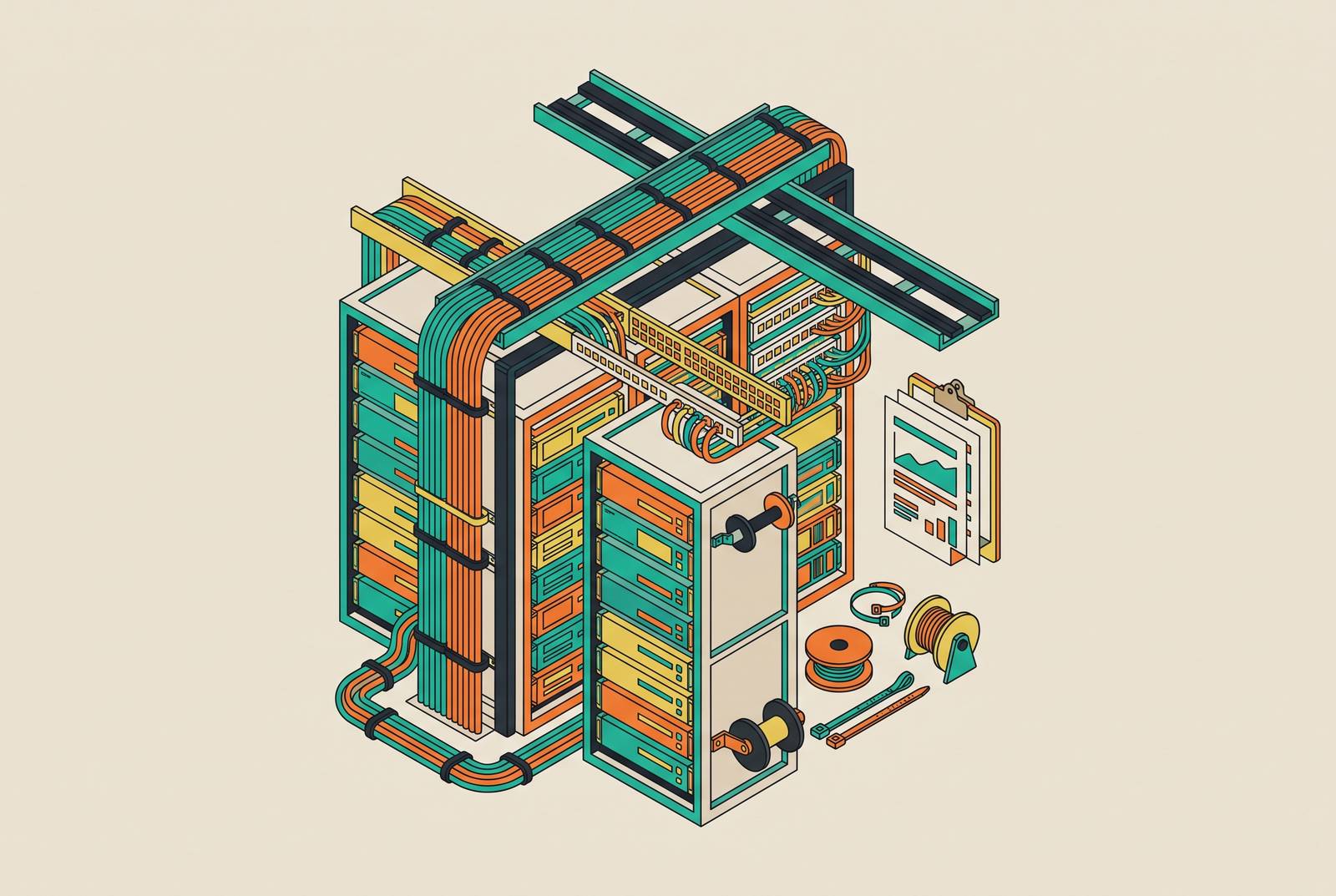
Documentation spans multiple documents. It's a family of records that all have to stay in sync with each other and with the physical plant, and if any one of them drifts, the rest stop meaning much:
- Cable schedules: type, length, endpoints, and rated performance. Cat6a runs 10 Gbps over 100 meters. OM5 fiber pushes 100 to 400 Gbps over 100 to 150 meters. These numbers set the ceiling on what a given run can carry.
- Pathway maps: tray routes, vertical cable managers, raised-floor runs, conduit assignments.
Labeling records: identification is required at both ends of every cable, along with a color-coding scheme and naming conventions consistent enough that a machine can read the labels, not just a technician squinting at a tag.
- Test records: performance verification tied to a specific cable ID, not a general "tested and passed" note.
- Change history: every move, add, or change logged against the original record, so the paper trail matches the cable trail.
TIA-942, updated in 2024 as revision C, sets the physical framework these records live inside: four reliability tiers, pathway requirements, and a minimum cabinet width of 24 inches. TIA-606 governs what the documentation itself has to contain. BICSI guidance fills in the installation detail, including a minimum 12-inch separation between power and data cables to keep electromagnetic interference out of the signal path.
The zoning model underneath all of this, Main Distribution Area, Horizontal Distribution Areas, Zone Distribution Areas, Equipment Distribution Areas, gives cable documentation something to point to. Think of it as the address system. Strip it out and the records have nowhere reliable to land.
Planning for 30 to 40% spare capacity in cable trays isn't just about future growth. Tray fill affects airflow directly, and it decides whether a technician can actually reach one cable during a maintenance call five years from now. This is also where structured versus unstructured cabling stops being a physical question and turns into a documentation one. Unstructured cabling has no stable address system to map against, so its layout stays undocumentable no matter how much paperwork gets thrown at it.
How AI-era density is outpacing documentation practices built for an earlier generation of hardware
The jump in power density is abrupt. It's a step change, and most documentation habits haven't caught up. GPUs now draw 700W to 1,200W per chip. A single high-density AI server can pull upward of 8 kW. Put ten GPUs in a rack and the total hits 80 kW before switches, storage, power supplies, or cooling loads even enter the math.
Every GPU in an AI training array needs to talk to every other GPU, full mesh connectivity, which multiplies fiber count and connector density well past what a conventional compute row ever needed. Bandwidth stacks the problem further. AI training workloads call for 40 to 100 Gbps per connection. 400G is the hyperscale baseline now. 800G is rolling out fast, and early 1.6T switches are due in AI and HPC environments starting in 2026.
To handle that volume of fiber, facilities pack more strands and connectors into the same footprint through dense MPO/MTP cassette systems. That saves floor space, but it also shrinks the room available for identification and access. Every added fiber, every connector crammed into a dense cassette, every high-power run is one more record that has to get created and kept current. Documentation load scales with density, not with rack count, and those two numbers stopped tracking each other a while back.
The industry-wide figures show what's riding on this. As of early 2026, 190 GW of hyperscale capacity has been announced across 777 projects: roughly 148 GW still in planning, 21 GW under construction, 12 GW operational. A quarter of the 110 projects slated to come online in 2025 got delayed. Power availability, permitting, and construction constraints are among the paths that delay travels through, and documentation gaps compound each one.
Where cable documentation breaks down during design coordination
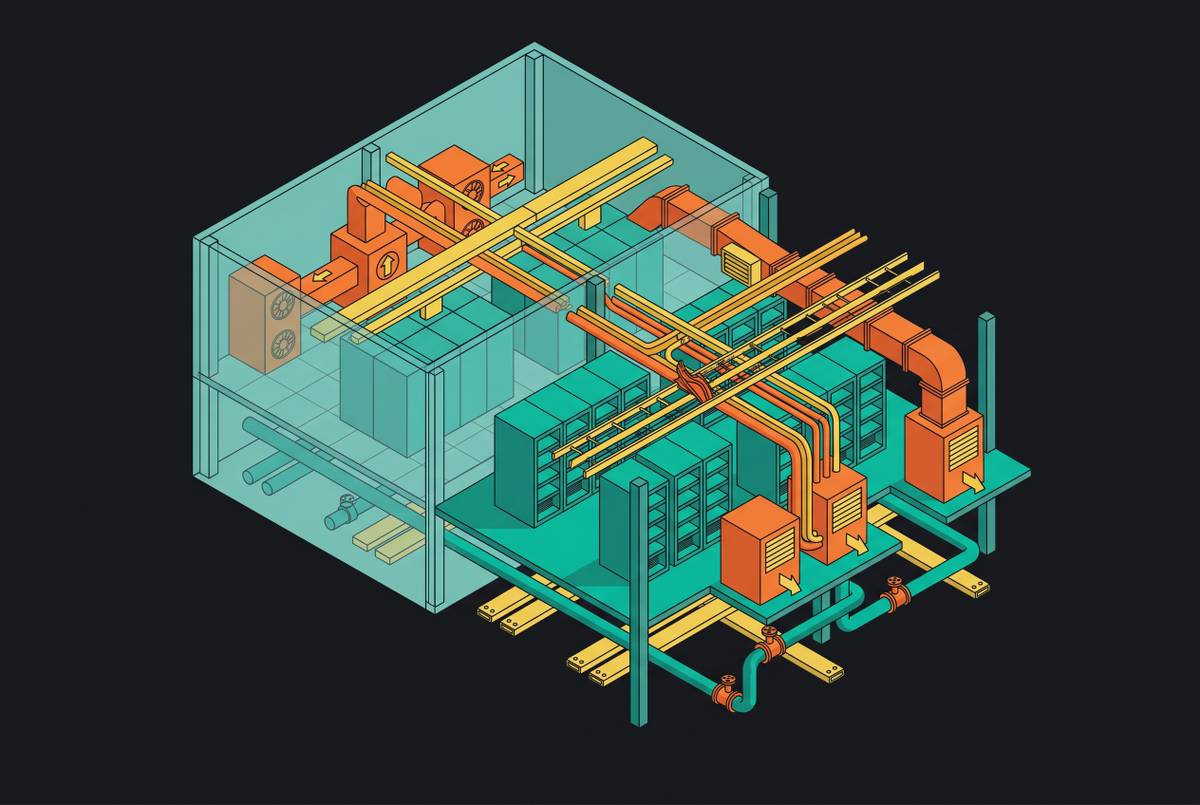
Physical space is the first place documentation turns into a coordination liability. Overhead zones hold HVAC ducts, electrical busways, sprinkler lines, and cable trays all at once. Raised floors have to fit cooling pathways alongside fiber and copper runs in the same shallow depth.
Cable trays from power distribution often end up blocking return air paths. Bad placement throws off pressure balance across the floor, and thermal hotspots show up right where cool air distribution runs into something in its way. Every one of those problems traces back to a routing call that never made it into a shared record.
Sequence is part of the same problem. Structural elements get placed first, then large-bore mechanical, then electrical raceways, then the smaller piping and cabling. Skip enforcing and logging that order, and trades start negotiating space in the field instead of in the model, and the field outcome never makes its way back into the documentation at all. A 2025 study in the Journal of Construction in Developing Countries looked at 65 MEP clashes on a single project and found unresolved conflicts added MYR 60,323.80 in cost on one case alone. That's the price tag on a coordination failure better documentation would have caught early.
Traditional 2D workflows make this worse. Mechanical, electrical, plumbing, and fire protection drawings sit in separate layers, and cable routing gets tacked on as yet another layer nobody actually owns start to finish. Whatever gap opens here, routing settled informally, sequences agreed to verbally, field adjustments nobody wrote down, is exactly what a technician inherits years later when something needs troubleshooting or expanding.
What BIM contributes to cable documentation and where it reaches its limits
BIM's real contribution is putting every discipline into one digital model, so automated clash detection catches conflicts before anyone breaks ground. A cable tray fighting with mechanical equipment, clearance too tight for maintenance, a piece of equipment that can't get swapped without tearing out something next to it: BIM catches these before they turn into field problems.
For cable specifically, that means trays, risers, and conduits modeled in enough detail that clearances and serviceability get designed in up front instead of discovered mid-installation. Maintenance teams get predictable pathways instead of routes some crew improvised on a Tuesday.
Rule-based model checking goes further than basic clash detection. A component distance rule can confirm a tray sits high enough above the ceiling for a scissor lift to pass underneath, and low enough that someone can still reach it to do maintenance. That's geometry no visual walkthrough reliably catches once a project reaches real scale.
BIM also opens the door to prefabricating cable tray assemblies and pipe racks off-site, which saves time on the floor. But prefabrication only works safely when the model detail is sufficient to catch coordination errors before fabrication begins. Coordination errors caught after fabrication mean rework, return trips, and schedule slip, and every one of those traces back to documentation that wasn't finished when it needed to be.
BIM has a ceiling, though, and here's where it sits: the model built to coordinate construction usually isn't the structured asset record that DCIM, EPMS, and BMS systems need once the facility goes live. BIM data commonly arrives at turnover incomplete, inconsistent, or simply disconnected from how operations actually works.
AI layered on top of BIM can help by ranking a clash register according to likely structural, schedule, or cost impact, rather than treating every conflict as equally urgent. It can suggest alternate routing that cuts down on conflicts or improves maintainability down the line. But AI backs up the people running the workflow, it doesn't stand in for them, and it can't invent structure the underlying model never had. A model built without consistent naming, without endpoint data, without change history, feeds nothing useful into operations no matter what gets layered on top of it.
How fragmented documentation makes power and cooling coordination unreliable
Electrical systems eat 40 to 45% of a data center construction budget. Cooling takes another 15 to 25%. Together they're the largest share of capital in the whole project, and cable routing touches both directly.
Power path traceability runs entirely on cable documentation. A rack move that never gets logged against the power schedule leaves the load calculation stale, and the facility ends up showing capacity that doesn't actually exist, or flagging a constraint that got resolved months ago. Cooling carries the same dependency running the other way: cable trays packed past their recommended fill choke off return air paths, cable runs through raised floors crowd out cooling pathways, and hot aisle/cold aisle containment leaks through penetrations left unsealed and unrecorded.
The move to liquid cooling makes the stakes sharper. Air cooling generally holds up to about 50 kW per rack for inferencing workloads. Liquid immersion handles racks at 100 kW or more, and dual-phase immersion reaches 150 kW per rack. Each cooling method carries its own routing constraints, and those constraints have to get documented before mechanical installation starts, not worked out afterward. Facilities that weren't built for AI density from day one face $200 to $400 per kW in mechanical retrofits, landing somewhere between $10 million and $50 million on a mid-size build. A real share of that bill traces straight back to routing decisions and cable layouts documented too thinly to support an upgrade without a full field survey first.
Mechanical trades, controls teams, and IT vendors now need to coordinate during installation, not at some late-stage fit-out review. That only works if cable documentation stays current and every discipline can actually see it in real time.
What breaks in operations when the documentation handed over at turnover is incomplete
Turnover documentation is rarely missing outright. It's incomplete in the specific ways that matter to operations: cable IDs that don't match the asset register, endpoints logged at the port level with no tie back to the actual device, test results sitting in a PDF nobody can search or query.
DCIM systems, EPMS platforms, and BMS integrations all need structured data with stable identifiers to work. Hand them a spreadsheet or a scanned PDF instead, and the integration either fails outright or someone rekeys it by hand, which is exactly the kind of manual step that piles new errors on top of the old ones.
Troubleshooting time is the cost everyone notices first. A technician tracing an undocumented run in a high-density AI rack isn't just working slower: tracing cable live in that kind of environment risks disturbing whatever sits right next to it. And the gap compounds. Every move, add, or change that skips the record widens the distance between the logical documentation and the physical plant a little more, and the longer that gap runs, the more expensive any future audit, expansion, or migration gets.
The real finish line for documentation is well beyond the day the ribbon gets cut. It's the day the records are validated and handed over as a structured, searchable, system-integrated record, one that lets operations start work without re-surveying the facility first.
The documentation practices that actually keep records synchronized with a live facility
Documentation has to work as a live system, not a one-time deliverable. Records update when the physical plant changes, not in a batch months after the project closes out.
Both-end labeling is the baseline unit that makes any of this reliable: every cable identified at source and destination, with labels tough enough to survive the actual environment they're stuck in. Color-coding should follow ANSI/TIA-606 conventions, blue for horizontal cabling, yellow for single-mode fiber, aqua for multi-mode fiber, so a technician can identify a cable on sight without pulling up a database.
Naming conventions connect a physical label to its digital twin. Consistent identifiers across cables, ports, and equipment mean a change made in the field shows up correctly in the management system, with no translation step where errors sneak in.
Change management can't be optional, full stop. A cable swap, a port reassignment, a tray extension, each one needs approval, a log entry, and a push to every dependent record (the power schedule, the cooling model, the asset register) before the work counts as done. Regular audits confirm the physical plant still matches the paper. The interval should track how fast the facility is changing: a fast-moving AI build-out needs shorter audit cycles than a stable enterprise environment ever would.
Planning is where documentation capacity actually gets set aside. Pathway designs need to exist before installation starts. Tray capacity needs its 30 to 40% headroom reserved before rack density gets locked in. Airflow routing needs to get checked against the cooling model before a single cable gets pulled.
None of that works if the records live in one team's DCIM instance or a project manager's shared drive. Digital records need to stay visible across disciplines, which is what lets DCIM, EPMS, and BMS integrations actually function instead of forcing a re-survey at turnover. Automation that ties layout decisions straight to cable schedules, power records, and operations systems closes the manual rekeying gap where most of these errors start in the first place. A routing decision made in design should carry its structured data forward through construction and into operations without anyone retyping it along the way.