Automated Change Propagation After a Rack Move
Synchronize power, cooling, cabling, and operations automatically when racks relocate at scale.
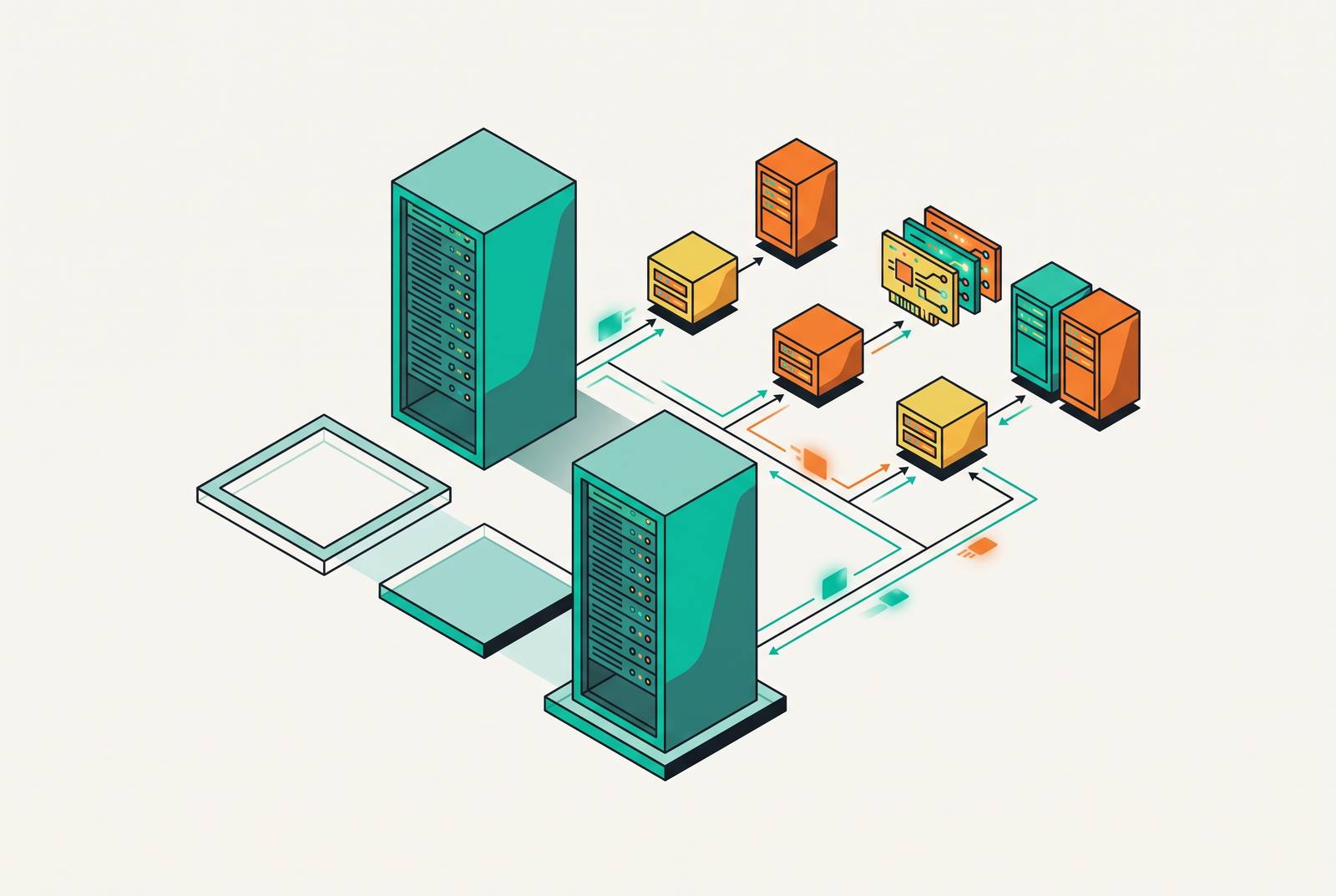
A rack move sounds like a facilities job: unbolt it, roll it, set it down somewhere else. In practice, it's a trigger that fires through five systems at once: power, cooling, cabling, documentation, and the operational databases that run the facility day to day. Each of those systems was built around the rack sitting in one specific spot, and the instant it moves, every one of them is wrong until someone fixes it. Most workflows don't fix it automatically; they wait for a person to notice, and at today's rack densities, that wait is no longer something a facility can afford.
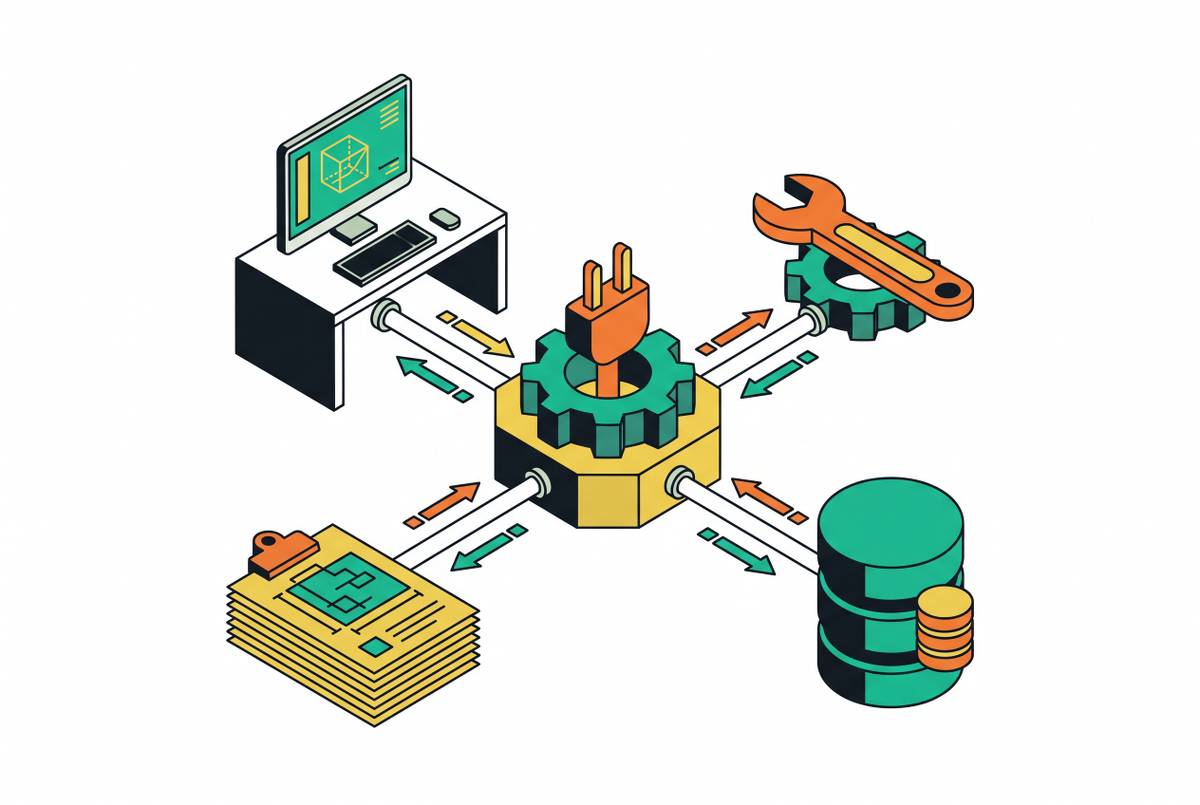
When a rack is physically relocated, five systems become wrong simultaneously: power distribution loses its circuit-to-rack assignments and UPS load balance, cooling geometry shifts so the zone the rack left is overcooled while the zone it lands in may lack airflow capacity, cable runs change in length and tray path, every floor plan and schedule tied to the old position falls out of sync, and DCIM, EPMS, and BMS each drift in different directions because none of them registered the move. The way to automate those cascading updates rather than waiting for human discovery is to give every rack a single persistent, machine-readable record that ties position, circuit assignments, thermal zone, and cable terminations into one upstream source, so that changing a rack's position is one operation that propagates into the power model, cooling model, cable schedule, documentation, and all three operational systems automatically, instead of five separate manual edits made whenever someone eventually notices the discrepancy.
Consider where densities sit now. Plenty of AI deployments already run past 125 kW per rack, with credible forecasts putting the ceiling near 300 kW and climbing. At that scale, stale data isn't a paperwork nuisance. It's a direct line to overloaded breakers, miscalibrated cooling, and cable runs that no longer make physical sense. Power redistribution, cooling remodeling, cable rerouting, documentation updates, and operational system sync don't happen one after another. They either happen together, correctly, or the facility runs on bad information until something breaks. Understanding each leg of that cascade is the only way to build automation that actually closes the gap.
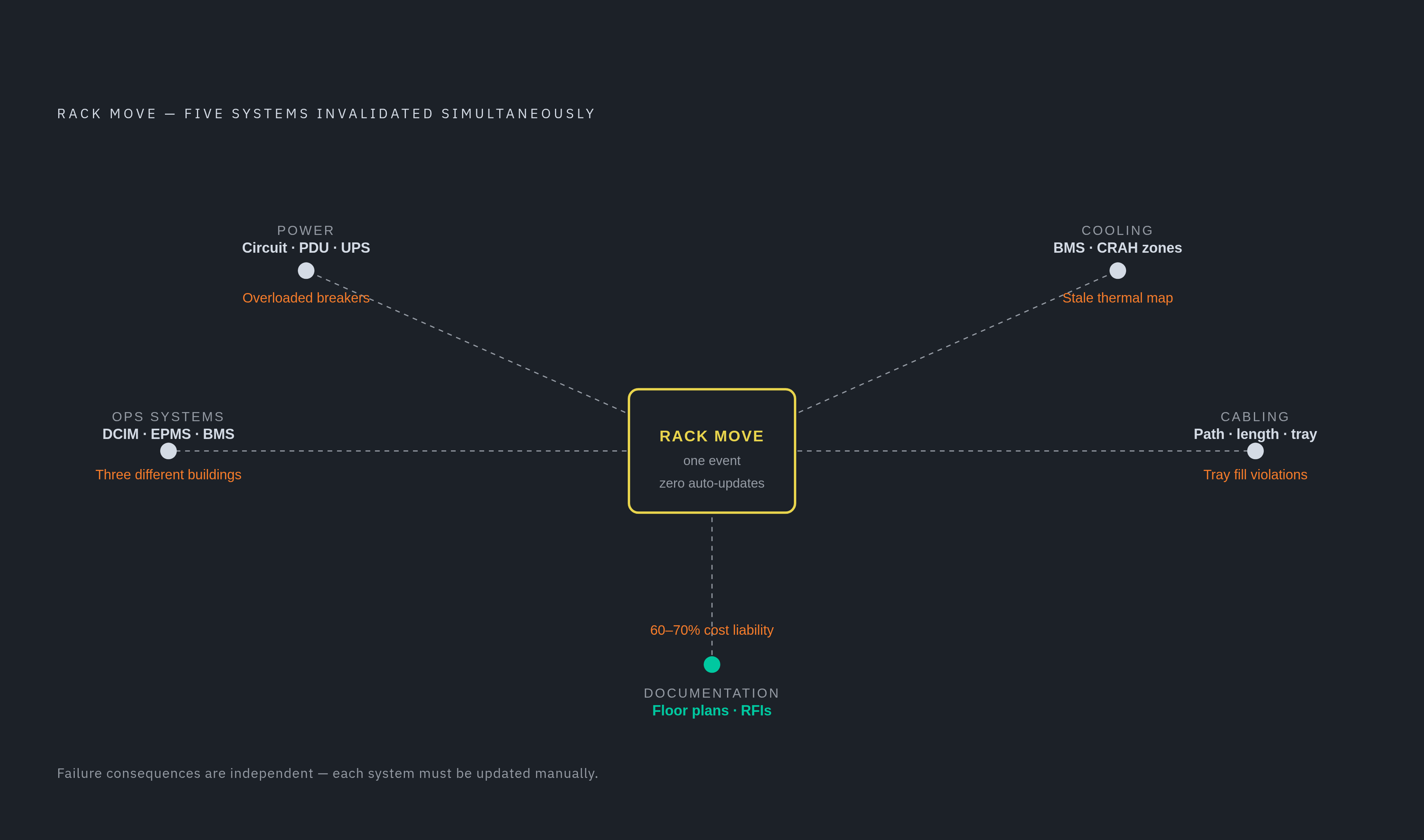
How power distribution is recalculated when a rack changes position
A rack isn't a generic load plugged into whatever's closest. It's tied to specific breakers, specific PDU ports, specific busway taps, and specific UPS legs, each with its own remaining headroom. Move the rack, and those ties snap. The new position lands on a different set of circuits, and those circuits might already be carrying a heavy load before the new rack shows up.
What actually needs to happen: a new circuit-to-rack assignment at the PDU level, a rebalance of load across UPS legs and busway segments, a check that no upstream breaker now sits over its rated capacity, and a redundancy check confirming the new spot still has proper A+B feed coverage. None of that is back-of-envelope math anymore. Next-generation GPU racks are already pushing power thresholds that demand entirely new architecture, so this recalculation needs real engineering validation against the full power model, not a guess from someone who remembers roughly how the panel schedule looks.
There's a broader shift happening underneath this too. Industry reporting points to more power conversion moving toward centralized, higher-voltage DC systems as densities keep rising. So the power model a rack move has to propagate into isn't holding still, it's getting more layered over time. Without automation, an engineer has to manually trace the rack's new position through every upstream path, re-enter the revised loads, and check compliance by hand, and that workload multiplies with every move that follows. What this really demands is a live, structured record of every circuit assignment, not a PDF one-line diagram that was accurate the day the permit was issued and nothing after.
What the move does to cooling geometry and why stale setpoints are dangerous
Where a rack sits determines which CRAH units cool it, which hot-aisle or cold-aisle containment zone it belongs to, and how much local airflow it's entitled to. Shift the rack, and the heat load shifts with it. The zone it left behind is suddenly overcooled, burning energy on a load that's gone. The zone it lands in may not have the airflow capacity to handle the new heat it's absorbing.
The BMS is the system holding the control logic here: CRAH setpoints, fan speed curves, temperature thresholds, all calibrated to a thermal map of the room. If nobody updates it, the BMS keeps running on the old map, cooling for a heat load that no longer exists where it thinks it does. That matters more than it sounds like it should. Cooling eats up somewhere around 30 to 40 percent of a facility's total energy draw, so a system tuned to the wrong rack layout isn't a one-time miss, it's a continuous drain, day after day.
ASHRAE's operating envelope gives a facility 18 to 27°C and 20 to 80 percent relative humidity to work within. Holding that range for a rack's new location requires the BMS to actually know where the rack is. And the stakes go up during a power event: utility dropout, UPS ride-through, generator pickup. That's the exact moment BMS and EPMS need to be talking to each other. If the thermal model is already stale from a move nobody logged, the risk window during that transfer just got wider. The fix has to come from a single authoritative record of rack position, feeding CRAH setpoints and zone assignments automatically, not a controls technician typing updates into the BMS separately from whatever DCIM or the power model says.
The cable routing problem: why a rack move can make physical cabling work invalid
Data centers pack more cable per square foot than almost any other building type, and code requires separation between power cable and data or fiber cable, which roughly doubles the pathway space you need to plan for. Move a rack, and three things go sideways at once. The length of every cable run to and from it changes, so cable cut precisely for the old position might be too short, or awkwardly long, in the new one. The tray segments carrying its connections change, and the new path might cross a tray that's already nearly full. And the fill ratio along that new route matters: trays shouldn't exceed 40 to 50 percent fill for thermal and maintenance reasons, so a reroute that pushes a tray past that line creates a compliance problem on top of a physical one.
TIA-568-D calls for service loops of 1 to 2 meters at patch panels, ODFs, and tray transitions, specifically so a move doesn't force a full re-pull. That works fine if the move stays inside the loop's reach. Beyond that, new cable is the only option.
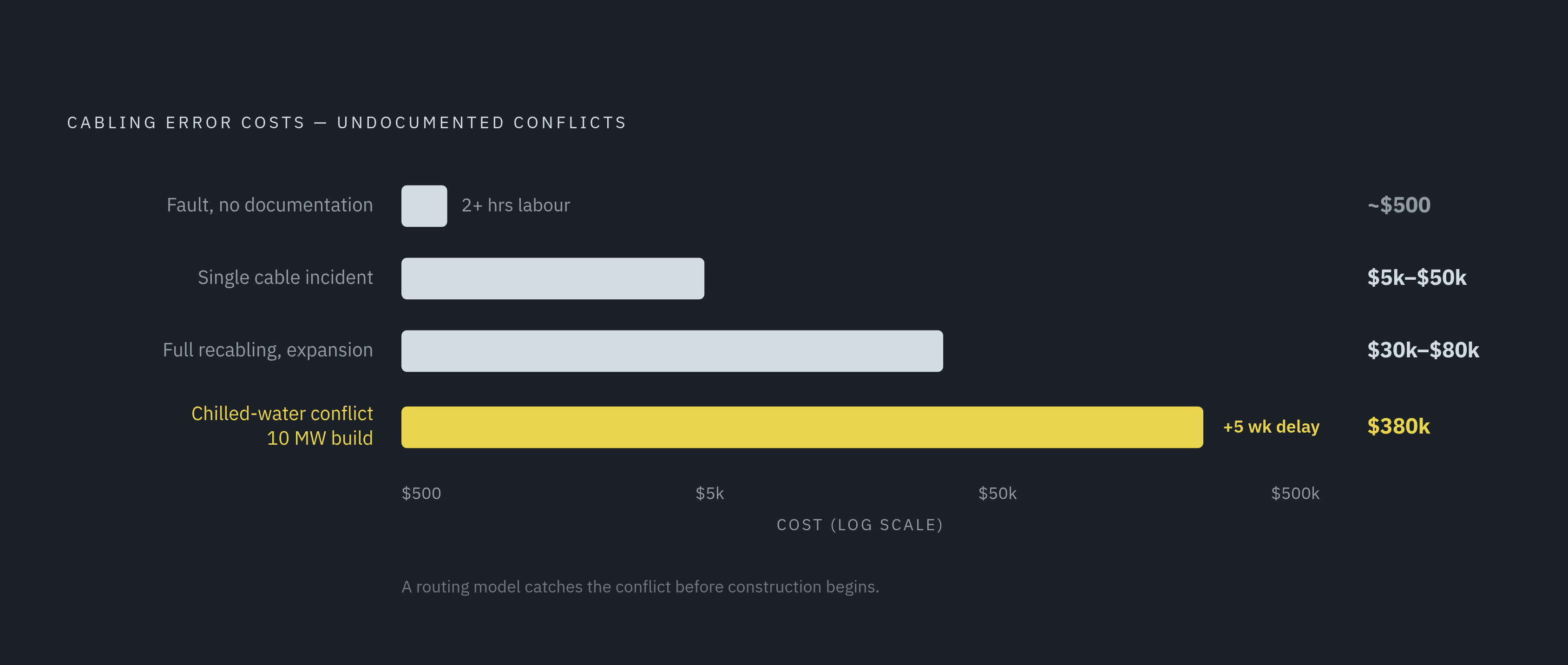
The dollar figures here aren't small. Cable mistakes, wrong lengths, non-compliant runs, missing labels, no forward planning, each carry incident costs running $5,000 to $50,000, and a full recabling job during an expansion can run $30,000 to $80,000. One documented case makes the stakes concrete: on a 10 MW data center build, a chilled water pipe conflicted with the primary cable tray route feeding 40 percent of the server cabinets. Discovered during construction, it cost $380,000 to reroute and pushed IT equipment installation back five weeks. A rack move that forces a reroute through an already tight zone can trigger that exact same class of conflict.
There's also a traceability cost that's easy to overlook. Troubleshooting a cabling fault with proper documentation takes about 15 minutes; without it, more than two hours. After a rack move, every connection that changed needs its record updated, or the facility is operating blind on its own cable plant. What's needed is a routing model that can check path, length, tray fill, and compliance for the rack's new spot before anyone touches a cable.
Documentation drift: how the design record falls out of sync after a move
Once a rack move isn't reflected in the documentation, a gap opens between what's physically true and what the paperwork says. Every floor plan, every schedule, every RFI response tied to that rack's old position is now wrong, and it's wrong across a wide set of documents simultaneously: floor plans and rack elevations, power schedules with their circuit assignments and load tables, cable schedules with run lengths and termination points, mechanical coordination drawings showing cooling zones, and the RFI and submittal logs that referenced the old location.
In a fragmented workflow, each of those documents sits in a different tool, owned by a different person, updated on a different schedule. So the rack move kicks off a manual chain of updates, and any link in that chain can get missed, delayed, or entered inconsistently. That matters more than it might seem, because mechanical and electrical systems account for 60 to 70 percent of total project cost. Documentation that misrepresents those systems isn't a filing error, it's a liability sitting against the project's biggest cost line.
Rework tied to coordination errors runs around 30 percent of total construction cost on complex builds, and data centers sit at the high end of that range. Whatever BIM data reaches turnover without reflecting the last rack move is incomplete, full stop; it doesn't describe what actually got built. The fix here isn't a better checklist. A change to rack position needs to propagate into every affected document from one shared source, instead of relying on someone to remember which five files need touching.
What happens to DCIM, EPMS, and BMS records when a rack move is not registered, and how can those updates be automated?
DCIM, EPMS, and BMS all hold a picture of the facility, but they're answering different questions, on different update cycles. DCIM tracks IT asset inventory and rack-level space and power capacity, so it needs to know where the rack sits and what it draws. EPMS tracks electrical distribution in real time, so it needs to know which circuits the rack is on. BMS runs cooling and environmental control, so it needs to know the rack's thermal zone and local heat load.
When a move goes unregistered, all three drift in different directions. DCIM holds a stale position. EPMS holds stale circuit assignments. BMS holds a stale thermal zone map. Three separate databases, each telling a different story about the same physical rack.
Integration is supposed to solve this, but DCIM and BMS are typically fed by different teams answering different questions, and without a shared propagation mechanism, a move entered into one system may never reach the other two. Getting real value out of correlating these systems requires unified naming conventions, consistent units (power normalized to kW, temperature to one scale), and synchronized timestamps, and an unregistered rack move breaks that correlation before it starts. The pattern is well established: fragmented platforms limit visibility, slow down incident response, and make it harder to spot correlations across systems. A facility running with DCIM, EPMS, and BMS out of sync post-move is living in exactly that condition.
The sharpest risk shows up during a power transfer. If the BMS isn't sequencing cooling recovery in step with the electrical recovery the EPMS is tracking, and the two systems disagree about what equipment sits where, inlet temperatures can spike during the very window the design was supposed to protect against. The rack-position record in the design model needs to be the upstream source feeding all three operational systems. It can't be a separate entry someone makes after handoff, hoping it lines up.
Why the rack-receiving workflow multiplies the coordination problem at hyperscale
At hyperscale, receiving a rack isn't a one-off event, it's a production line. Receiving and positioning is one team, energizing is another, cabling a third, and provisioning is largely automated, and every handoff between them is a place where change data can stall or drift. A hyperscale case study from AnyLogic found that even at provisioning, teams still need to rework steps roughly 20 percent of the time. Upstream, where handoffs depend on manual change propagation, the failure rate runs higher.
The volume alone explains why this matters. Global data center capacity under construction hit roughly 31.7 GW in 2025, more than double the 12.5 GW under construction the year before, according to Cushman & Wakefield. At that scale, the cascade problem isn't occasional, it's constant, running every day across every site under construction. And it's landing at the exact moment labor is tight: both Uptime Institute and CBRE have flagged shortages of electricians, mechanics, and skilled construction workers as active constraints through 2025. Manual change propagation after a rack move eats up exactly the specialist labor that's hardest to find right now.
A rack move at hyperscale isn't a design decision anymore, it's a delivery event, happening under schedule pressure with skilled hands stretched thin. Automating the propagation frees those workers to focus on the physical work in front of them instead of chasing paperwork across five systems. Any propagation system built only with the design phase in mind is going to miss where most rack moves actually happen, which is during delivery and commissioning, exactly when the cascade is most likely to get skipped.
What automated propagation actually requires: structured data, deterministic rules, and connected systems
None of this gets solved by AI alone, and it shouldn't. Power circuit validation, tray fill compliance, ASHRAE envelope checks, NEC separation rules, these are precision constraints where a wrong answer has physical consequences. That's the domain of deterministic rules, not probabilistic guessing. AI earns its place elsewhere: interpreting ambiguous RFI language, surfacing relevant precedent from past projects, flagging anomalies in incoming equipment specs. The cascade itself has to run on rules that don't bend.
Structured data means a few concrete things. Every rack carries a persistent, machine-readable identity tied to its position, its circuit assignments, its thermal zone, and its cable terminations. Changing that rack's position is a single operation on that record, not five separate manual edits across five separate tools. Every downstream system, the power model, the cooling model, the cable schedule, the floor plan, DCIM, EPMS, BMS, reads from that one record instead of keeping its own independent copy.
That means the design model has to sit upstream of the operational systems, feeding them directly, rather than existing as a parallel document that quietly diverges once handoff happens. Equipment data pulled from manufacturer specs, power draw, thermal output, weight, dimensions, needs to flow straight into the model driving the cascade instead of getting retyped from a PDF into each downstream tool by hand. And the goal isn't to replace the tools teams already use. BIM authoring, power modeling, cable management, DCIM, these stay in place; automation should connect them, not bolt on a new silo that just creates its own version of the same divergence problem, which is the design problem Archil Labs, a data center design automation platform that links layouts, critical-systems engineering, documentation, RFIs, and ops handoff inside one connected workflow, was built to address.
ArchiLabs Studio is built on exactly this idea: one connected workflow linking layout, critical-systems engineering, cable routing, documentation, and operational handoff, so a rack move cascades through every affected system on its own instead of kicking off a manual chain of updates across tools that don't talk to each other. The real test of whether propagation is working is simple. After a rack moves, every circuit assignment, cooling zone, cable run, drawing, schedule, and operational record should already reflect the new position, without a person having to go touch each one by hand.
Catching the cascade early: where propagation failures surface
Propagation failures don't announce themselves at the moment of the move. They show up later, downstream, in the places least equipped to catch them. A breaker trips during a load spike nobody modeled for. A CRAH unit runs flat out cooling an aisle that's half-empty while the rack that actually needs the airflow sits somewhere else, starved. A technician pulls a cable schedule that hasn't matched reality in three moves and burns two hours finding a fault that a current record would have shown in minutes.
The pattern is consistent: the failure surfaces at the system furthest from where the decision got made. A rack gets repositioned on the floor, and the consequence shows up in a power audit weeks later, or during a utility transfer event when BMS and EPMS turn out to be describing two different buildings. That gap between cause and consequence is precisely why manual propagation fails so quietly. Nobody's watching for a mismatch they don't know exists yet.
Catching it early means the check has to happen at the point of the move itself, before the rack settles into its new spot and the paperwork trail goes cold. That's the entire argument for structured, connected data over manual updates chased after the fact. A facility that can validate power, cooling, cabling, and documentation the moment a rack moves isn't reacting to a cascade. It's not letting one start.