Commissioning Workflows That Validate BIM Attribute Completeness Before DCIM Import
Validating BIM attributes during commissioning keeps DCIM records true to the floor.
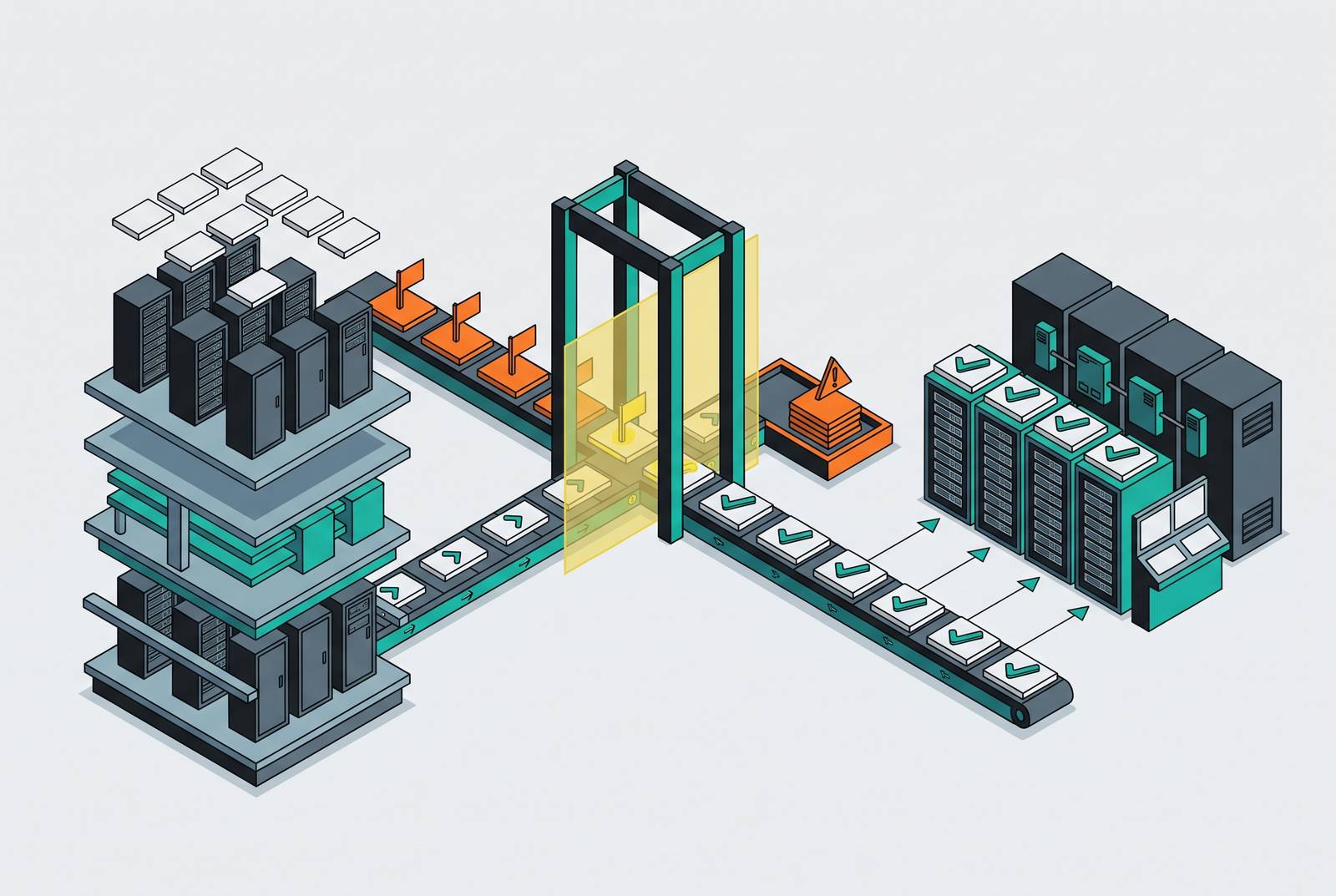
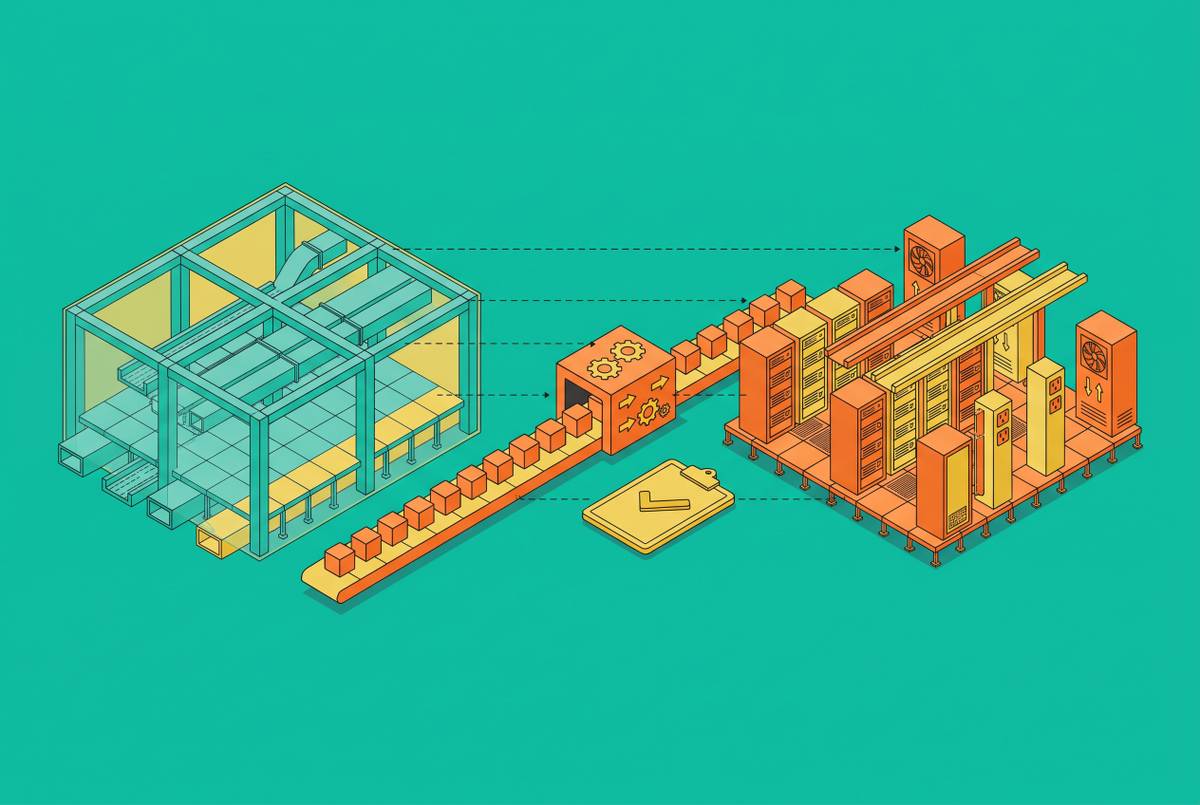
A DCIM-ready BIM handoff requires attribute completeness to be a formal commissioning checkpoint. Teams must define the required data before construction, validate it against installed equipment during commissioning, and reconcile discrepancies before Operational Acceptance. Only field-verified records should cross into the operational baseline, so DCIM reflects the facility as built.
Why BIM data arriving at DCIM import is so often wrong before anyone checks it
On day one of live facility management, an operations team runs capacity planning or reviews a change request against a DCIM record that does not match the floor. A rack has moved, a circuit has been re-routed, or procurement has substituted equipment without the model catching up. The record still looks complete enough to use. That is the trap. Small differences between the design and what was installed add up to a wrong operational baseline.
The consequences extend beyond an inconvenient drawing mismatch. Capacity planning starts from the wrong conditions, while cybersecurity personnel cannot tell exactly what belongs in the asset inventory. Risk management assessors find discrepancies between documented configurations and physical installations. Operations inherits those discrepancies with the facility. Correcting them after occupancy is expensive, slow, and politically difficult when several contractors share responsibility for the build.
The root cause is when the transfer happens. DCIM is commonly treated as an operations tool, so population waits until turnover, after construction. By then, contractors have demobilized and submittals are scattered across project management platforms. The people and evidence needed to explain a substitution or changed connection are harder to bring together. Importing the model at that point transfers unresolved design assumptions into the operational record.
What DCIM actually needs from BIM that BIM alone does not reliably produce
A BIM model built for construction coordination serves a different purpose from an operational asset record. Geometry and clash detection help teams coordinate the build, but they do not show whether the identity, location, and connection data for every installed asset is correct. Those are separate tests of completeness. DCIM needs equipment identity matching, spatial placement verification, and infrastructure relationship validation, each with a defined process, responsible party, and evidence standard.
Equipment identity means confirming serial numbers, model numbers, asset tags, and firmware versions against installed equipment. A specified model number is not proof of an installed model number. Spatial verification has the same distinction. Rack and room coordinates must show where equipment actually sits, and rack elevations must show the installed configuration even where it differs from the design layout. A well-positioned BIM object can still describe the wrong equipment.
Power paths must be traced from utility entrance through switchgear, UPS, PDUs, and rack-level strips to individual equipment receptacles, including breaker identification, amperage ratings, phase assignments, and measured load at commissioning. Network records need cable type, length, color code, port identifiers at both ends, and patch panel cross-connect assignments. These connections give the record its operational meaning. Assuming that BIM, drawings, and DCIM already agree leaves the most consequential relationships untested.
Why schema alignment and naming conventions must be locked in before construction, not after
Before construction begins, operations must help decide which fields are needed and how they map into DCIM, so the model meets those needs as well as the architect’s deliverables. A shared asset identifier must connect each BIM object to its drawing schedule, submittal, and DCIM, EPMS, and BMS records. Naming is not a cosmetic choice here. If those identifiers differ, a translation layer is needed for the integrations, reports, and model references that use them.
Point lists also belong before installation. Each list defines every monitored parameter, its source device, communication protocol, DCIM tag name, engineering units, and alarm thresholds. Writing it after equipment is installed leaves tag names that do not follow the same rules and thresholds that people can set as they see fit. These definitions determine what commissioning can actually test. Without them, teams reach the field with no settled specification for the data they are supposed to validate.
Information Delivery Specification, or IDS, lets teams state which BIM elements must meet which property or value conditions in a form that machines can check. Requirements usually arrive as specifications, design notes, or tabular checklists, and converting them means handling IFC vocabulary, XML structure, and validator conformance together. Ishigaki-IDS research found that assisted authoring reduced aggregate work time by 54.7% compared to manual authoring, showing why preparation of the rules deserves time in the workflow.
How commissioning phases create the natural sequence for progressive attribute validation
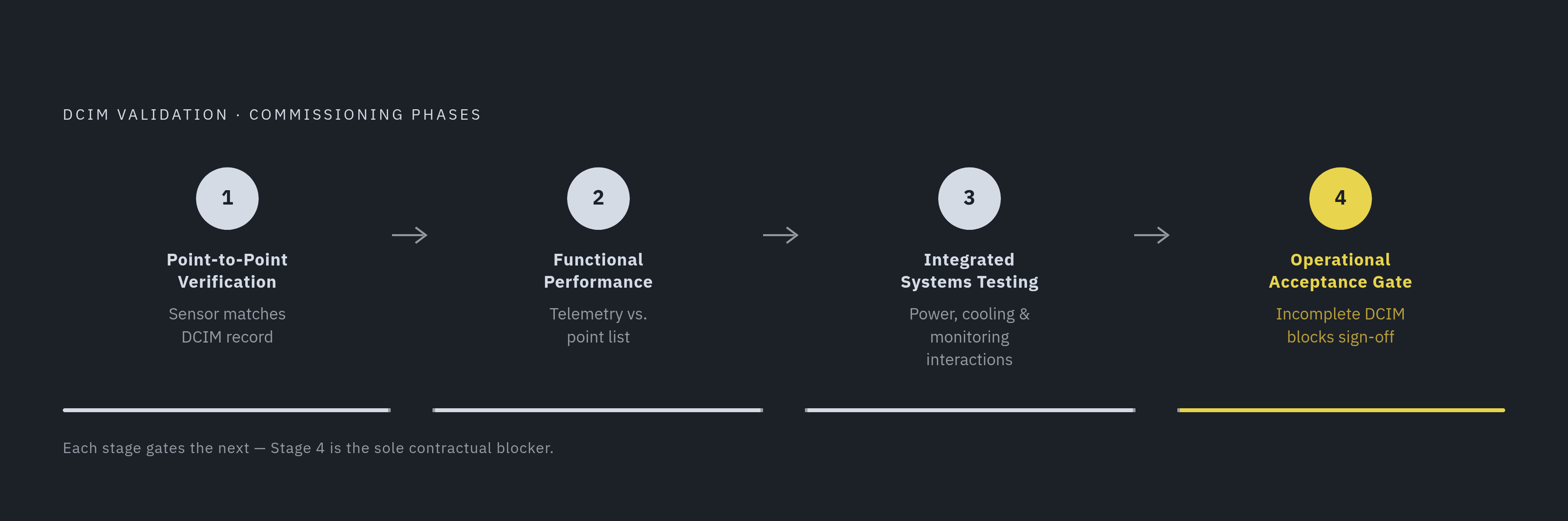
With those requirements fixed, commissioning can validate attributes progressively before closeout. DCIM must be provisioned and partially configured before construction is complete so that field teams have a baseline to compare against installation. Early population creates a working record where teams can add verified changes while contractors are still on site, and each commissioning activity tests something the one before it could not.
Point-to-point verification establishes the first distinction between a connected device and usable operational data. A sensor can be physically wired and communicating without DCIM receiving, displaying, and alarming on accurate information. Both sides need verification. The sensor map and point list provide the basis for checking whether the physical device and its digital representation agree.
Functional performance testing then needs more than confirmation that a point communicates. The commissioning authority needs access to real-time and historical telemetry to assess equipment performance during the test window. Spot measurements are not an equivalent evidence record. If DCIM is unavailable, testing depends on those measurements and manual logs, leaving an evidentiary gap that is especially consequential for thermal performance and power distribution verification. This phase builds on verified points to establish a record of actual performance.
Integrated systems testing checks how power, cooling, and monitoring work together as well as how each piece of equipment behaves. Cause-and-effect scenarios under abnormal conditions test those interactions rather than assume them from separate subsystem results. At the same time, digital commissioning remains a distinct responsibility throughout these activities, because proving that equipment operates correctly does not prove that the model accurately represents it.
Test results should enter DCIM directly during commissioning. That keeps another round of manual entry out of the record. The evidence package should contain the sensor map, point list, alarm validation records, functional performance test data, integrated systems test records, and deficiency log with resolution documentation. Together, these records support the next gate without forcing acceptance reviewers to reconstruct the commissioning history from scattered files.
What the attribute validation checkpoint at Operational Acceptance must actually verify
DCIM database completeness must be a formal acceptance criterion verified before acceptance documentation is signed. Otherwise, operations has no contractual basis for demanding a fully populated and validated system at handover. Commissioned assets in DCIM must be reconciled against commissioning test records and the configuration management database, or CMDB, so that every operationally accepted asset has a corresponding configuration item with accurate attributes.
For each installed piece of equipment, the physical asset record must include manufacturer, model, serial number, asset tag, rack location, rack unit position, installation date, and physical dimensions. Those fields establish what the asset is and where it sits. They are only part of the check. The gate must also verify power paths down to individual equipment receptacles, metering point and sensor assignments, network connectivity, and rack elevations that match the installed configuration. Warranty and maintenance records need start and end dates and the service provider.
Live data requires its own acceptance evidence. Sensor and telemetry validation is what turns a static model into a digital twin that can support operational decisions. Defects and retests must therefore be formally tracked within commissioning, with documented resolutions. A populated field is not proof of accuracy. Undocumented retests leave gaps that complicate warranty work and risk management activities after acceptance.
Discrepancies also need structured classification so that acceptance-blocking corrections are separated from items that can be tracked after occupancy. Cybersecurity review of DCIM data, integrations, and access controls must occur before the platform becomes the operational system of record. Ownership must then transfer explicitly from the construction contractor to operations, with documented responsibilities and a sustainment plan for ongoing change control. This is the handover of the baseline itself. Its accuracy determines how much correction work follows the facility into operation.
How fragmentation across tools makes manual attribute validation structurally unreliable
Doing that workflow by hand is unreliable because parts of the record sit in different tools and with different organizations. Equipment data may be typed from a manufacturer PDF into a BIM object, from a BIM schedule into a submittal, and from an approved submittal into a DCIM import file. Every transfer can drop, rename, or contradict a parameter. A correction in one place does not, by itself, reconcile the other copies.
Organizational boundaries compound the problem. Responsibility assignments among the design team, construction manager, commissioning agent, facilities team, IT operations, and cybersecurity personnel belong before construction begins. Without them, attribute ownership falls between the groups that create, approve, test, and inherit the data. An RFI can expose that gap. When it asks for missing design information during construction, the question is new to the workflow, but the missing documentation predates it.
Acceptance also depends on traceability from design requirements to commissioning test scripts. A test result with no connection to a specified requirement has limited weight in government acceptance review, even if the test itself was performed carefully. Retrospective data entry cannot repair that chain reliably. Once contractors leave, finding the supporting evidence costs more, and teams often cannot recover all of it. Machine-checkable requirements help, but they cannot by themselves govern the disconnected records to which those checks must apply.
What software bridges BIM models and DCIM at project handover
A connected project OS addresses the split record by linking layout, equipment data, power and cooling relationships, and commissioning evidence within a single governed workflow. Such a workflow connects layouts, critical-system coordination, cable routing, documentation, RFIs, and operations-ready handoff, with structured data persisting across the project lifecycle. The distinction from a point tool is structural. A closeout checker can inspect what it receives, but the handoff workflow also needs control over how that information develops and changes.
For a team implementing this workflow, a rack move should cascade changes across power, cooling, cable, and documentation rather than require separate manual edits in disconnected systems. Equipment specification extraction should likewise feed models, schedules, and validation rules directly. Completeness checks need deterministic rules. Rules should apply where precision is non-negotiable and AI where language and flexibility are useful, keeping traceable attribute checks separate from language-based assistance.
The governing record must also keep the evidence behind each RFI answer, design decision, and equipment parameter through test scripts and acceptance. It must support the ownership transfer already defined at Operational Acceptance beyond file export. DCIM still depends on EPMS and BMS data. A connected handoff brings attributes that have been reconciled and relationships that have been verified into those operational systems, giving the operations team a DCIM record it can trust from day one.