Eliminating Manual DCIM Population by Enforcing Structured Data Contracts Earlier in Design
Data contracts set in design let asset data reach DCIM cleanly.
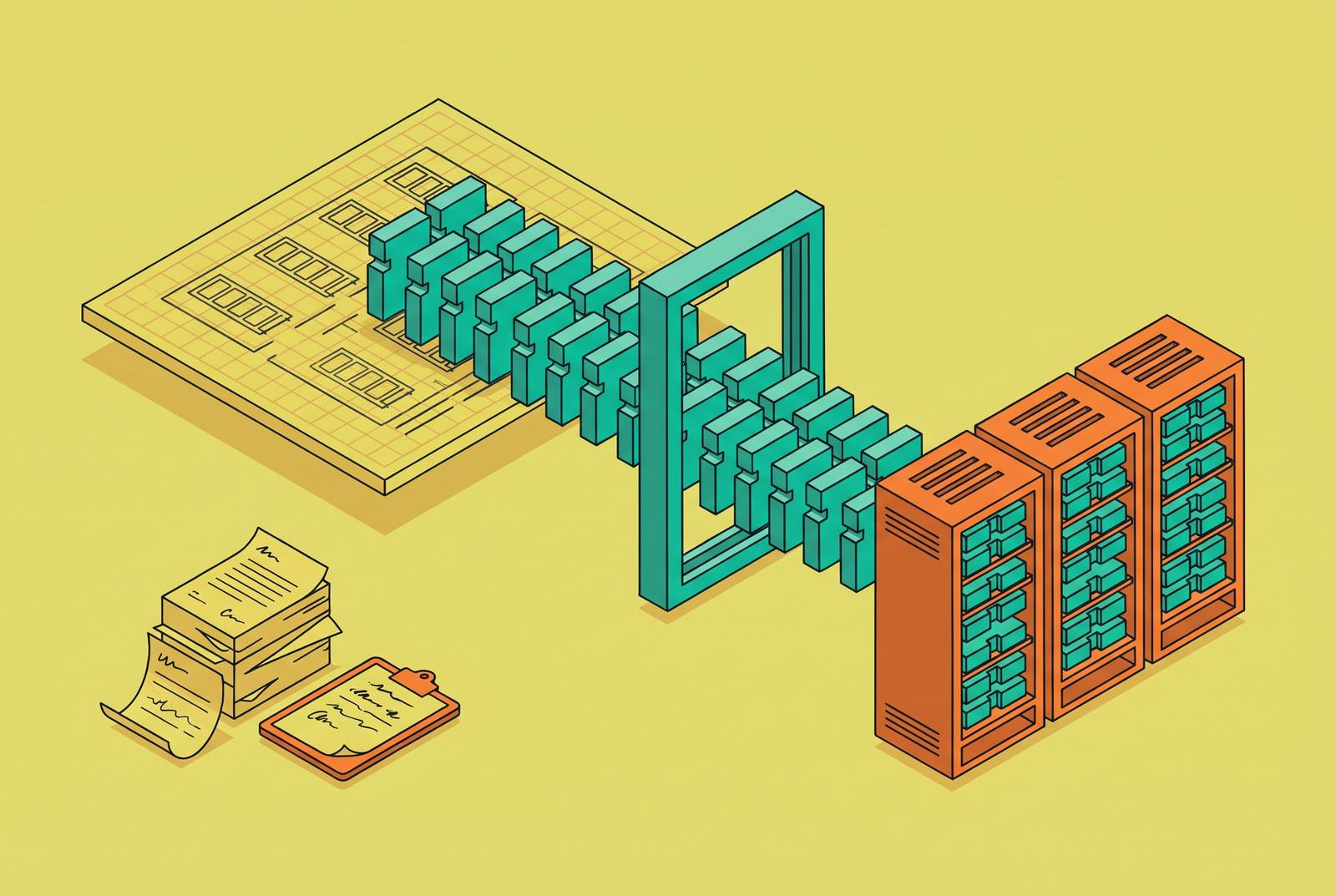
A DCIM-ready BIM handoff requires structured data contracts enforced during design. Those contracts set out the asset identifiers, required fields, verification evidence, and rules for acceptance before the models are built. Connected design automation makes those requirements part of the workflow so structured asset data reaches DCIM, EPMS, and BMS without manual re-entry.
Why DCIM population keeps failing despite better platforms
A build team hands over a populated DCIM, and operations immediately has to re-audit it. Rack locations need to be checked, equipment names do not match the records, and it is unclear what the commissioning status is. Operations' distrust of the platform's data originates before turnover, when the project defers assembling operational data and defining its delivery rules until after design.
In the prevailing delivery pattern, the platform is licensed and installed, then operations staff populate it from as-built drawings after the facility is occupied. By then, construction verification is a missed opportunity. DCIM could have compared planned assets with installed conditions while discrepancies were still part of the build team's work. Instead, operations inherits incomplete asset data, disconnected controls, and weak commissioning records in a facility that is technically complete.
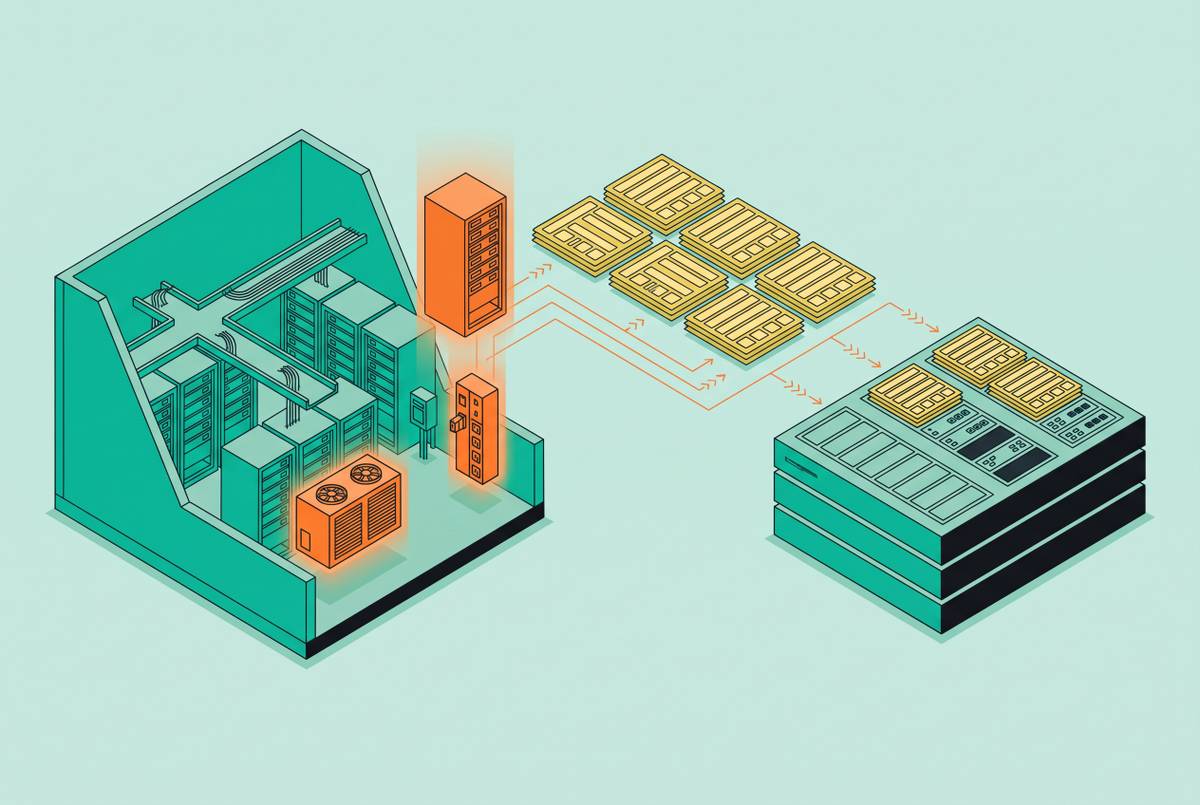
Anchor Defense's federal DCIM guides show how the records drift from what is built during construction. Staged assets end up in the wrong rows, installed configurations diverge from plans, and change orders proceed without DCIM updates. The record falls behind before the first server is powered on. The missing requirement is an enforceable agreement about the data those platforms will receive.
What "structured data contract" means in a data center delivery context
A structured data contract is a formal specification written into project documents and contracts. It defines which asset attributes must be captured, their format, the delivery stage at which they are required, the evidence used to verify them, and who accepts them. Its purpose is to make the operational record a defined project output.
That record spans four connected layers, namely physical assets, systems, capacity, and workflows. The physical layer includes equipment such as racks, PDUs, UPS, chillers, sensors, and network gear, with identifiers, locations, manufacturer and model details, capacity, commissioning status, and maintenance context. The systems layer connects records across BMS, EPMS, SCADA, CMMS, ITSM, and security systems. Capacity data describes available and committed resources, redundancy, breaker loading, and stranded capacity, while workflow data connects incidents, work orders, maintenance windows, and change controls.
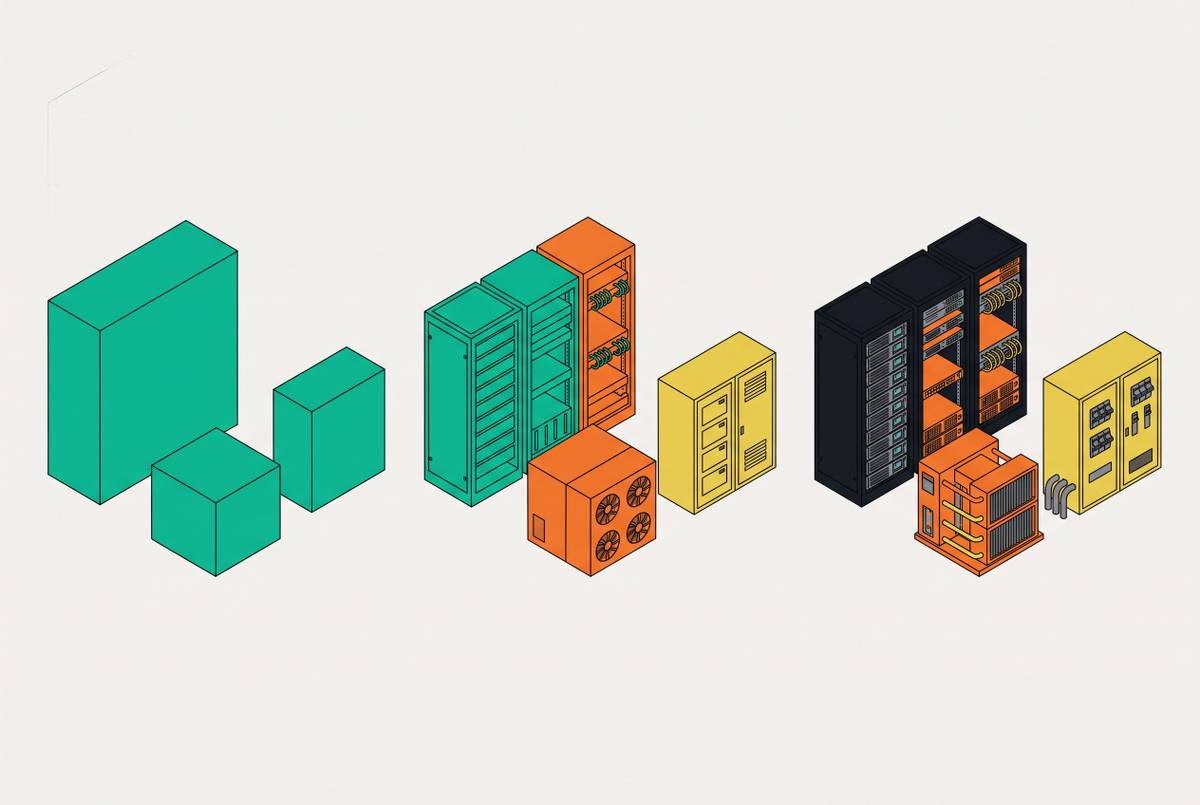
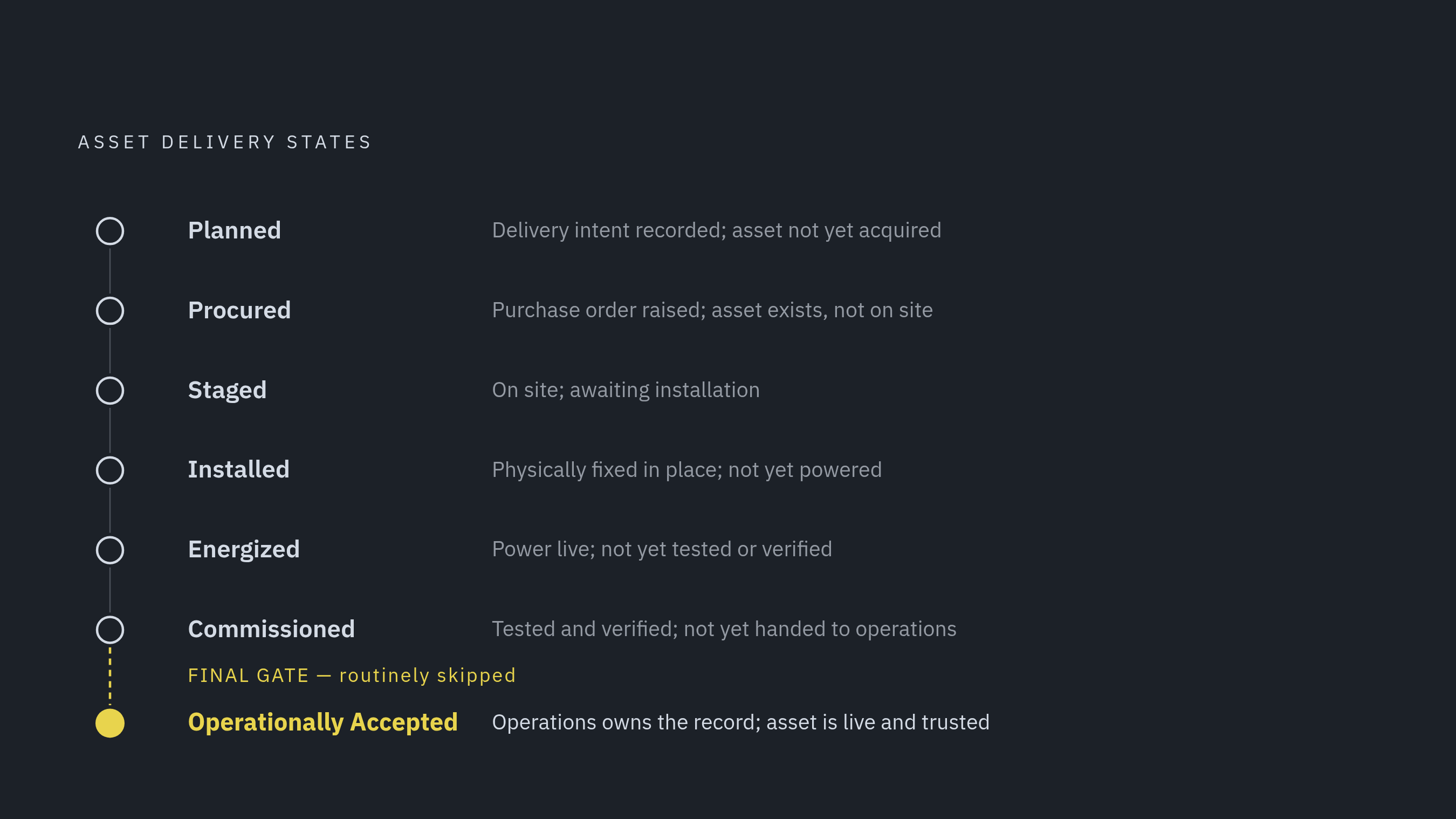
A shared asset identifier binds those layers together. The same identifier connects an object to its drawing schedule, submittal, and DCIM, EPMS, and BMS records. Without it, integration becomes manual matching. Status labels such as “ready” also need an exact meaning. The guides distinguish planned, procured, staged, installed, energized, commissioned, and operationally accepted assets because each state describes a different point in delivery.
Why doesn't BIM alone deliver a populated DCIM?
BIM provides real value in coordination, clash detection, and drawing production. Those functions make it necessary, but not sufficient, for a DCIM-ready handoff. A successful drawing export proves that a drawing can be produced. It does not prove that the model contains the structured information operations needs, or that an export preserves the relationships required by downstream systems.
Only some BIM attributes are useful to operations, and some DCIM fields require sources beyond BIM. Geometry does not automatically establish capacity, commissioning state, redundancy configuration, or circuit assignment. When the handoff specification arrives after construction starts, the integration team may find that the model was built around the architect's deliverables, leaving gaps in the operator's records. Extracting more of that model cannot supply information it was never required to contain.
The problem grows when field decisions outpace model updates. BIM workflows span authoring, coordination, document management, and scanning for progress verification, so strong change control is needed to keep their records aligned. Fast-track schedules make any lag harder to recover. BIM and DCIM schemas need to align before construction begins, while the model can still be built around the operational system's requirements. That alignment defines what comes from BIM and what must be supplied through other delivery records, rather than leaving the integration team to discover the gaps at turnover.
How fragmentation across power, cooling, cable, and fiber compounds the data gap
If the BMS does not sequence cooling recovery in step with the electrical recovery tracked by the EPMS, inlet temperatures can spike during the window the design was meant to protect. The systems are physically coupled, but their delivery responsibilities may not be. The mechanical contractor delivers the BMS, the electrical contractor delivers the EPMS, and the client's IT team buys the DCIM. Integration can fall outside everyone's scope. With separate records, operations then has a harder time seeing how the systems work together across the facility.
Records for cable and fiber have the same gaps. One route appears in the survey file, another in permits, and construction redlines show something else, making re-survey the default at turnover. A single high-density GPU rack may need hundreds of fiber connections for its east–west links, uplinks, storage fabrics, and redundancy paths. The documentation burden grows with those connections. When structured identifiers persist through routing decisions, later moves, additions, and changes remain manageable using the existing records.
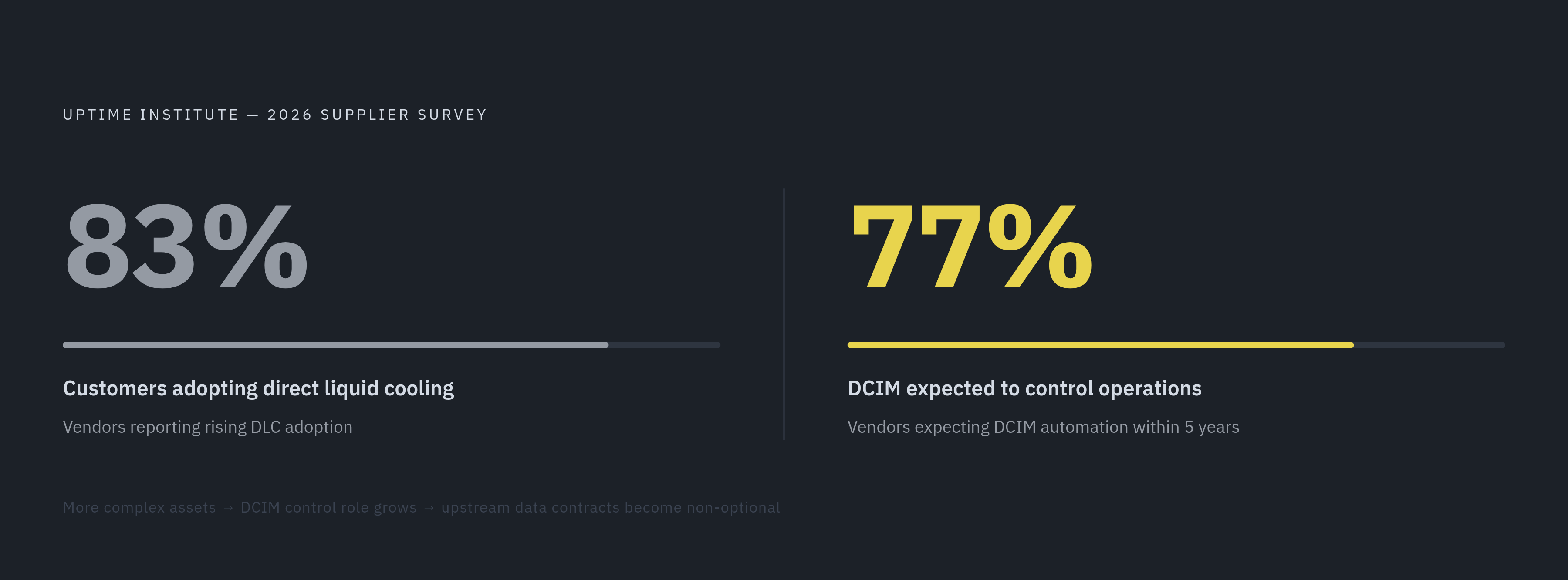
Cooling also makes that shared asset record harder to keep. Uptime Institute's 2026 supplier survey finds that 83% of the vendors who responded say the rate at which their customers adopt direct liquid cooling is rising. The asset layer is becoming more complex. A contract confined to one discipline therefore leaves the underlying problem intact, because operations still has to reconstruct the connections between power, cooling, cable, and fiber.
Where the data contract must live: the design phase, not the handoff meeting
The intervention belongs in acquisition and design, before construction begins. Requirements introduced later cannot retroactively shape a model already built around different deliverables. At that point, the integrator is reconciling independently grown datasets. The DCIM record needs to be part of delivery from the start, with its requirements embedded in both the contract and the design workflow.
The guides set out three states for each space, construction complete, infrastructure ready, and operationally released. These distinct states belong in DCIM workflow, because a finished space requires more than verbal confirmation to be ready for equipment installation. Before an installation work order for rack population is released, power circuit certification, network port assignment, and cooling zone validation must also be confirmed.
Handoff is a formal gate, and DCIM should record who accepted what and which exceptions remained at transfer. Reconciliation with the CMDB and commissioning records belongs at each deployment gate. For colocation operators, this has a direct commercial role. DCIM records what is installed, who owns it, remaining capacity, and network cabling, none of which a BMS handles, making early data requirements a prerequisite for revenue and billing as well as facility management.
What the contract language must specify to make enforcement possible
The contract must name the DCIM model as a deliverable and assign responsibility for each data field. It must also set out how accurate the data for each asset class must be, how it will be checked, what evidence is required, and the acceptance criteria. General promises to provide “complete data” are not enough. Physical surveys, cross-checks of commissioning records, and automated import validation provide clear ways to check the data, while a named party is responsible for keeping DCIM up to date through each phase of construction.
The deployment state model must be a contractual deliverable. The specification should require the states already defined and set out how the record must be updated when field substitutions or scope changes occur. Change control cannot wait for operational acceptance. Moves, additions, and changes during construction need the same rigor as steady-state processes, because construction is already changing the inventory operations will inherit. BIM-to-DCIM schema alignment should also have a defined completion date before structural construction begins.
RFI and submittal workflows need to support that obligation. An RFI that reopens a submittal can delay fabrication and procurement, leaving commissioning records behind the physical installation and passing the gap into DCIM. The objection is predictable and fair. Detailed requirements add procurement complexity and owner-side overhead, but the alternative is reconciliation across every discipline after occupancy, when the facility is expected to be in service. Upstream work can be scheduled within delivery, while late reconstruction competes with live operations.
How connected design automation enforces data contracts without manual discipline
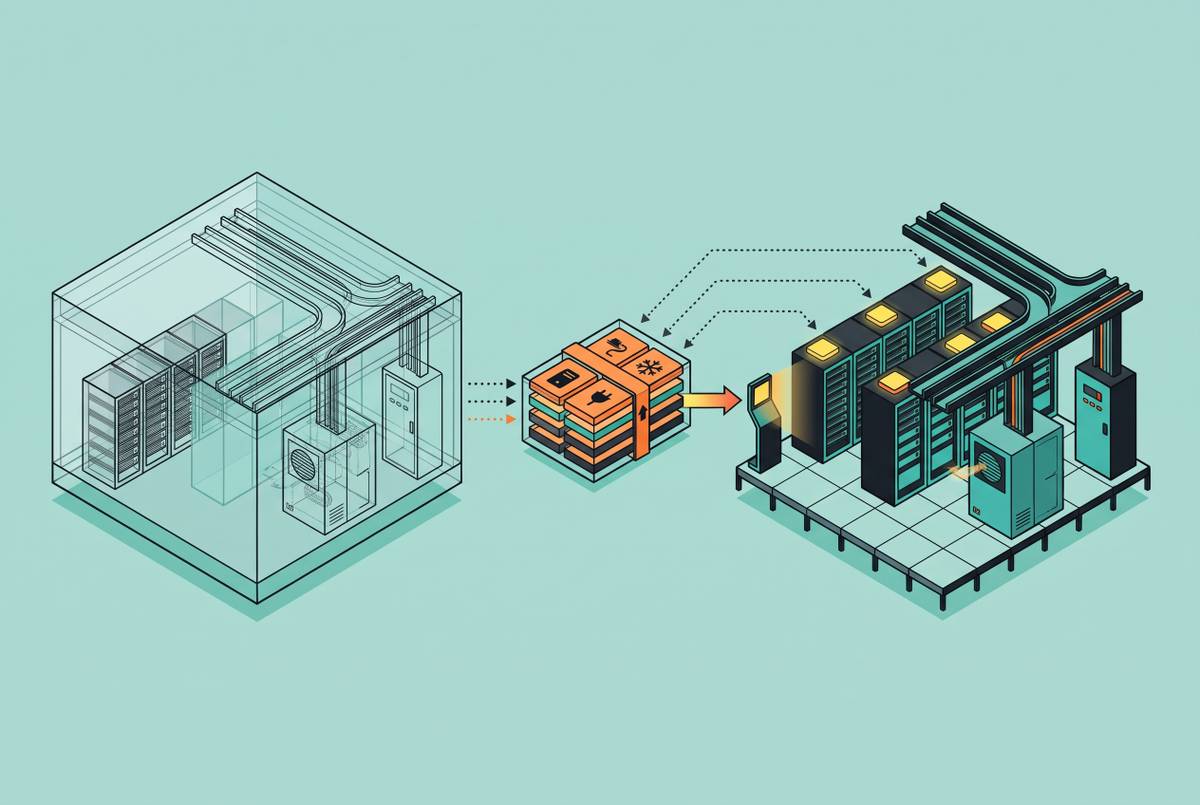
A contract enforced only through human review remains vulnerable to fragmented tools and missed updates. Connected design automation enforces the rules as part of authoring. When a rack move propagates through power, cooling, cable routing, and documentation, the structured identifier stays attached to the change. Each discipline no longer has to recreate that relationship. Validation at the authoring stage can then test required fields before incomplete records reach turnover.
This approach can be put into a connected workflow covering layouts, critical-system coordination, cable routing, documentation, RFIs, and operations-ready handoff. Structured identifiers enforced in design flow through to DCIM, EPMS, and BMS without manual re-entry. This is the bridge between design models and operational records. It addresses more than drawing export by connecting design changes to the structured data required at handoff.
Equipment specifications are another important input to that workflow. Extracting information trapped in manufacturer PDFs into models, schedules, and validation rules removes a source of missing asset attributes. Precision still requires deterministic rules for circuit assignment, nameplate capacity, and commissioning state, while AI supports metadata extraction, coordination gap detection, and pattern recognition. These roles do not replace each other. AI also needs data from enough operating conditions to learn how complex systems behave, so it is less reliable when the data is poor. Early data contracts give automation the consistent records it needs, so it does not have to make up for missing records.
What operations teams receive when the contract is enforced upstream
Operations receives a DCIM record of the commissioned facility. Deployment status distinguishes commissioned equipment from assets that are merely installed. Redundancy states reflect actual circuit topology. Asset identifiers link directly to commissioning records and O&M documentation, so operations has the evidence behind the record without having to match it all up again.
Handoff verification becomes an automated cross-check across asset registers, commissioning scripts, as-builts, O&M manuals, warranty data, and control points. Discrepancies surface and are resolved before operations takes control, eliminating the reconciliation work that otherwise consumes the first months of service. The economics change with that timing. Enforcing requirements upstream is bounded and schedulable, while reconstructing data after occupancy is open-ended and competes with the work of running the facility.
The value extends beyond a cleaner turnover. The same supplier survey finds that 77% of the vendors who responded expect operators to use DCIM for automation and control within five years. Anomaly detection, capacity forecasting, predictive maintenance, and alarm rationalization depend on consistent labels, complete attributes, and connected system layers. Those capabilities need a trustworthy asset record from commissioning onward. A structured handoff is therefore the finish line for BIM delivery and the starting point for operational automation, with clean upstream data becoming more useful as DCIM takes on a larger role in control.