Automating BIM-to-DCIM Data Population at Project Turnover
Setting asset tags and schemas at kickoff turns DCIM turnover into an export.
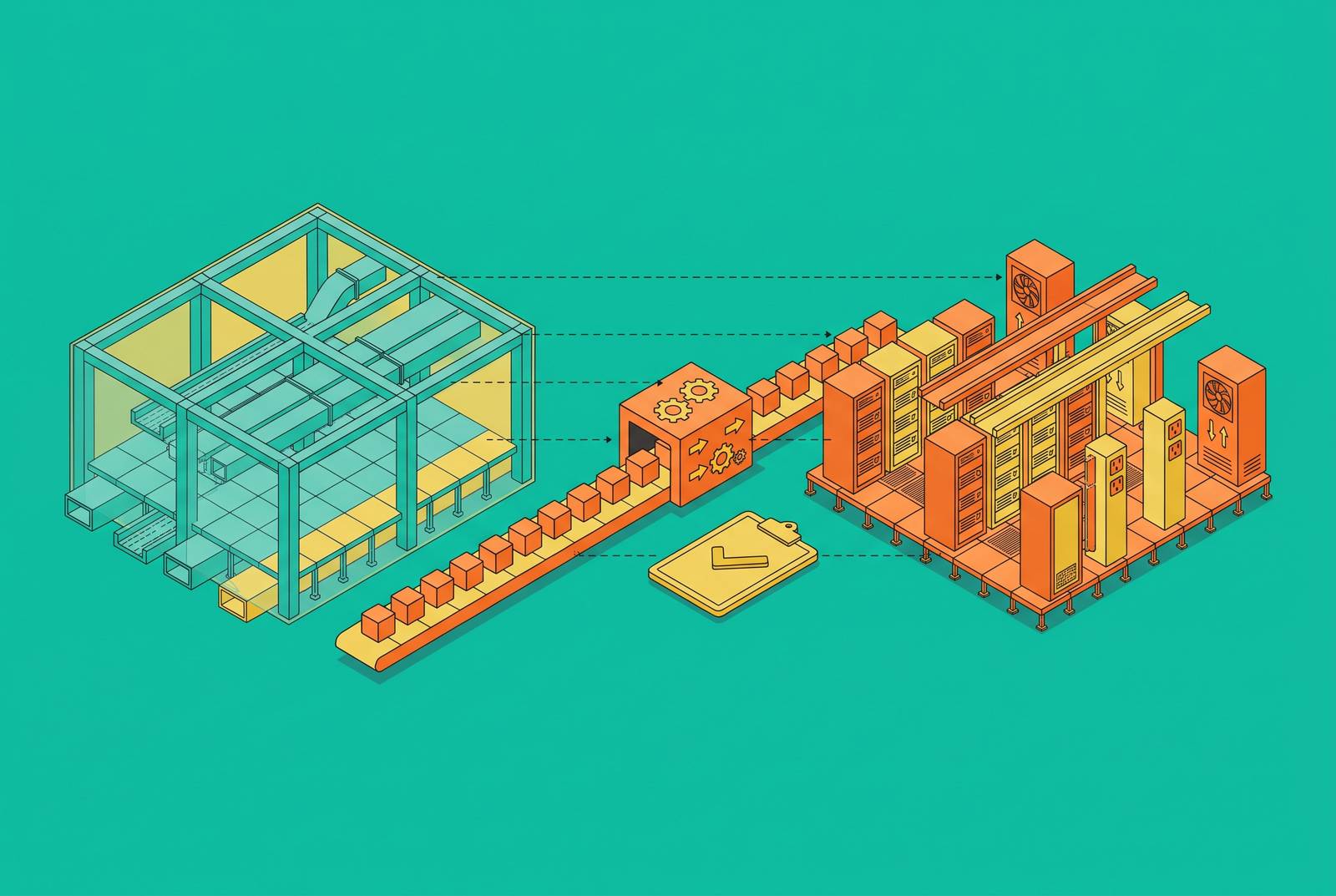
A DCIM-ready BIM handoff from design models to operations starts with a data contract. Asset tags, naming conventions, required parameters, and import formats must be set at kickoff, with automation used to enforce them. That turns DCIM population at turnover into a structured export rather than a manual reconstruction of information the project already captured.
Why the BIM-to-DCIM gap persists despite widespread BIM adoption
BIM can work well enough to coordinate construction and still leave operations without asset records it can use. The model is not the missing technology. Construction BIM and DCIM do different jobs, and their teams work under different contracts. Without a shared schema, a model that satisfies the construction team does not necessarily contain the tag structures and parameters that operational systems need.
The missing agreement is about what counts as a complete delivery. The output format, asset identifiers, and required attributes must be contract deliverables with measurable acceptance criteria. Yet those requirements are almost never written into construction contracts or enforced. Without them, field teams reach turnover and have to reverse-engineer information gathered during design but never put in a form operations could reuse.
What DCIM must absorb at turnover and why incomplete data creates immediate operational risk
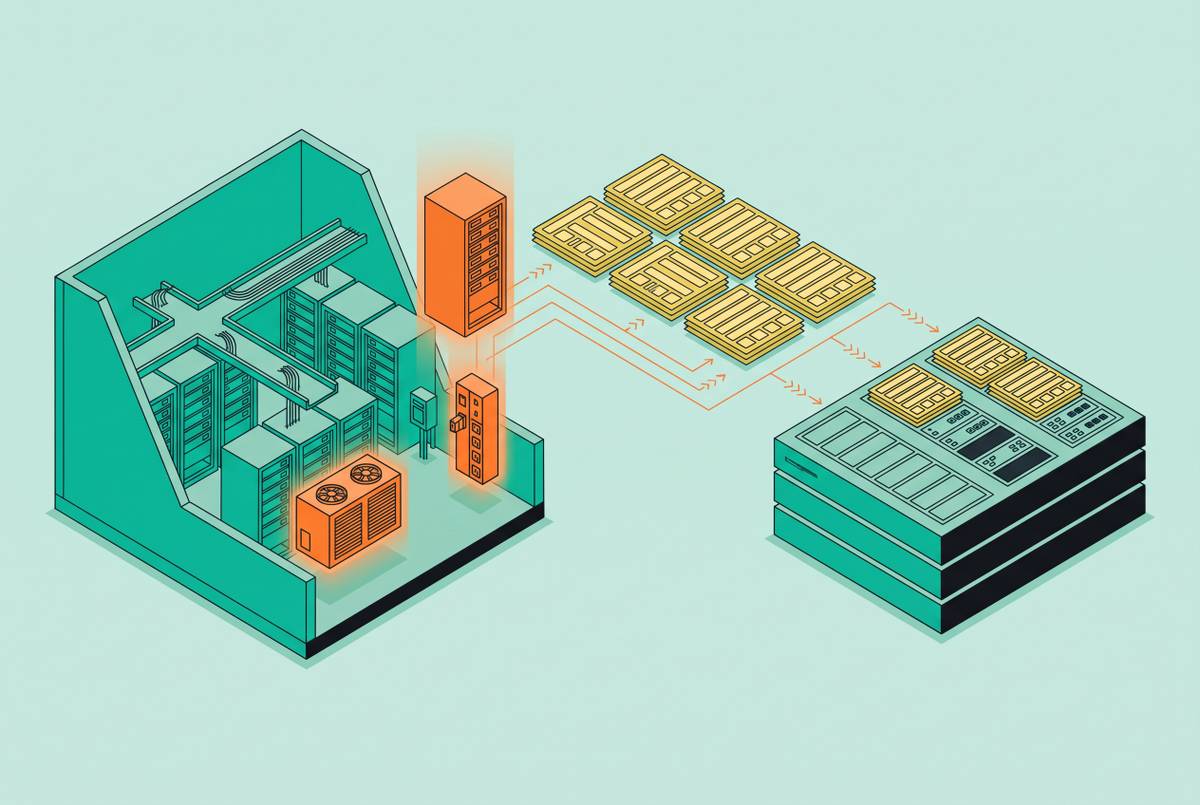
Three platforms used by operations each need data on different parts of what is installed. BMS controls and monitors mechanical and environmental plant, including cooling, airflow, temperature, humidity, and leak detection. EPMS monitors the electrical path from utility incomer to rack. DCIM manages IT assets, rack space, power capacity, and network connectivity in the white space, while consuming data from the other two. Their records must describe the same installed facility.
Those connections are where incomplete data becomes operational exposure. Uptime Institute’s 2025 analysis identifies power as the leading cause of impactful outages. DCIM needs complete, structured data traceable to the installed configuration, with maintenance manuals, installation firmware versions, and recommended service intervals attached or linked to each record.
The handoff must also make the platform usable. Anchor Defense identifies a common mistake in treating DCIM as a project tool handed over without a transition plan, leaving operations without training, administrative access, or a clear understanding of its configuration. Meanwhile, service information is routinely scattered across contractor submittals and becomes difficult to reconstruct after closeout. Treating warranty and lifecycle information as just documents to hand over creates the PDF trap. The files arrive, but the records operations needs still have gaps.
How the capital scale of current data center delivery makes incomplete handoff a larger financial event than it once was
Larger projects turn the same handoff failure into a larger financial event. Manual DCIM reconstruction can delay commissioning, with revenue consequences measured in millions per month for a typical large facility. A procedural weakness becomes harder to absorb at that scale.
The Construction Industry Institute estimates that rework accounts for a meaningful share of total project cost. Data centers compound that burden because one missed change can cascade across power, cooling, cable, and documentation. Each disconnected update creates another opportunity for the model and installed scope to diverge.
RFIs absorb much of that fragmentation first. Navigant Construction Forum’s research puts per-RFI processing costs in four figures, with collective costs on larger projects reaching hundreds of thousands of dollars. Nearly one in four RFIs receives no reply, leaving field teams to work from assumptions. In a critical facility, an unresolved RFI becomes a hold point because power or cooling equipment cannot be released for fabrication until its submittal clears. With large power transformer lead times stretching to 30–36 months, what would it take to prevent this at the source?
What a data contract actually specifies and when it must be defined
A data contract defines what the model must contain for operations to accept it. It moves existing project requirements to kickoff and makes operational acceptance part of the delivery agreement. Asset tagging requirements establish the naming conventions and identifier schemas that DCIM, EPMS, and BMS will use after turnover.
Parameter schemas then define the required attributes for each asset type, including equipment specifications, system connections, clearance requirements, and service data. Those attributes must match what the operational platform ingests. Delivery requirements set out the output format, level of detail, and federated model structure. Acceptance criteria establish measurable completeness checks through structured validation.
Requirements set at handover arrive after teams have built a model that may need substantial revision for operations. Requirements set at kickoff let every discipline work to the operational schema from the start. The same approach incorporates lifecycle data into the model by making firmware versions, maintenance intervals, and service records required model parameters. They travel with the asset.
Where automation enforces the data contract across the construction phase
A kickoff agreement will degrade without enforcement during construction. When time is tight, teams skip parameters, reuse off-schema tags, and leave attributes blank. Deterministic rules keep that drift in check by using the same checks for naming conventions, tag structures, and completeness across all assets. These checks do not need interpretation or judgment. A required identifier either meets the agreed structure or it does not.
AI has a different job in this workflow. It can prioritize clash registers by likely impact, flag assets likely to lack required attributes before a formal audit, and surface constructability risks that fixed checks cannot anticipate. Rules enforce the contract, while AI helps direct attention under ambiguity. That distinction keeps acceptance requirements from depending on variable interpretation.
Model auditing, parameter population, quantity extraction, and documentation workflows are already being automated within construction. But operational population still requires transformation into the receiving systems’ tags and schemas. When a GC and a mechanical subcontractor use platforms that do not connect, someone must re-key data each time the work changes. Each time someone transfers data by hand, it can stray from the agreed structure. AI gains value from trustworthy structured data, but it cannot substitute for that foundation.
How AI workload density is changing the scope of what the data contract must cover
With AI workloads, a mixed-density facility needs more than a single enterprise-hall schema. Traditional racks draw between 7 and 15 kW, while AI training clusters demand 40 to 100+ kW per rack. Those differences change the assets and relationships operations must manage. The contract must match how the hall is actually configured.
High-density training halls contain tightly synchronized GPU clusters, while lower-density inference zones have different cooling profiles. Traditional enterprise workloads have familiar power envelopes, and expansion shells leave room for future hardware generations. Some assets therefore exist in the model before they exist in reality. Each hall type needs its own power, cooling, and cable-routing parameters, all within the same asset schema.
Advanced architectural workflows let teams test structural changes while the layout engine calculates downstream effects on rack spacing, raised-floor configurations, and overhead containment. If those tools are connected to the contract schema, layout changes can propagate automatically to the asset records DCIM will eventually ingest.
How do teams get structured BIM asset data into DCIM without manual re-entry?
At kickoff, the DCIM asset schema, tag conventions, and required parameters become project deliverables. Acceptance criteria go into the contract before modeling starts. During design, parametric tools generate hall configurations against that schema, with rack types, power envelopes, and cooling assignments established from the start.
Construction coordination then tests that structure at every model update. Deterministic rules check that naming is correct and data is complete, while AI-assisted clash detection helps teams review issues likely to have a greater impact. The two forms of automation serve different purposes.
As commissioning approaches, the coordinated model provides equipment locations, system boundaries, and test point access for planning. The commissioning scope can be checked against the installed scope without manual reconciliation. At turnover, the structured asset export passes the agreed acceptance checks before handoff. Operations receives populated DCIM records with linked maintenance information, firmware versions, and service intervals. Prefabrication follows the same underlying discipline, since fabrication tolerances also depend on accurate models and controlled changes.
Where ArchiLabs Studio fits in this workflow and what a connected project OS changes for design and operations teams
ArchiLabs Studio Mode is built as a central operating system for data center projects. It connects layouts, critical-systems engineering, cable routing, documentation, RFIs, and operations-ready handoff within one workflow. That addresses the fragmentation that otherwise forces teams to re-key information between disconnected tools. The data contract can be enforced where the work happens.
The change can propagate across power, cooling, cable, and sheets rather than requiring separate manual updates in each downstream system. Studio Mode applies AI to creative and responsive work while using deterministic rules where precision and compliance are non-negotiable.
The same connected approach extends to equipment information and handoff. Data extracted from manufacturer specifications flows into models, schedules, and validation rules, with structured handoff to DCIM, EPMS, and BMS as the intended endpoint. RFI and submittal traceability connects design decisions and equipment parameters to their supporting information. That makes the handoff package auditable. The platform provides a connected environment for enforcing the owner’s definition of acceptable data throughout delivery.
What project teams should specify before the first model is authored
For design firms and owner-operators, the practical starting point is to define operational requirements before BIM authoring begins. Teams should identify the DCIM, EPMS, and BMS platforms and obtain their asset schemas, required parameter sets, and import specifications before writing the BIM Execution Plan. Naming conventions and tag structures should become contract deliverables with measurable acceptance criteria. An appendix of guidelines is not enough.
The specification should also name the enforcement work. Teams should define which parameters deterministic rules will validate at each model milestone and who must resolve failures before the model advances. Warranty information, firmware versions, and service lifecycle data should be required model parameters rather than separate documentation deliverables. The DCIM transition needs explicit deliverables too, including training, access provisioning, configuration documentation, and a support model for the first year of operations.
This adds specification work to the design contract. The added work is smaller than rebuilding the operational record at turnover, especially as project scale and asset complexity grow. Teams with disciplined prefabrication workflows already govern models closely enough to support fabrication tolerances. Extending that governance to operational handoff means applying an existing discipline to a different output. Archil Labs, a Y Combinator-backed maker of an AI teammate for Revit and AutoCAD, works on keeping native models structured enough to feed operations.