Cross-Discipline Coordination Automation for Electrical Mechanical and Structural Data Center Design
Shared structured data lets all three disciplines catch conflicts early.
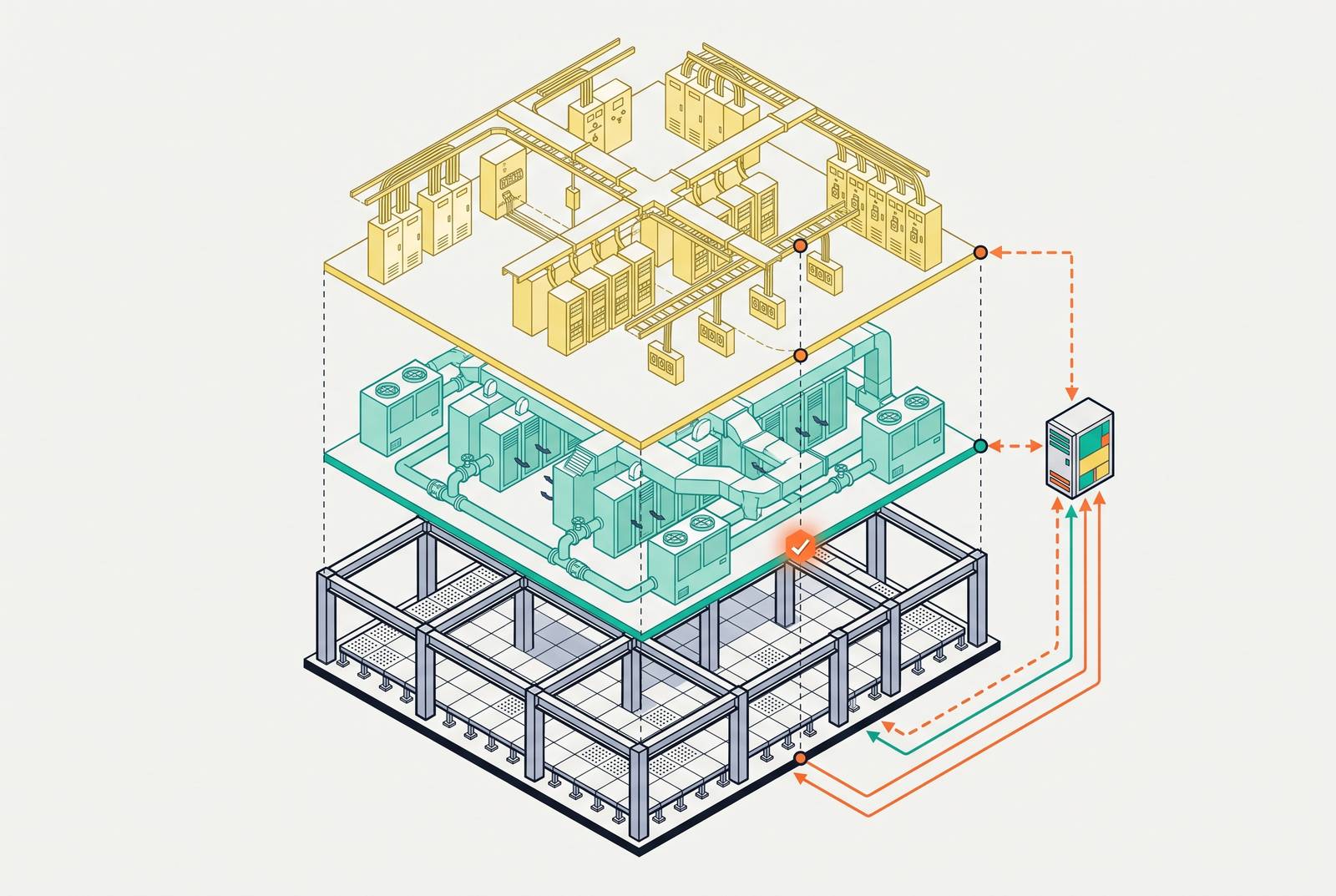
ArchiLabs Studio is a data center design automation platform for critical-facility engineering teams that connects layouts, critical-systems engineering, cable routing, documentation, RFIs, and operations handoff in one workflow. The central requirement is shared, structured data across electrical, mechanical, and structural design. Automation lets those disciplines work together in parallel, so they can see how their decisions affect each other before it is too late.
Why cross-discipline coordination in data center design fails at the workflow level, not the people level
In sequential design, one discipline makes decisions before another can test what they will do. Mechanical teams establish cooling requirements, electrical teams work out supply, and structural teams receive loads and equipment locations after much of the design has hardened. Each team can do competent work within its scope. The gaps still accumulate between them. Coordination then becomes a process of undoing decisions.
Technology disciplines expose the same weakness. Rack layouts, structured cabling, and network rooms have traditionally been scoped after mechanical and electrical systems are set, even though they affect both. Structural teams often join later still, when construction documents or submittals are underway and schematic design is already over. HKA's 2026 predictions warn that pressure to build fast will clash with the need to coordinate work carefully, raising risks at structural and MEP interfaces. Faster individual work does not fix that sequence.
Higher rack density removes the room for compromise. Design West Engineering's 2026 analysis describes AI factory builds that aim for 100+ MW IT load and need major changes to their thermal, electrical, and structural infrastructure. The NVIDIA GB300 NVL72 rack-scale system draws 132–142 kW per rack and weighs approximately 3,000 pounds. Those specifications tie the needs for power, cooling, and support together, so the teams must design them together.
The schedule leaves little room to recover. Lead times for generators, switchgear, transformers, and cooling systems often reach 12–18 months. If an interface failure emerges at submittal stage, correcting a drawing cannot recover the procurement time already committed. The workflow has to expose dependencies while the affected decisions remain open.
Where the cascade actually starts: the mechanical-electrical interface
Cooling load and electrical load depend on each other, but separate teams often design them from separate assumptions. Cooling towers, pumps, and distribution piping need to be sized with electrical capacity. Electrical design, in turn, must separate critical IT circuits from mechanical circuits so that controlled load shedding is possible. Neither discipline can simply finish first and hand over. The dependency runs in both directions.
Liquid cooling makes that dependency more demanding to build. Direct-to-chip and liquid immersion cooling introduce tighter piping tolerances, more extensive pressure testing, and installation coordination between mechanical trades, controls teams, and IT vendors. Those interfaces cannot wait until commissioning to be resolved. A cooling choice changes more than the mechanical drawing. Its construction requirements have to fit the electrical layout and the installation sequence.
At site scale, the same conflict becomes spatial. ATK Energy's 2026 EPC guide describes the need to coordinate medium-voltage distribution pathways with mechanical cooling loads during site layout. Cable runs, cooling towers, IT buildings, and staging areas compete for space. The choice between one large dedicated substation and multiple smaller substations also affects how teams coordinate mechanical work and how much the site can expand later. That choice needs to reach the disciplines together, while they can still shape the site around it.
Late additions make the consequences harder to contain. Battery Energy Storage Systems add structural loads and need fire safety design and specialized electrical sequencing, so planning for them late can add several months to the critical path. Fiber and cable routing repeat the pattern at a smaller scale. When those routes follow MEP design rather than inform it, penetration conflicts, fire-rated pathway separations, and cooling obstructions become submittal-stage problems.
Structural coordination treated as downstream creates the most expensive late-stage failures
Equipment weight, cooling plant size, and site footprint all depend on decisions made elsewhere. Yet structural teams often receive those decisions after they have been made. At AI-density loads, that order is untenable. Some consequences are physically irreversible once construction fixes the design.
Design West's analysis describes fully loaded GPU racks concentrating approximately 3,000 pounds in under 7 square feet. Those point loads are close to twice what standard raised floor panels can hold, which helps explain why high-density AI environments are moving away from raised floors. The resulting slab-on-grade decision belongs in the first phase, before structural design is locked.
AI factory builds need larger chiller yards, floors that can carry heavier loads, and much larger site footprints. Mechanical and power decisions therefore establish structural conditions that cannot simply be absorbed without redesign. Cooling topology also depends on operational resilience. Redundancy policy helps determine the optimal subloop configuration, so structural and mechanical co-design must account for how the plant is expected to operate and where its equipment fits.
HKA says structural delivery risks remain high because the industry lacks skilled people and traditional procurement leaves gaps in scope. These shortages and gaps make the sequencing failure worse. When the workflow does not require early structural participation, a shortage of experienced structural-MEP coordinators leaves the interface unresolved. Resolving that interface requires earlier co-design.
What connected, parallel workflows require: shared structured data across all three disciplines
Parallel work only helps when the disciplines share the information that governs their decisions. Otherwise, three teams working at once produce three sets of inconsistencies faster. Electrical, mechanical, and structural teams need to read from and write to the same structured data. Shared timing is not shared design intent. Equipment identities, loads, connection points, and routing assumptions must remain connected across the work.
BIM provides valuable geometric coordination and supports automated clash detection before fabrication. That does not, by itself, create a continuous data pipeline into downstream systems. Teams often move design information through IFC or COBie exports that they then have to import into other systems. Teams also put electrical rooms, cooling plant, and white space halls in separate models that reference one another. That cuts model overhead but puts version control at risk wherever one model references another.
An equipment identity needs to agree across BIM, BMS, EPMS, CMMS, drawings, and commissioning scripts. If each discipline uses its own naming conventions, someone still has to reconcile the names by hand before anyone can trust the combined information. Cable schedules, equipment datasheets, test records, and drawings must also use that same identity. A shared model is useful only if its parts refer to the same equipment.
Prefabrication makes this a schedule requirement. A rack module, power skid, and cooling assembly may be fabricated concurrently by different vendors. A change to electrical routing, structural attachment, or a cooling connection point must reach all three immediately. PDFs cannot provide that propagation.
How automation resolves coordination failure: rules-based propagation versus AI-assisted review
Automation needs two distinct mechanisms because coordination contains two different kinds of work. Some consequences are calculable and must follow explicit rules. Other tasks call for reading through large amounts of information to find cases that need judgment. These jobs should not be confused. A system becomes unsafe when it treats an exact constraint as a likely answer, and unhelpful when rigid rules are asked to interpret ambiguous documents.
A rack move illustrates the deterministic side. When the move changes power load, the consequences must propagate to panel schedules, cable routes, cooling zone assignments, and structural point-load calculations. The relationship comes from an encoded rule. Electrical separation requirements and fire-rated pathway separations also need to be followed exactly. Their enforcement cannot depend on a probabilistic approximation.
Rules also support decisions before construction fixes them. The Frontier supercomputer co-design research evaluates cooling subloop configurations against energy, cost, carbon, and reliability objectives. Because that topology is expensive to retrofit, systematic evaluation belongs in greenfield design. Automation makes the options available for engineering judgment. It does not choose the project's resilience priorities on the engineer's behalf.
AI has a different role in review. Comparing BIM model data with equipment schedules can identify mismatched tags, quantities, and specifications before a purchase order turns an assumption into an expensive delivery. AI can also flag structural consequences of MEP decisions for early review. Its useful output is a case for a person to examine.
ArchiLabs Studio applies this distinction to its workflow. Deterministic rules govern power allocation, cable routing, and compliance constraints, while AI supports specification extraction, submittal review, and documentation. Engineers make the decisions, while automation removes the burden of manually propagating their calculable consequences.
RFI and submittal volume as a measure of coordination failure — and what automation changes
High RFI and submittal volume signals unresolved design interfaces. When disciplines hold different assumptions about equipment specifications, penetration locations, or rack loads, the field has to ask which assumption governs. By the time that question comes, the chance to coordinate the work at low cost has passed. Faster document processing helps with the response. It does not remove the conflict that generated the request.
A submittal rejection cycle can consume more than five weeks through the RFI process, revised submittal preparation, and a second review. That burden multiplies across the dozens of RFIs a complex data center project generates. For hyperscale facilities that regularly surpass $1 billion in capital expenditure, the exposure is not merely administrative. Ready-for-Service date certainty is at stake. Modular delivery sharpens that risk because unresolved interfaces surface during installation and commissioning, when separately fabricated assemblies must finally meet.
Connected automation changes where the conflict is resolved. When rack layouts, power allocations, cooling zones, cable routes, and structural point loads share a model with propagating rules, their inconsistencies can surface during design development. That is the upstream contribution. AI can then accelerate intake, log maintenance, and closeout for the RFIs that remain, rather than serving only as a faster processor of avoidable questions.
Resolution also needs a traceable thread. RFIs, submittals, and change orders are often managed separately, so a submittal change can lose its connection to the decision and cost that follow. Every RFI answer, design decision, and equipment parameter must remain traceable to its supporting information. That link connects coordination automation to RFI management. When a field question does arise, its answer can rest on documented design intent.
Operations-ready handoff as the finish line for cross-discipline coordination
An accurate building with an incomplete operations handoff is still an unfinished coordination job. The same fragmentation that forces discipline teams to reconcile designs can force operations teams to reconstruct asset information after turnover. Moving that burden downstream puts the problem where correction is harder and more costly.
Approved and as-built drawings, single-line diagrams, mechanical schematics, point lists, cable schedules, and commissioning records must connect to consistent equipment identities. BMS, DCIM, and EPMS need usable structured information. Commissioning results captured only in PDFs require manual re-entry into operational systems, recreating the manual work the connected design workflow was meant to remove.
A live connection between design models and operational dashboards is the emerging goal. Adding equipment in BIM and automatically updating DCIM capacity metrics, with changes also flowing back, describes the direction of travel. Integrating BMS and EPMS data further supports a centralized view from the building down to electrical components. That depends on consistent structure from the earliest project phase.
ArchiLabs Studio's project operating system approach connects design, documentation, RFIs, and operations handoff within the same workflow. The data that supports parallel electrical, mechanical, and structural coordination is also the data needed to populate operational systems at turnover. The finish line is reached when operations can use that information without rebuilding the connections that design should already have established.