What Hyperscale and Colocation Engineering Teams Actually Use to Automate Critical-Facility Design
A connected design stack matters more than any single tool's automation.
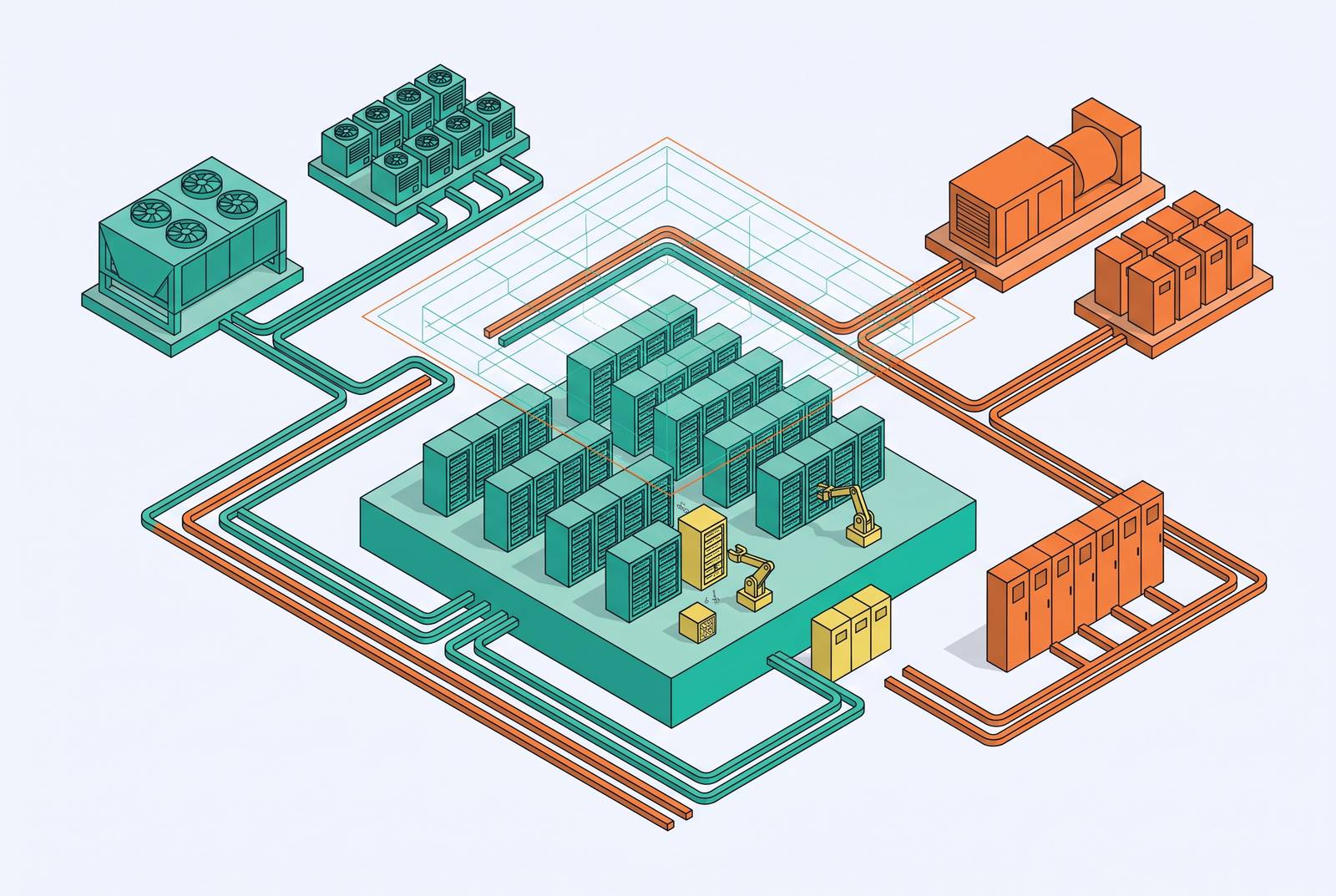
Data center design automation for critical-facility engineering teams is a connected stack. Teams use parametric layout engines, AI-assisted model population, deterministic coordination rules, and structured handoff platforms because each helps with a different risk to delivery. ArchiLabs Studio is designed to connect those layers across the project. The central distinction is not how much a tool automates, but whether its output reaches the next stage without being rebuilt.
Why hyperscale and colocation teams are rebuilding their design workflows from scratch
Traditional construction timelines of 18 to 30 months from groundbreaking to commissioned capacity were already tight. Power delivery delays, permitting constraints, and a shortage of hundreds of thousands of skilled trades workers leave less room to recover from design errors. Meanwhile, AI-driven demand and plans for hyperscale campuses have made data centers more like transport or utility infrastructure in their size and the pressure to deliver them. The old workflow has little slack left.
Lead times have extended sharply for MV switchgear, generators, chillers, CDUs, UPS, and PDUs, so design decisions directly affect when equipment can enter fabrication. A design team cannot leave procurement for later while it rebuilds the same information in models, spreadsheets, and PDFs. Those sequential steps are both slow and difficult to trace. Teams are therefore assembling connected stacks rather than buying isolated efficiency gains, because fragmentation has become a primary delivery risk.
What software do engineering teams use across a critical-facility project?
The stack starts with layout and capacity planning, then moves into 3D model population and coordination. Critical-systems engineering addresses power, cooling, and fiber, while RFI and submittal management spans the delivery sequence. Structured handoff connects the resulting design and commissioning information to operations. Each layer solves a different breakdown point.
That distinction determines which kind of automation belongs where. Layout tools need to keep up with rapid density changes, AI can speed up model population, and coordination and compliance checks need deterministic rules. Handoff needs structured, tagged asset data. ArchiLabs Studio is designed around this connected-stack approach, bringing layout, critical-systems engineering, cable routing, documentation, RFIs, and operations handoff into one workflow. Otherwise, information passes from tool to tool and can fall out of date, become incorrect, or get lost along the way.
Parametric layout and capacity planning tools: what they do and why static templates fail
Requests for design loads above 100–200 kW per rack are becoming common. At those densities, a rack layout is also a power, cooling, and structural decision. Black & White Engineering's 2026 analysis notes that cooling systems, power distribution, and structural layouts are being adapted to handle the added weight, heat, and cabling complexity. Capacity planning has to account for space, power, cooling, and weight together.
A static template preserves an arrangement while leaving out the constraints that made it workable. When hardware changes, the team has to reconsider those constraints and redraw the layout manually. Parametric engines instead encode the rules governing placement and capacity. DCIM platforms also help teams plan racks and rows and place equipment, while AI agents do the placement tasks that repeat. These tools help teams plan the layout before they start detailed model population.
ArchiLabs' data hall layout generation uses parametric rules for density, clearance, and systems constraints, so a rack-load change propagates through power, cooling, and structural planning. The objection is reasonable. Defining those constraints upfront takes work while design intent may still change. But changing explicit rules is more traceable than repeatedly redrawing static layouts, and the manual alternative is slower precisely when hardware changes force repeated revisions.
AI-assisted model population: where speed gains are real and where they are not
E-J Electric's work on hyperscale data centers shows how AI-assisted electrical model population speeds up work at production scale. The gain is limited to that phase. Initial population models inform materials procurement, logistics, fabrication, and installation planning, so completing them sooner can bring prefabrication releases and field mobilization forward. That is a practical scheduling benefit. It does not mean the generated model is ready for fabrication without further work.
Tom Kregel, EVP at E-J Electric, says automating time-intensive modeling tasks lets teams “focus on coordination, shop drawings, and prefabrication” and “deploy larger numbers of field craft earlier in the project”. Augmenta describes electrical system design as “the hardest discipline” for large-scale mission-critical projects. The work it has shown is demanding, but results for every other building system have yet to be established.
Engineering review and coordination still precede fabrication release. Whether faster population saves time depends on the quality of its output and how that output feeds into those workflows. Augmenta's roadmap includes expansion from electrical to full MEP/S system automation, but that remains a future state. AI fits model population because the work is high-volume and pattern-intensive.
Deterministic coordination engines: why rules, not AI, govern power and cooling routing
A clearance violation, an undetected conflict, or a missed redundancy path can force rework that a compressed schedule cannot absorb. Liquid cooling for high-density GPU racks also changes the mechanical architecture of the facility. Electrical distribution, cooling distribution, and structural loading therefore need continuous coordination, rather than a final clash-detection pass after separate designs are complete.
This is where explicit rules take precedence over AI inference. A deterministic engine checks the design against defined requirements rather than inferring an acceptable answer from patterns. Fragmented BMS, EPMS, SCADA, and DCIM data can pass errors into AI systems trained on those portfolios. Rules do not depend on training data quality, though the underlying design information still needs to be complete.
A single facility can house hundreds of thousands of fiber connections, and manual connector inspection does not scale to deployment timelines. Automated pass/fail analysis against IEC 61300-3-35 criteria is the standard for fiber connector end face inspection, which is a separate task from route coordination. ArchiLabs applies the same rules-first principle to power, cooling, and cable routing, with rack changes cascading through the connected system instead of requiring separate manual revisions across disciplines.
BIM workflows in data centers: where they stop and where automation must continue
A coordinated BIM model is not automatically fabrication-ready or operations-ready. When routing is dense, systems are redundant, clearances are strict, and hanger counts are high, small modeling gaps can cause long delays in the field. Rework from those gaps is a substantial productivity drain. The failure is that the workflow can stop before the model supports the next task.
That workflow commonly spans Revit for authoring, Navisworks or BIM 360 for coordination, Bluebeam or Procore for document work, and scanning tools for progress verification. Each serves a distinct purpose. Information can be lost between them unless exchange formats and processes are carefully managed. Cooling simulation also runs alongside BIM rather than inside it, creating a coordination risk when thermal and mechanical decisions do not reach the design model.
Where operational BIM is an objective, the model format, asset tags, and data requirements for the operator's CMMS and DCIM systems belong at project kickoff. Developers are also standardizing assemblies and using connected workflows to make models fabrication-ready earlier. ArchiLabs takes that approach beyond clash detection by linking layout, cable routing, and documentation to the same structured dataset. Design decisions can then update the shared record and keep separate tools aligned.
RFI and submittal management: how unresolved information becomes a procurement crisis
An unresolved RFI can be a fabrication hold point. Power and cooling equipment cannot be released for fabrication until its submittal clears, so an RFI that reopens a submittal directly delays procurement. That delay lands in a market where equipment lead times are already measured in months. Rejected submittals add weeks, and those weeks can push long-lead gear back by an entire production cycle.
The exposure grows with the volume of unresolved information. Large data center projects generate many RFIs, closure times are long, and a significant share receive no reply at all. Costs add up fast when those gaps block fabrication or procurement. A low-dollar clarification can still be high-risk if it prevents electrical energization or integrated systems testing. Ranking questions by their apparent financial size alone misses that dependency.
The appropriate workflow links RFIs, submittals, and change orders in one traceable record. AI-assisted risk scoring can assess schedule impact, procurement impact, cost exposure, commissioning impact, and downstream coordination risk. That gives the team a basis for distinguishing routine clarification from a delivery hold. ArchiLabs connects RFI answers directly to the design record so decisions remain traceable to their supporting information. The benefit is preserving what was decided and why, rather than leaving an answer disconnected from the design it changes.
Operations-ready handoff: what structured asset data looks like and why most projects fall short
Operations systems need more than a finished model. DCIM holds the asset register, rack elevations, power chain, and capacity model for the white space, and reads live data from BMS, EPMS, and intelligent PDUs. It does not control equipment or replace the BMS. A typical setup for operations also has a layer built for cooling optimization and a system for electrical power monitoring, and each system needs its own structured inputs.
The handover package therefore extends well beyond approved and as-built drawings. It includes single-line diagrams, mechanical schematics, BMS/DCIM and EPMS point lists, cable schedules, equipment datasheets, and testing and commissioning records. Load-bank tests, failure-scenario tests, and snag closure records belong with fire-system drawings, network diagrams, and security-system layouts. The gap appears when the documents exist but their equipment identities and operating information cannot transfer cleanly into the receiving systems.
To avoid that gap, developers should establish a clean asset taxonomy before equipment arrives and require naming standards across BMS, EPMS, CMMS, drawings, and commissioning scripts. Commissioning outcomes should be captured as structured data alongside PDFs. ArchiLabs' operations-ready handoff is designed to connect the design model to DCIM, EPMS, and BMS integration rather than require asset data to be rebuilt at turnover. Incomplete data at that point is not BIM working as intended. Handoff is the test of whether the connected stack worked.
What a connected automation stack actually changes about how critical-facility projects are delivered
In a connected stack, a rack move cascades through power, cooling, cable, schedules, and sheets. In a fragmented stack, the same move triggers manual work across disciplines and tools. Faster modeling alone does not remove that cost.
Equipment information offers another concrete distinction. Specifications trapped in manufacturer PDFs, submittal packages, or disconnected CMMS records cannot directly support models, schedules, and validation rules. Spec extraction that feeds those uses turns an isolated document into usable engineering input. That information can then support later decisions without teams having to translate it by hand each time.
ArchiLabs is designed to serve as the central operating system for this connected stack alongside the tools a team already trusts. Its purpose-built scope connects layout, critical-systems engineering, cable routing, documentation, RFIs, and handoff so information is built once and flows through the project. That is a different proposition from adding automation to one authoring task. For design and engineering leaders, the buying decision turns on where their current workflow incurs its highest-cost information break, and what connecting that transition would change about delivery cost, schedule, and traceability.