Submittal Review Automation for Data Center Equipment Packages
Automating equipment compliance checks removes the schedule bottleneck from submittal review.
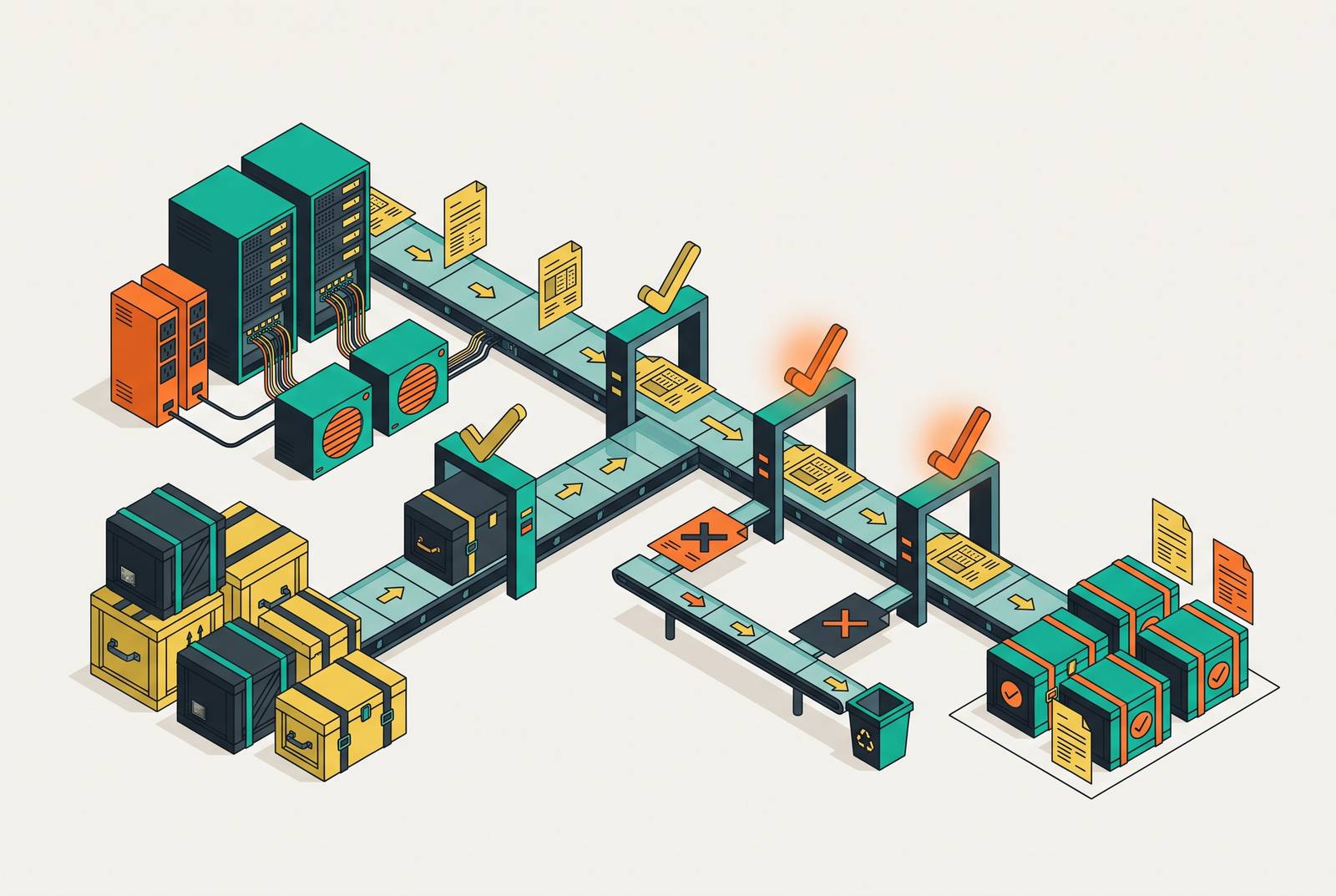
Submittal review decides when the procurement clock starts for every major piece of MEP equipment on a data center project. A UPS, a switchgear assembly, a generator, a PDU: none of it can be ordered until the submittal behind it gets approved. Any day lost in that review is a day added to the back end of the schedule, and that day does not come back later.
Switchgear, transformers, UPS systems, cooling plant: these carry lead times that dwarf almost anything else in commercial construction. The submittal approval window sits in front of that lead time as a hard prerequisite. Delay the approval and the order date slides with it, one for one.
Schedule float makes this worse than it looks on paper. A blocked review sitting on an activity with two days of float before it hits the critical path is a different emergency than the same blocked review sitting on an activity with three weeks of buffer. Teams that cannot see which is which are managing schedule risk with a blindfold on.
Submittal quality also decides what happens months later, at handoff. Model numbers, nameplate ratings, firmware versions, port assignments, circuit IDs: these details, once approved, become the asset data that DCIM, EPMS, and BMS platforms need to run the facility. If that data gets captured as a static PDF instead of structured, tagged information, someone has to retype it by hand before any operations system can use it. Open APIs that move equipment and testing data into long-term management platforms only pay off if the data entering them was already clean. Submittal review is where that data either gets built correctly or doesn't.
The fragmented manual review chain
The manual submittal process is slow for a structural reason, not a personnel one. The same information has to be rebuilt by hand at every handoff: subcontractor to general contractor, general contractor to engineer of record, engineer of record to design team. Each transfer is a chance for the same data to be re-read, re-typed, and re-checked by someone new.
A typical equipment submittal takes the form of a dense, multi-page PDF: vendor cut sheets, shop drawings, installation details, certification paperwork, all bundled together. The engineer reviewing it has to locate every relevant parameter inside that stack, pull it out, and compare it against the project specification by hand, one line at a time.
For critical-systems packages, that comparison carries weight because the parameters depend on each other. A breaker's interrupt capacity affects fault coordination upstream of it. The footprint and weight of a switchgear assembly affects structural and clearance assumptions already built into the BIM model. Catch a dimension error late, and a prefabricated skid may need to go back to the shop for rework. Medium-voltage and low-voltage switchgear also follow separate code compliance paths and separate AHJ approval routes, so a classification error at submittal does not just cost time in review. It resurfaces at inspection, usually at a worse moment.
Fiber routing submittals used to sit at the bottom of this risk list, treated as routine shop drawings. Rising fiber topology complexity, driven by denser AI workloads, has pushed fiber packages up to schedule risk on par with electrical packages.
This fragmentation scatters project information across emails, spreadsheets, project management platforms, and supplier portals, and teams end up spending real hours locating information rather than acting on it. Because review happens manually and asynchronously, layout and coordination decisions often get made against provisional specs rather than confirmed ones. When the approved submittal later contradicts an assumed dimension or electrical characteristic, the rework cascades: power path, cooling topology, cable tray routing, construction sheets, all of it needs a second look. Every discrepancy that surfaces during that manual review and needs clarification turns into an RFI, and every open RFI sits on the schedule consuming float right alongside the submittal that triggered it.
What current submittal workflow tools can and cannot do
The construction software market has made real progress on routing and tracking submittals. It has not solved the technical compliance problem, and for data center equipment packages, compliance is where almost all the risk sits.
Autodesk Forma Build's submittal tool centralizes the creation, customization, and management of construction submittals, with configurable review workflows and mobile access (a separate tool, AutoSpecs, handles automated submittal log generation). That is a genuine improvement in how documents move through a project. It routes documents. It does not read them.
BuildSync takes a different approach: AI-powered review that extracts dimensions, ratings, materials, and certifications from product data submittals and checks each one against plans and specs before a reviewer even opens the file. If your bottleneck is technical compliance rather than routing speed, that approach targets the right problem.
Part3 identifies key details, inconsistencies, and missing requirements the moment a submittal arrives, which is a real step up from manual triage. General-purpose document AI still is not the same thing as domain-specific compliance logic built around data center equipment parameters. It can tell a reviewer something looks off, but it is not built to know what "off" means for a switchgear bus rating.
SubmittalLink, eSUB, Submittal.com, and ClickUp each serve real needs around tracking, closeout documentation, and lightweight workflow management. They are useful tools for the segments they were built for. None of them were architected around equipment-spec compliance checking. Procore covers the full project lifecycle for general contractors at enterprise scale, and its submittal module handles routing and log management well. It does not perform equipment-parameter validation against engineering specifications either.
The gap across all of these tools is the same one: spec-compliance analysis for equipment-specific parameters like torque ratings, interrupt capacity, UL certifications, bus ratings, and arc flash labeling requirements. That kind of checking needs domain-specific logic, not faster document routing. A tool that moves a submittal through approval steps more quickly does not lower the rejection rate if the compliance check behind it is still a manual judgment call that depends on one reviewer's bandwidth and knowledge. For data center MEP packages specifically, general document management software does not surface the parameters that matter most: fault current ratings, UPS transfer characteristics, cooling capacity curves, cable fill ratios. They need extraction logic built around the engineering specifications that govern critical-facility systems.
AI extraction and deterministic rules at different review stages
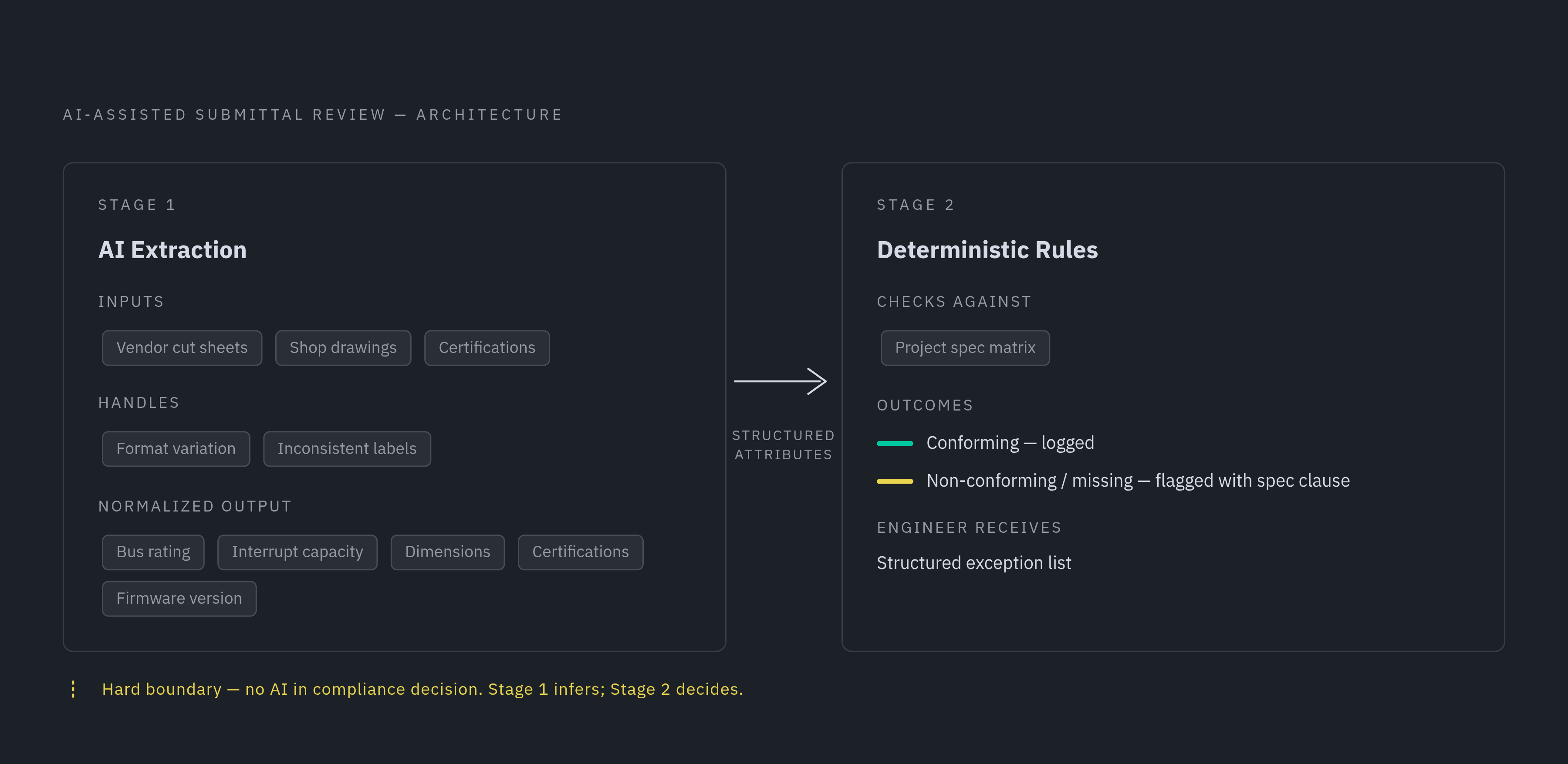
Intelligent submittal review needs two distinct mechanisms, applied in sequence, not interchangeably. First, AI reads and normalizes unstructured manufacturer documents. Second, deterministic rules decide compliance against the project specification. Mixing the two stages together produces either a brittle system or one nobody can defend in front of an inspector.
The first stage exists because equipment submittals arrive as unstructured PDFs: vendor cut sheets, multi-page shop drawings, certification documents, each manufacturer labeling fields its own way. Pulling consistent attributes out of that pile benefits from document understanding at the level modern language models provide. This is the stage where AI earns its place, handling the format variation, the inconsistent field labeling, and the terminology differences between manufacturers.
The second stage works differently. Once attributes are extracted and normalized, bus rating, interrupt capacity, dimensions, certifications, firmware version, the compliance decision becomes a lookup against a specification matrix. An attribute either meets spec or it does not. That decision needs to be deterministic, auditable, and explainable, because pure deterministic automation is the most predictable form of automation available: when the trigger, the conditions, and the action are all clearly defined, rules execute the check without needing human judgment in the loop. If a compliance check already has clear rules, adding AI decision-making on top of it adds risk without adding value.
The case for AI-only review falls apart on auditability. AHJs and PE-stamped review processes need a defensible record that shows how each compliance decision got made. A rule-based engine produces that record by design. A generative model's output does not, at least not in a form that holds up to the same scrutiny. The case for rules-only review falls apart from the other direction: no rule engine can parse a 47-page switchgear submittal PDF and find the interrupt capacity value buried inside it without a document-understanding layer doing that work first.
Full AI replacement has no place in life-safety review or PE-stamped sign-off. The two-stage model exists to support engineers, not to take over the licensed judgment that critical-facility submittals require. Licensure liability on life-safety systems means most owners will not accept an AI system as the final word on compliance, so the workable design puts AI-assisted extraction in front of engineer review, with deterministic rules flagging exceptions instead of auto-approving anything. Automation gathers the data, normalizes it, flags discrepancies, and prepares a structured package for review. The engineer makes the compliance call, with full traceability behind the decision. That division of labor is what survives scrutiny from AHJs, certification bodies, and owner legal teams.
The connected submittal review workflow
A connected submittal review workflow turns what is currently a serial, manual handoff chain into one structured pass, where extraction, compliance checking, exception flagging, and design propagation all happen together instead of in separate, disconnected steps.
Take a switchgear submittal as the clearest example, since it carries the most interdependent parameters and the most AHJ sensitivity of any equipment package. When it arrives, the AI extraction layer reads the PDF and identifies the relevant values: bus rating, interrupting capacity, dimensions, UL listing, arc flash labeling. It normalizes those values and maps them directly to the project's specification fields, with no manual data entry required to get them there.
From there, the deterministic compliance layer checks each extracted attribute against the project's specification matrix. Values that fall within tolerance get logged as conforming. Values that fall outside tolerance, or that are missing entirely, get flagged along with the specific spec clause they fail against. The reviewing engineer sees a structured exception list instead of a raw stack of PDF pages to comb through by hand.
Once an attribute is approved, it propagates directly into the project model, the equipment schedules, and the cable routing documentation. A rack move or a switchgear substitution updates the power path, the cooling load calculations, and the cable fill numbers automatically, instead of triggering hours of manual rework spread across a dozen sheets. The same logic applies to cooling plant packages and fiber routing packages: the extraction and compliance steps look the same, even though the parameters being checked differ by discipline.
Every extraction, every check, every flag, and every approval decision gets logged with the source document, the spec clause it was checked against, and the reviewer who signed off. That log is the traceability record that Tier certification, AHJ inspection, and PE-stamp accountability all depend on. Factory Acceptance Testing results, now typically generated starting at Level 1 in controlled factory environments as part of standard commissioning practice, can feed into that same structured record, linking FAT data back to the approved submittal and forward to the as-installed asset.
The payoff extends past the review itself. The structured data produced during review becomes the handoff payload for DCIM, EPMS, and BMS, closing the re-entry gap that currently eats weeks at commissioning. Model numbers, nameplate ratings, port assignments, and circuit IDs, once extracted and validated during review, already exist in machine-readable, tagged form. They move through an open API straight into DCIM and EPMS platforms at commissioning, instead of being re-keyed by hand from paper submittals. The BMS controls the mechanical and environmental plant. The EPMS monitors the electrical path. DCIM manages IT assets and pulls data from both. None of these three systems can be populated correctly at handoff unless the submittal data was captured in structured form during review. A connected workflow makes that structure a natural byproduct of review.
ArchiLabs Studio and the data center project workflow
ArchiLabs Studio is built around this exact workflow problem. It functions as a central operating system for data center projects, connecting layouts, power and cooling coordination, cable routing, documentation, RFIs, and operations-ready handoff inside one working system, rather than adding yet another silo to a tool stack that already has too many.
Where the tools covered earlier solve routing or tracking in isolation, ArchiLabs Studio connects the submittal approval event itself to downstream model updates, equipment schedules, and cable routing. A reviewed and approved switchgear submittal propagates its confirmed dimensions and electrical parameters straight into the coordinated model, with no manual re-entry step standing between approval and the updated drawings.
The platform splits automation the same way the two-stage model calls for. AI handles extraction and normalization of equipment data from manufacturer PDFs and cut sheets. Deterministic rules handle the part where precision cannot bend: compliance checking against project specifications runs on auditable rule logic rather than generative inference, producing a record that holds up for AHJ review and PE-stamp accountability. Equipment data that would otherwise stay locked inside manufacturer PDFs flows directly into models, schedules, and validation rules. The spec extraction performed during submittal review is the same data that populates DCIM, EPMS, and BMS at handoff, closing the re-entry gap described earlier rather than leaving it for someone else to solve later.
Every RFI answer, every design decision, and every equipment parameter traces back to the submittal and specification behind it, because the traceability record gets built during the review process itself, not reconstructed from memory and email threads after commissioning is already underway. And ArchiLabs connects to the tools teams already use, Revit, AutoCAD, DCIM platforms, rather than asking anyone to abandon them for a new silo. On programs where multiple stakeholders have their own established tool preferences, that compatibility often decides whether a new system gets adopted.