Equipment Spec Extraction from Manufacturer PDFs into Design Models
Automating PDF spec extraction saves engineers from manual data entry on billion-dollar builds.
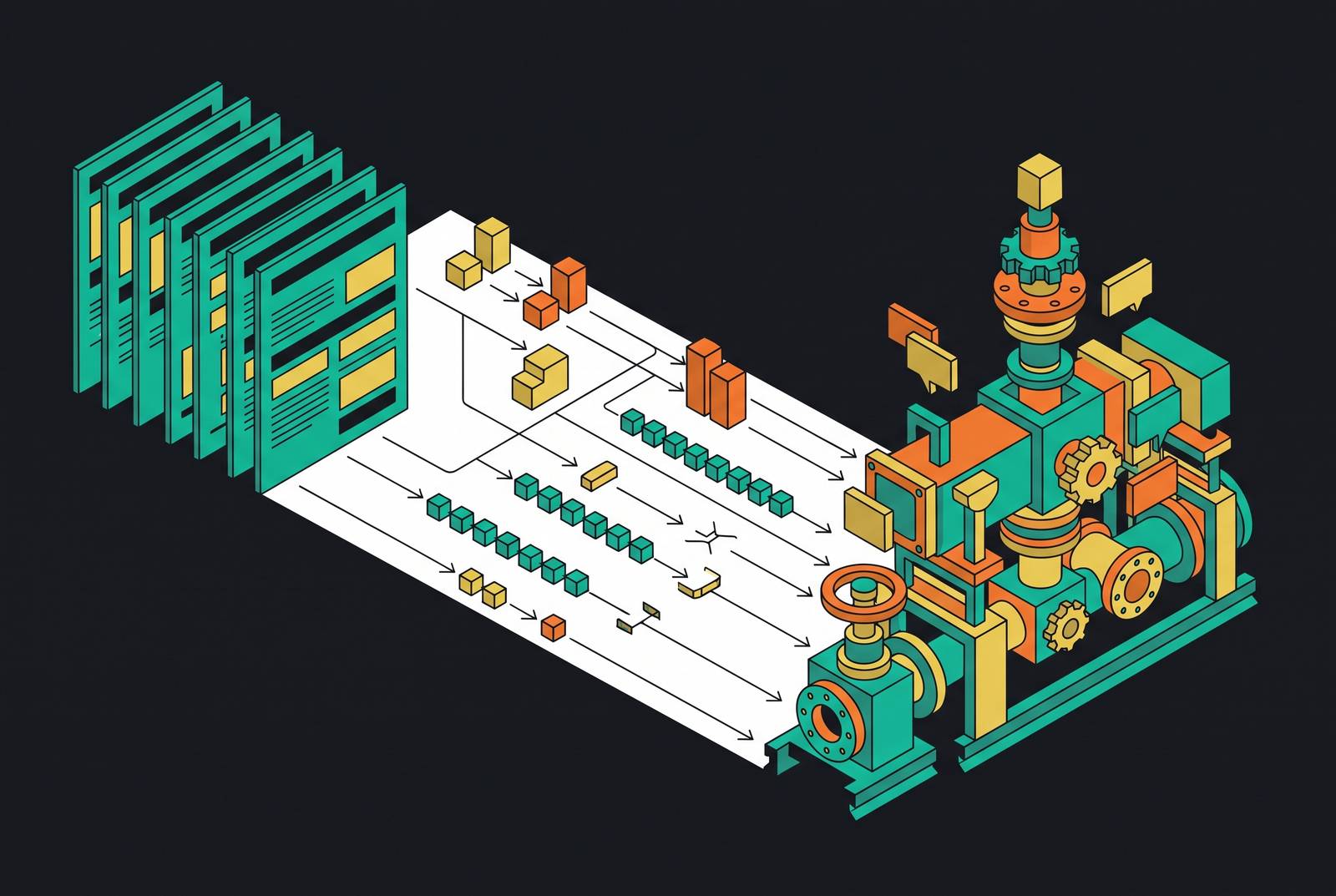
Every piece of critical infrastructure in a data center ships with a manufacturer PDF: a submittal, a cut sheet, a data package listing the electrical, mechanical, and physical specs of that equipment. Most teams still treat that PDF as the finish line. It's the starting line, and the gap between the PDF and the design model is where the real cost of a data center build hides. That gap doesn't shrink as projects get bigger, it compounds, and most teams are staffing it with the wrong resource: a licensed engineer, retyping numbers by hand.
Data center construction starts went from $14.9 billion in 2023 to $26.9 billion in 2024, then to $77.7 billion in 2025, a 190% year-over-year jump. At $10 to $12 million per megawatt for a standard build, and $20 million or more for AI-ready facilities, every hour spent re-keying a spec sheet by hand is an hour burned against a schedule with no slack in it. Manual re-typing was never going to keep pace with a market that grew fivefold in two years. Pretending otherwise is how projects end up short-staffed on the one task that scales worst by hand: reading PDFs.
What makes manufacturer PDFs structurally resistant to automated extraction
Manufacturer documents split into two categories, and both often show up on the same page of the same submittal package.
The first is unstructured text: free prose where the spec value is buried in a sentence instead of sitting in a labeled field. A generator's operating temperature range might show up as a clause in a paragraph about site conditions, not as a number next to a header. The second is semi-structured text: tables, cut sheets, data grids, where a value's meaning depends entirely on where it sits in the layout. A number in the third column of the fourth row means nothing without knowing what that row and column represent.
Rules-based extraction, the kind built before modern AI models, fails at both, and it fails in a specific, predictable way. It runs on rules a domain expert writes for one specific document layout, with almost no flexibility outside it. One manufacturer formats a UPS cut sheet one way, another formats it differently, and a manufacturer updating its own template for a new product generation is enough to break the rule set. Quietly, too. No error message, no flag. Just a wrong or missing value passed downstream, waiting to surface three stages later as somebody else's problem.
Layered on top of that is a second failure mode, separate from finding the field at all: format variation inside the value itself. A date reads as 2024-06-03, June 3rd, or 06/03/2024. A weight comes in pounds or kilograms. A voltage shows up with or without a tolerance range attached. A person reads all of these as equivalent without blinking. A machine expecting one format and getting another does not.
Stack those two failure modes together, and equipment data stays locked inside the PDF. The engineer becomes the extraction engine: reading documents by hand, retyping values into whatever model, schedule, or coordination drawing needs them next. That's a fully trained engineer doing data entry a script should be doing instead, and it's the wrong use of the most expensive person on the project.
How modern AI extraction approaches close the gap rules-based systems leave open
Two things changed here, and neither was true five or six years ago.
Table and structure recognition got good first. Modern AI models reconstruct a nested table, a grid with merged cells, a data sheet with sub-headers, by reading the visual boundaries and inferring the logical relationship between cells. That's exactly the structure most equipment specs live in, so this alone closes a big share of the gap rules-based tools never touched.
Semantic understanding matters more, though. Traditional OCR turns pixels into characters and stops there. It has no idea what those characters mean. Modern AI extraction goes further, reading a document's intent well enough to know that a number sitting next to "Input Voltage" is an electrical parameter, not a list price or a part number. OCR says what the characters are. NLP says what they represent in context. That distinction separates a system that can only read labeled cells from one that can pull a spec value out of a sentence buried in paragraph prose.
The output is a structured schema, JSON or XML, something a downstream system reads directly. Nobody sits in the middle translating.
This is where AI earns its keep: a document format the system has never seen, a manufacturer missing from its training data, a spec written into prose instead of a table, a cut sheet that changed layout between product generations. AI is genuinely good at surfacing a first-pass candidate value across all of that mess.
What it can't do alone is confirm the value is correct, and this is the part vendors gloss over. Surfacing a candidate weight for a UPS unit isn't the same as confirming that weight belongs to this exact model, in this exact configuration, inside this project's context. Confirmation is a different job, and treating AI output as final without that second step is how a wrong number gets a design's confidence behind it.
Where deterministic rules take over from AI, and why the boundary matters for critical facilities
Deterministic means the same approved input always produces the same output. Repeatable, reviewable, auditable. AI means flexible interpretation of something ambiguous or unfamiliar, with an answer that's probabilistic rather than guaranteed.
The line in spec extraction falls exactly where that distinction predicts. AI figures out what a value is and where it's hiding inside an unfamiliar document. Deterministic rules take it from there: checking the format is right, confirming the value falls inside an engineering range that makes physical sense, and mapping it to the correct field in the model.
Take the date example again. Whether a date reads 2024-06-03 or July 3rd doesn't matter to a person glancing at it. It matters enormously to a downstream system built to expect one format and handed the other instead. A deterministic rule resolves that before the value ever touches the model. There's no reason to leave that step to probability when a fixed rule handles it perfectly, every single time.
The engineering stakes aren't small. A value in the wrong unit, a power rating missing its operating mode context, a range mapped to the wrong field: none of these throw a visible error. They produce a model that's quietly, confidently wrong, and that wrongness propagates straight into structural calculations, power schedules, and cooling designs before anyone catches it.
So the architecture has one right answer, and it isn't a judgment call. AI proposes, deterministic rules validate, a domain engineer confirms before anything commits to the model. That's decision support, not autonomous data entry. Anyone pitching a pipeline where AI output writes straight to the model with no validation layer in between is selling a shortcut critical-facility work can't afford. Precision and traceability aren't negotiable, no matter how good the models get. Vendors who treat that layer as optional overhead have misread what this work actually requires.
What a connected extraction pipeline from PDF to design model actually looks like end-to-end
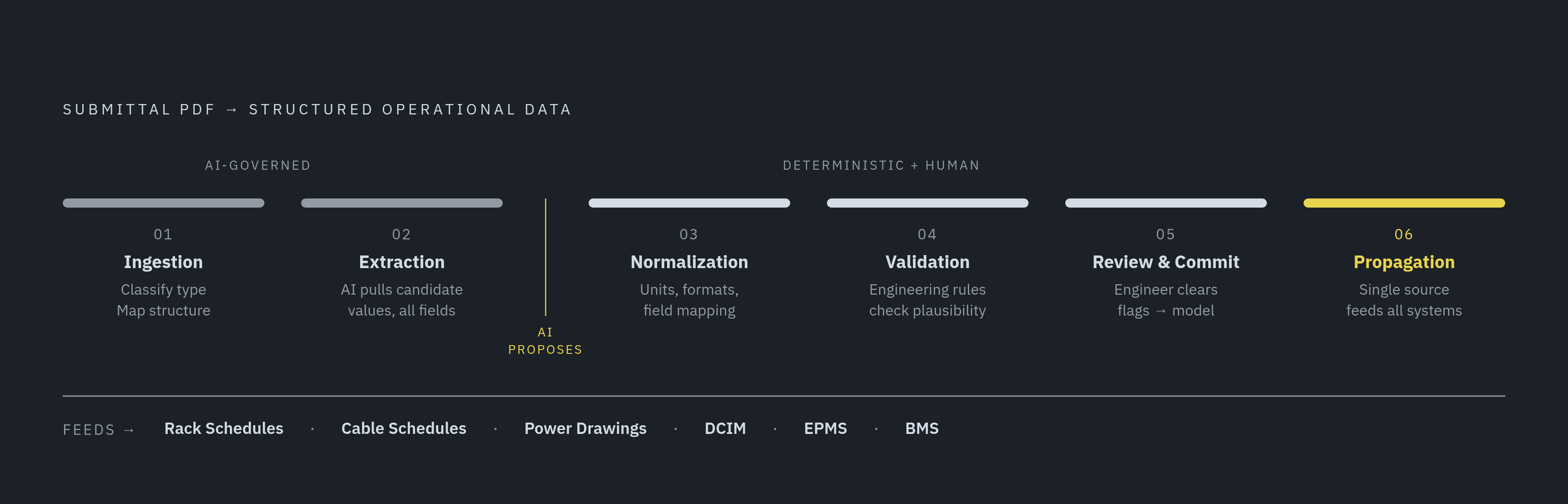
Run the whole thing in order, and it breaks into six stages.
Ingestion. The submittal PDF enters the pipeline. The system classifies what it's looking at, a cut sheet, a full submittal package, an install guide, an O&M manual, and maps the page structure before anything else happens.
Extraction. AI models pull candidate values for each required field: electrical characteristics, physical envelope, weight, cooling interface type, compliance certifications.
Normalization. Deterministic rules force those candidate values into the project's data schema: standard units, standard formats, mapped to the right field. Whatever comes out the other side looks exactly the way the downstream system expects it to look.
Validation. The system checks extracted values against engineering rules. Does this UPS weight trigger a structural review flag? Does this PDU's input voltage match the panel schedule it's tied to? Does this CRAH's rated cooling capacity actually cover the rack load assigned to it in the layout?
Review and commit. Anything flagged as an exception or low-confidence gets routed to a domain engineer for confirmation. Once confirmed, the value writes directly into the model, the schedule, and the equipment database. Nobody retypes anything.
Downstream propagation. The committed record becomes the single source of truth feeding rack schedules, cable schedules, power coordination drawings, and eventually the handoff to DCIM, EPMS, and BMS on the operations side.
The property that makes this whole pipeline work is simple to state: each value gets extracted once, validated once, and referenced by everything downstream. Never retyped. Structured formats make that reference-not-retype model possible, moving data from document to decision point with nobody standing in the middle of every handoff.
How unextracted spec data breaks critical-systems coordination across power, cooling, and structure
Coordination in a data hall is a spatial problem and a simultaneous one. Chilled water piping and CRAH units compete with electrical busways for the same overhead real estate. Cable trays from power distribution block return air paths if they land wrong. Get electrical placement wrong, and pressure balance in the room suffers.
Clash detection software can only catch what's actually in the model. If a piece of equipment's dimensions, weight, or service clearance never got extracted from its PDF, the model is carrying placeholder geometry instead of real numbers. That placeholder sails through clash detection without a single flag, right up until the real equipment shows up on site and doesn't fit where it was supposed to go.
Weight is the sharpest version of this failure. The Nvidia NVL72 rack-scale system runs at 132 kW and can weigh 1.4 metric tons. Those two numbers have to move from the manufacturer's spec sheet into the structural model directly, with nothing lost in translation. If they don't make that trip, the structural engineer is designing against a load that isn't real, and nobody finds out until the floor is already poured.
Cooling tells the same story from a different angle. The NVL72 needs direct liquid cooling, and that single specification has to reach the mechanical model before pipe routing starts, not after. Show up late with it, and the routing work already finished has to be torn out and redone.
Multiply either failure across a full equipment list, every PDU, every CRAH, every generator, every busway run in a data hall, and the rework compounds fast. That cumulative load, not any single clash, is the real schedule risk on a project. Research examining MEP clashes on a single project found unresolved conflicts generated substantial costs on that project alone, and in a data center, thermal consequences stack on top of electrical rework in ways that push that number higher still.
Call these coordination failures if that's the convenient label. They aren't. They're extraction failures wearing a coordination costume, and coordination is just the stage where they finally become visible.
How the extraction gap corrupts the handoff to operations
DCIM, EPMS, and BMS all run on structured equipment data: asset tags, rated capacities, electrical parameters, cooling interface types, maintenance intervals. That's exactly the information sitting inside manufacturer PDFs.
If those fields never got extracted during design, they're missing from the handoff package too. Operations inherits a half-built asset database, or rebuilds the whole thing by hand from the same PDFs the design team already read once. That's not a new problem born at handoff. It's the same extraction gap from earlier in the project, showing up at a new address and charging the same tax a second time, this time to a different team that had nothing to do with creating it.
A BIM model, on its own, does not populate DCIM. It doesn't generate a rack schedule or a fiber routing database out of thin air. Those systems need structured attribute data, and that data can't live inside the BIM if nobody pulled it out of the PDF to begin with. The PDF is where things start, the operational system is where they need to end up, and extraction with a structured handoff is the only thing that connects the two.
When equipment data lands in operations with no link back to its source spec, every future change, a swap, an upgrade, a capacity bump, starts from a guess instead of a confirmed baseline.
What teams building or selecting an extraction workflow should look for
Schema coverage. Does the extraction system map to the specific parameter fields data center equipment schedules and BIM families actually use? Generic document parsing is not the same product as extraction built around critical-facility equipment types. Treating them as interchangeable is the first mistake worth avoiding, and it's the one vendors are least likely to volunteer up front.
The AI/deterministic split. Is AI handling interpretation while deterministic rules handle validation and formatting, or is the whole pipeline running on probabilistic output start to finish? The second setup isn't acceptable for engineering data. Full stop, not a matter of preference.
Review workflow. When the system flags an exception or a low-confidence extraction, does it show the domain engineer the source document right alongside it? Every committed value needs to trace back to an exact spot in the original PDF, or the traceability claim is empty.
Downstream connectivity. Does an extracted value write directly into the model, the schedule, the cable and power databases? Or does it dump into a spreadsheet someone then re-enters by hand? That second path just rebuilds the manual transfer the whole pipeline was supposed to eliminate, and it's the failure mode worth screening out before signing anything.
Change management. When a submittal gets revised mid-project, does the system know which downstream records came from the old version and need a second look? Without that, a revised spec kicks off the exact same cascade of manual fixes it always used to trigger.
ArchiLabs Studio is built around this exact chain: extraction connected to layout, to power and cooling coordination, to schedules, and to an operations-ready handoff, all inside one structured environment, rather than an extraction tool that hands its output to yet another disconnected system. A pipeline that ends at a spreadsheet hasn't solved the fragmentation problem. It's just moved it one step further down the line, where it costs more to fix.