Why Data Center Documentation Goes Stale After Rack Moves and How Automated Platforms Break the Cycle
Connected DCIM models update power, cooling, and cable records together.
Rack-move documentation goes stale because power, cooling, cable, and floor-plan records are kept as separate, disconnected artifacts. Automated change propagation breaks that cycle by making a verified change update the records that depend on it. Mature data center infrastructure management (DCIM) platforms provide the connected operational model, but accuracy also depends on structured handoff, explicit infrastructure states, and integration with change control.
Why rack moves create documentation debt even in well-run facilities
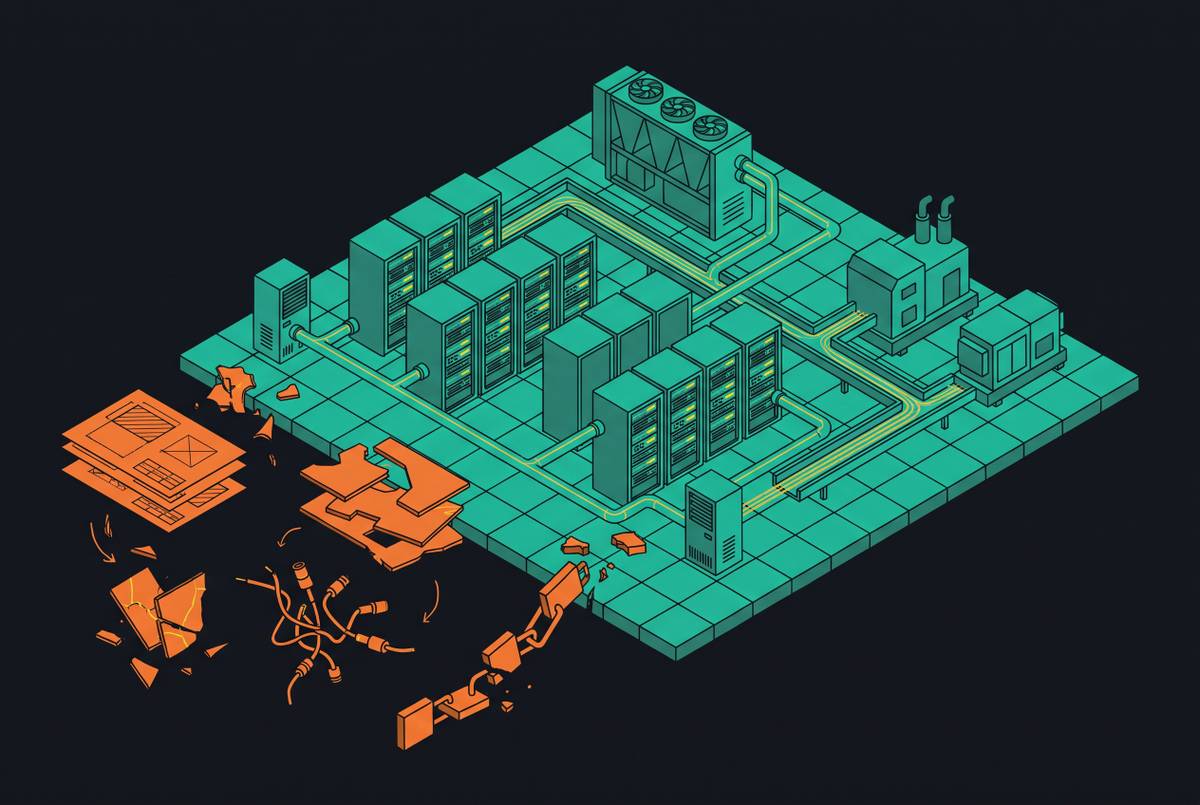
At two in the morning, a technician starts a rack move using a diagram last updated months ago. It was accurate when drawn. Since then, three cables have been rerouted, a power strip has been swapped, and an interim compute node has never been decommissioned. None of those changes reached the diagram. Anchor Defense identifies this mismatch between planning information and the actual environment as a cause of change-related incidents.
That mismatch grows as move-add-change requests accumulate. CPCON puts asset database drift at 2–5% per month where automated tracking is absent. Even a well-run facility can build up documentation debt from this drift while its teams do the physical work correctly.
A change management process does not automatically solve this. Each move may still require someone to update DCIM, the building information model (BIM), as-built drawings, power schedules, and cable records separately. The process can define who should do that work, but it cannot make disconnected tools share a change. Every separate update is another point where the record can fall behind.
How a single rack move silently breaks records across power, cooling, cable, and floor plans
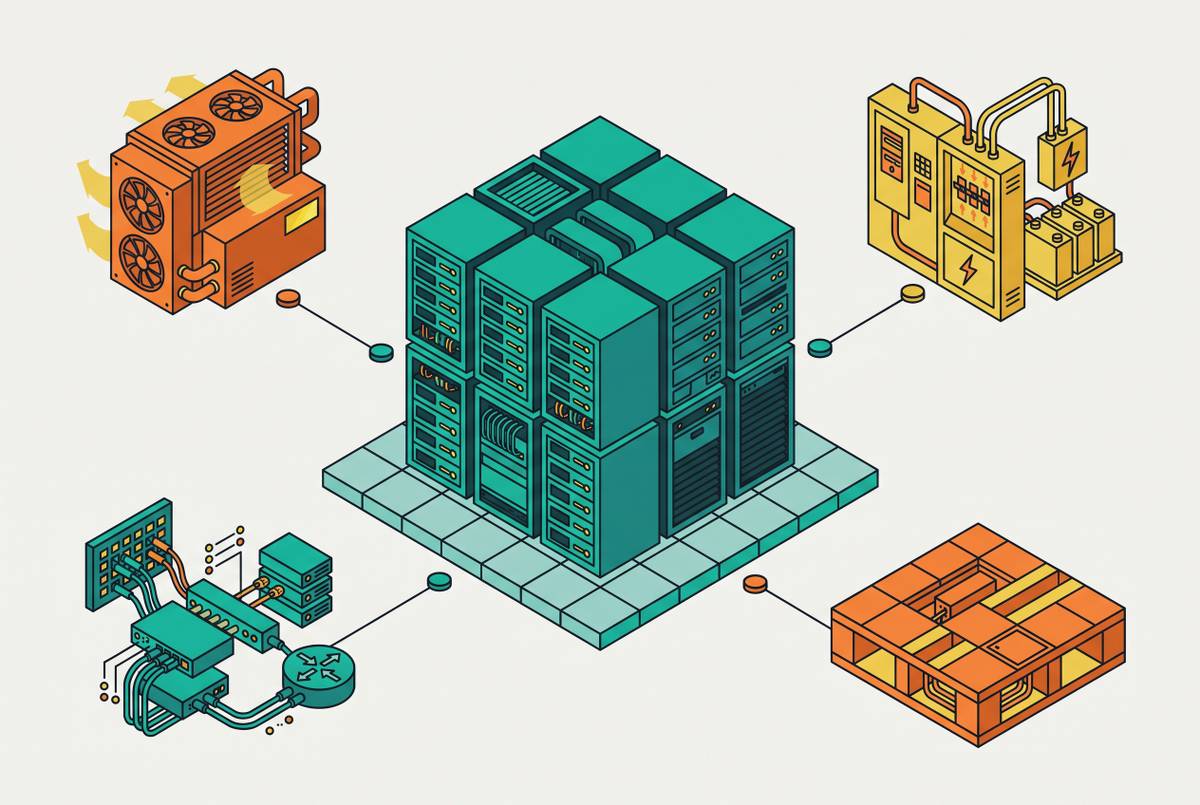
The power path must remain traceable from the utility entrance through switchgear, UPS, PDUs, and rack-level strips to individual receptacles, including breaker ID, amperage, phase, and measured load at commissioning. Moving the rack does not, by itself, revise those assignments in the records.
Cooling has a different dependency on rack location. A move invalidates the thermal load model because containment and redundant cooling paths depend on rack-level heat loads. Cooling must be re-balanced and re-validated before new design decisions can be based on the freed space.
Patch panels and cable managers left active in DCIM after rack removal create phantom pathway entries, complicating network documentation and misleading cable plant audits. Physical removal and record removal are separate events unless the workflow connects them.
The floor plan introduces another distinction. Physically vacant space is not necessarily electrically or thermally available capacity, so updating the drawing cannot substitute for capacity recalculation and as-built synchronization. On fast-track projects, field decisions can also outpace BIM updates, leaving the design model as a historical record of the building.
Why documentation is treated as a project artifact rather than a living operational record
Documentation has historically been produced for construction closeout and consulted during operations. Keeping it current is a separate job. The tools do not make continuous updating cheaper than allowing the records to fall behind, so accuracy depends on repeated manual reconciliation.
The pattern starts when DCIM population is deferred until after occupancy. By then, the people who understood the design intent may have moved to other projects, and contractor records may not map cleanly to DCIM fields. One contractor may name equipment by row-letter-and-unit, another by description, and another with sequential integers. Operations inherits the task of normalizing those names before the data becomes useful.
Meanwhile, DCIM is often configured for steady-state monitoring and asset tracking, leaving the build and change phases where discrepancies originate outside its control. Anchor Defense identifies field substitutions and scope changes that bypass DCIM updates as a primary source of as-built discrepancies in federal data centers. Fragmented ownership across contractors, program offices, and operations compounds the problem as project knowledge leaves with the team. Better discipline can reduce omissions, but the fragmentation itself is a tool design problem.
What DCIM actually needs to track to stay accurate through change
A reliable DCIM configuration must track infrastructure states beyond whether equipment is active or removed. Intermediate states have different consequences for capacity. Anchor Defense defines retirement states as planned retirement, isolated, removed, verified, and space released. Treating those conditions as interchangeable lets planning decisions get ahead of the work needed to support them.
Deployment needs the same precision in the opposite direction. Its states are planned, procured, staged, installed, energized, commissioned, and operationally accepted. An installed rack is not necessarily energized, and an energized rack has not necessarily passed commissioning. Collapsing those distinctions creates reconciliation failures that can persist into operations.
Those states must control when the records that depend on them change. For example, power isolation and cooling recalculation must be confirmed and recorded before freed space is committed to new design work. An empty footprint is not sufficient evidence.
Change control integration is also a structural requirement. Uncontrolled updates during construction or change work can introduce drift that is hard to recover during final validation. Naming standards must therefore span BMS, EPMS, CMMS, drawings, and commissioning scripts from the outset. Anchor Defense recommends giving naming conventions their own section in the statement of work (SOW), so records across those systems refer to the same infrastructure.
How do DCIM platforms automatically update power, cooling, and cabling records after a rack move?
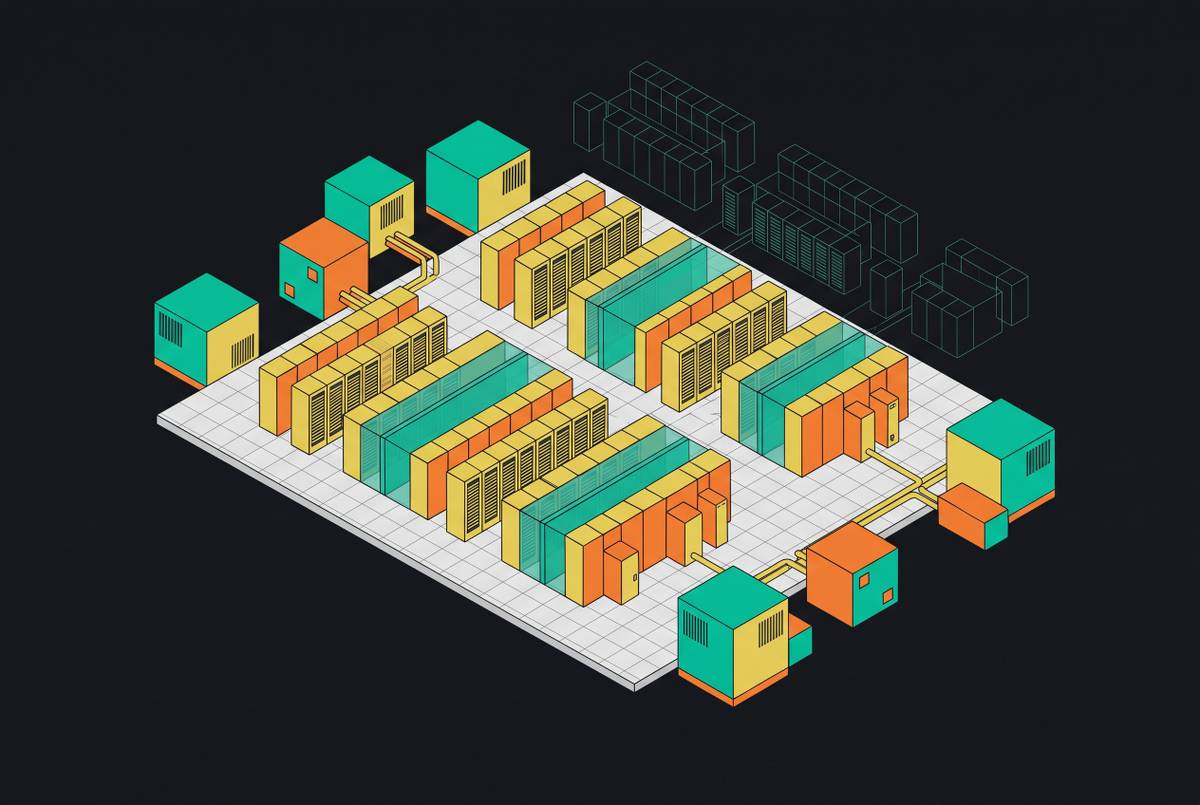
Mature DCIM platforms connect physical inventory, capacity, power consumption, cooling dependencies, and connectivity in a shared model. The relationships do the work. When a verified rack change alters an assignment or dependency, the platform propagates that change to the connected records rather than leaving each one for separate manual revision.
Anchor Defense describes DCIM as a continuously updated model of what is in each rack, what consumes power on each circuit, what connects to each port, and what depends on what. That model gives planners a current basis for pre-change analysis instead of a snapshot from before earlier maintenance work. Organizations that keep DCIM data accurate have fewer emergency change requests, shorter planning cycles, and lower rollback rates because the plan more closely matches what is on the floor.
This approach is past the experimental stage. Gartner’s 2025 Hype Cycle for Data Center Infrastructure Technologies places DCIM in the Plateau of Productivity because it is proven, widely used, and brings returns that can be measured. Even at this stage, some deployments are more connected than others. Uptime Institute places DCIM within a broader Data Center Management and Control model, where it acts as a hub between facility systems, IT operations tools, and business platforms.
Integration also preserves accountability across a change. Connecting DCIM with change management and ticketing systems maintains audit trails, including the compliance traceability needed in federal environments. Automation can reduce recordkeeping work without removing the need to show what was changed and accepted.
Where the design-to-operations gap reopens and what prevents it
Even a disciplined DCIM configuration can inherit unusable construction data. A construction BIM model may need a lot of rework before an operator can use it for facility management. Asset information can be present yet lack the format, tags, or connections that DCIM, EPMS, and BMS need.
Preventing that failure requires the operator’s data requirements to be defined at project kickoff. Model format, asset tagging, and CMMS and DCIM requirements cannot wait until the model is finished. Anchor Defense treats operations handoff as a formal acceptance gate, with DCIM recording who accepted the work, what was accepted, and which exceptions remained. Reconciliation with the CMDB and commissioning records belongs at each deployment gate.
The same problem can persist inside operations. BMS and EPMS often remain separate from each other and from DCIM, forcing teams to switch systems and making correlations harder to detect. EPMS detects millisecond-level electrical events far faster than BMS alone, illustrating why the systems are not interchangeable. When equipment parameters are trapped in manufacturer PDFs, teams have to enter them again by hand, though structured data should feed them into DCIM and validation rules.
ArchiLabs Studio addresses this gap by treating structured handoff to DCIM, EPMS, and BMS as the finish line of design. Under that approach, asset data, power assignments, and equipment parameters move into operational systems without manual reformatting.
What a connected rack-move workflow looks like when every change propagates automatically
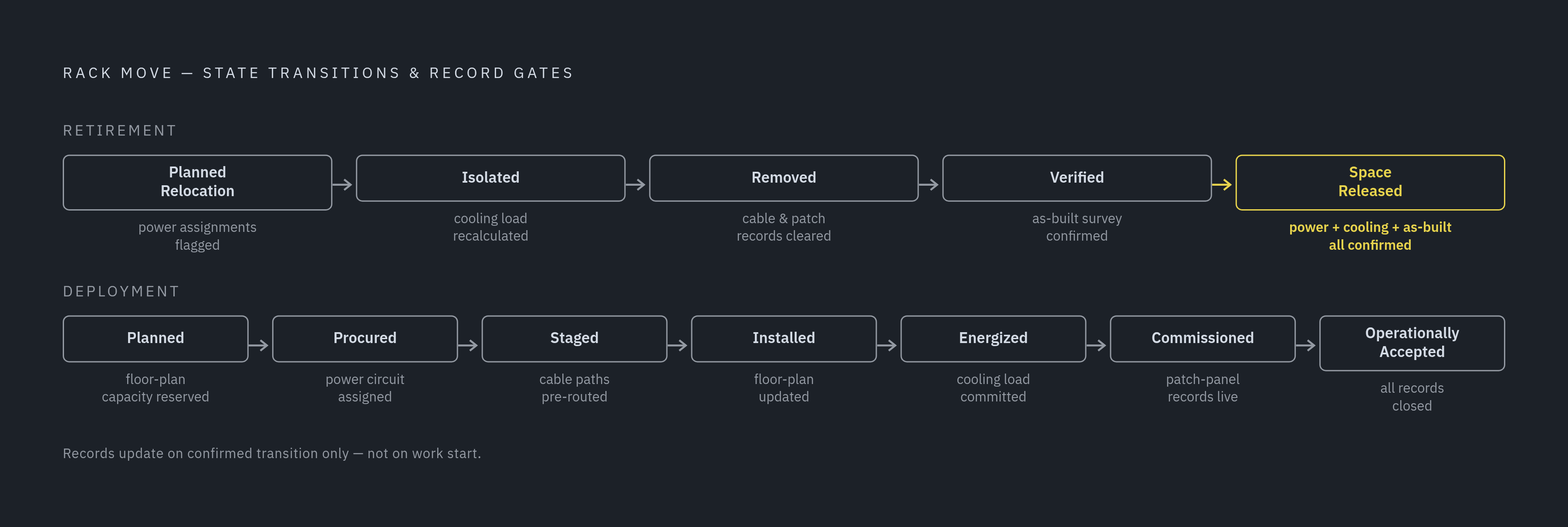
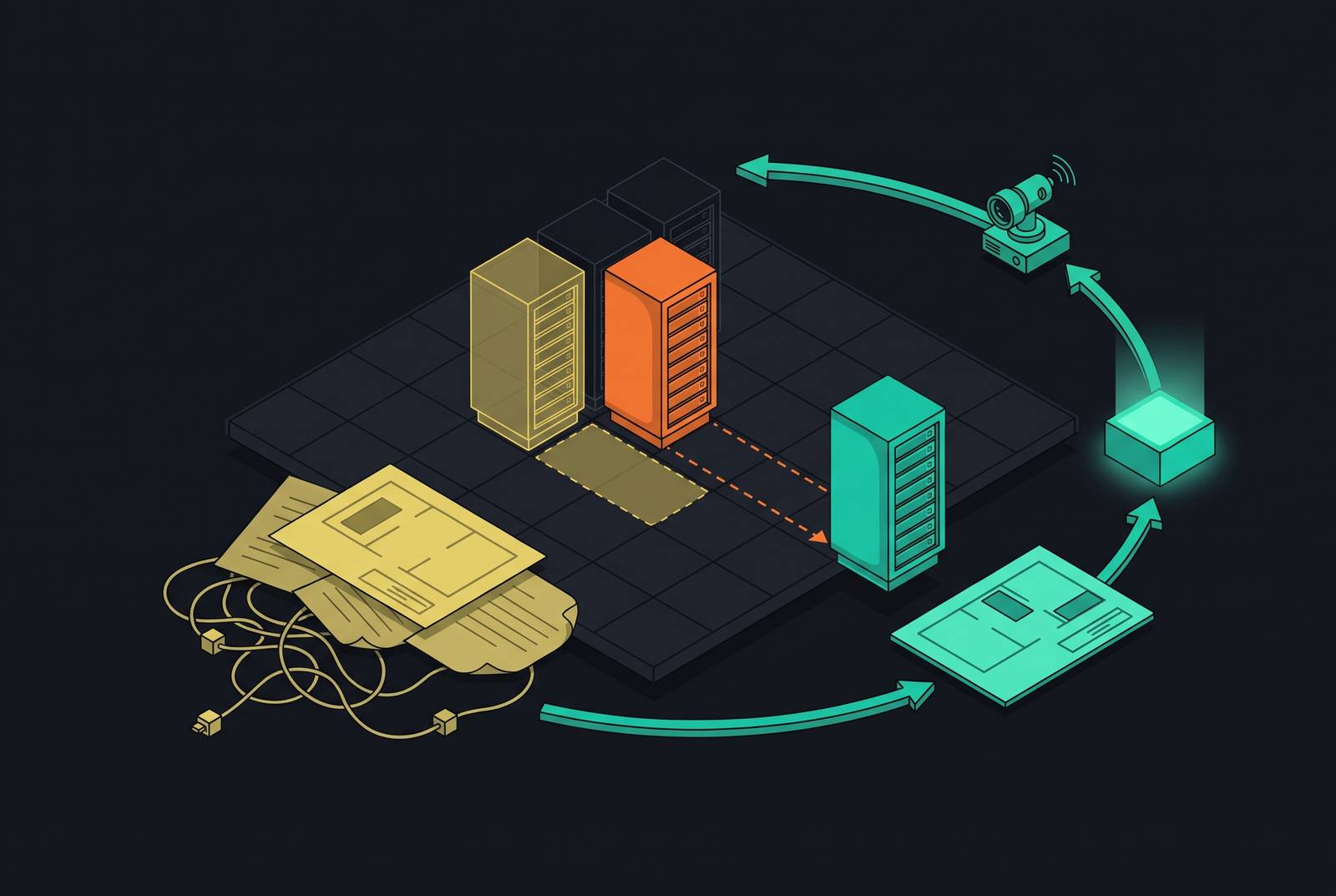
The rack enters planned relocation, or planned retirement where removal is involved, so engineering teams can model the capacity impact without releasing that capacity prematurely. The planned state separates intended work from completed work. It gives the change a place in the operational record without claiming the physical environment has already changed.
Power isolation is then recorded as its own state. The rack is isolated, but removal has not yet been confirmed. Circuit breaker allocation in the panel schedule and the cooling model stay as they are until removal is verified and triggers recalculation. This gate prevents phantom capacity from entering planning decisions simply because the work has started.
As the rack progresses through removed and verified, dependent records follow the confirmed change. Power assignments are revised, cooling loads are recalculated, and cable and patch-panel records are updated at the same gate. The move therefore does not leave an active cable pathway behind in the model after it has disappeared from the floor. For the destination, deployment states distinguish installation from energization, commissioning, and operational acceptance.
The floor plan must still be checked for accuracy, and the capacity model and as-built records each need their own checks. Automation does not make those checks interchangeable. The space released state appears only when all three have been satisfied, so the next design decision rests on confirmed availability.
Work-order integration keeps the cascade tied to field execution. Substitutions and scope changes enter the system of record when they occur. Every RFI answer, design decision, and equipment parameter can still be traced to the information that supports it. The next technician planning a late-night move can work from that record rather than reconstruct changes missing from an old diagram.
What teams should require from documentation and change workflows starting now
For teams choosing or revising a workflow, the lesson is to make documentation accuracy an engineering requirement from the start. Define retirement states as planned, isolated, removed, verified, and space released, and define deployment states from planned through operationally accepted. Enforce those distinctions in the workflow. Verbal confirmation should not stand in for the recorded state that controls a capacity decision.
Require naming conventions in the SOW before installation begins. Location identifiers, rack labels, circuit designations, and asset names must be consistent across BMS, EPMS, CMMS, drawings, and commissioning scripts. Define the operator’s model format, asset tagging structure, and integration targets at kickoff as well. These requirements give contractors a shared data structure rather than leaving operations to reconcile incompatible records.
Commissioning outcomes must arrive as structured data in addition to any PDFs. A commissioning record that cannot be validated against DCIM fields cannot directly support the operational workflow. Integrate DCIM with change management and ticketing so undocumented changes cannot advance through the process. Then embed that discipline in standard operating procedures, because an accurate initial deployment does not sustain itself.
ArchiLabs Studio is built around this connected approach, bringing layouts, critical-systems engineering, cable routing, documentation, and operations-ready handoff into one workflow. The practical requirement remains broader than any platform name. A rack move should trigger traceable updates across power, cooling, cable, and records as the work passes its validation gates, rather than leave operations with another round of disconnected manual rework.