AI vs. Rules-Based Automation in Data Center Design Decisions
AI handles design complexity; rules enforce safety in power, cooling, and compliance.
Data center construction is running at a pace and price tag the industry has never seen. Around 97 gigawatts of new capacity is expected to come online between 2025 and 2030, nearly doubling global supply in five years, and getting there will take roughly $3 trillion in investment. Under that kind of time pressure, the gap between AI and rules-based automation becomes visible on invoices.
Greenfield costs already average $17.6 million per megawatt. A liquid-cooled, AI-optimized build now runs $1,200 to $1,800 or more per square foot, roughly double a standard Tier II project at $650 to $800. Material costs are climbing 2 to 4% a year, skilled labor is short, and transformer lead times stretch out to 72 months. Every design decision made today gets locked into an asset that's expected to run 15 to 20 years, even though the AI hardware inside it will be obsolete in 12 to 18 months. Flexibility, not just capacity, has become the thing worth designing for. The Uptime Institute's 2026 outlook names "increasing fragmentation in the design and deployment of data centers" as a defining challenge. Knowing where AI belongs and where deterministic rules belong is the operational skill that decides a project's fate: it ships on budget or gets rebuilt in the field.
What rules-based automation and AI mean in this context
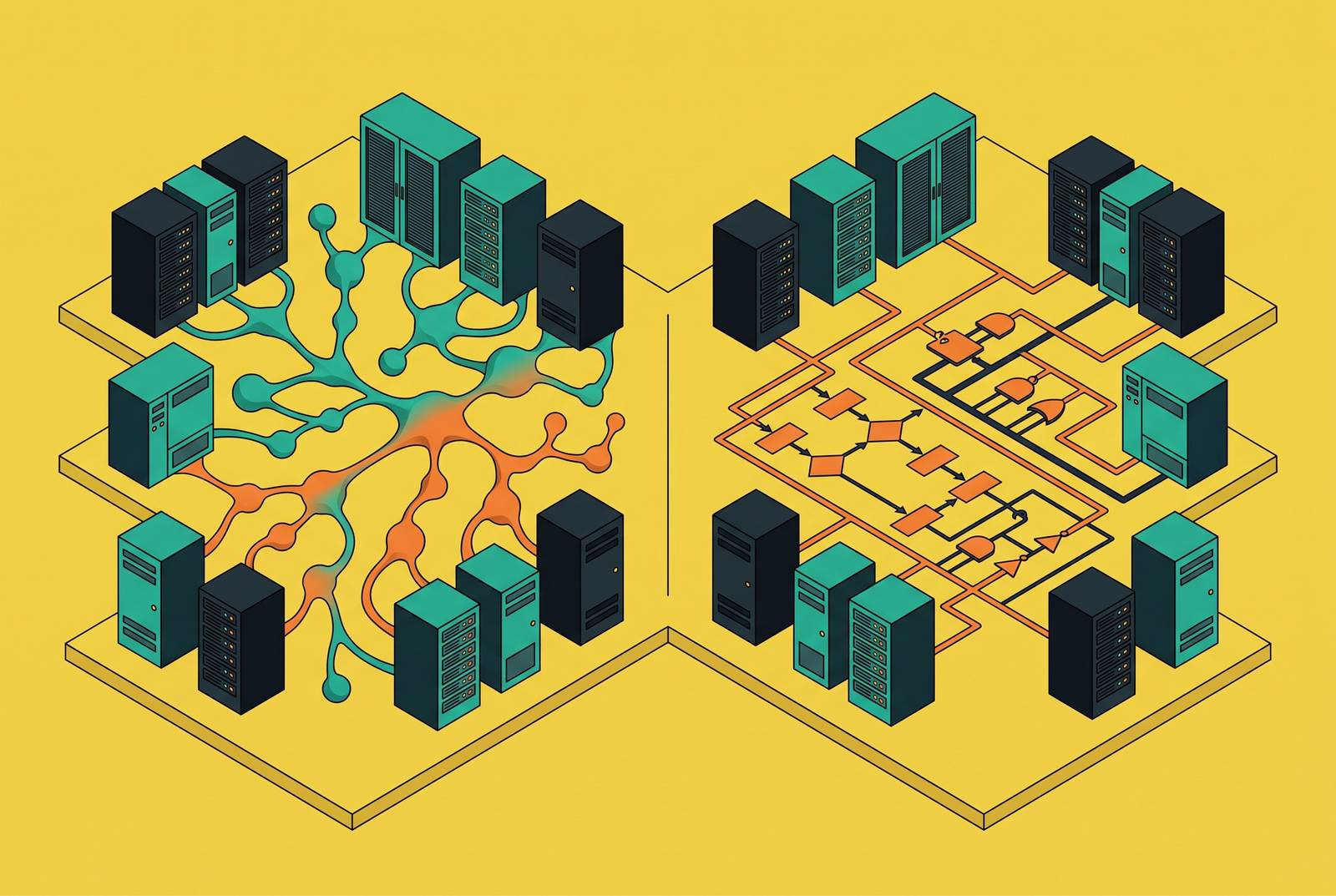
Rules-based automation runs on fixed logic. When it is given a structured input and an explicit condition, if X happens then Y follows, and it fires the same way every time, with no guessing involved. In data center design, that shows up as power-cap enforcement at the rack or outlet level through EPMS and PDU integration, code-compliance checks against Tier classification requirements, and cascade updates: change one rack's power draw, and cooling loads, cable schedules, and construction sheets update with it. The strength here is precision. A rule either fires or it doesn't, and every outcome traces back to a cause. The limit is just as clear: rules need structured information and a pre-built ruleset, and they choke on anything genuinely novel or ambiguous.
AI works differently. It learns patterns from large, often messy data sets, sensor telemetry, historical outage logs, equipment specs written in everyday language, layout constraints, and it generates options or predictions from that mess. In design work, that means generating a layout from a brief, predicting a thermal anomaly before it happens, reading a spec sheet in natural language, or picking equipment out of a stack of manufacturer PDFs. AI handles ambiguity and creative generation where there's no single right answer. But its outputs are probabilistic. A confident, wrong answer in a power path or cooling loop isn't a rounding error, it's a hazard.
Think of it as a maturity ladder. Scripted rule engines make up Level 2: standard reboot sequences, static traffic routing. Level 3 lets machine learning predict anomalies and notify a human, but it doesn't act on its own, rules still decide the boundary of what's allowed. Level 4, the goal most teams are building toward, is closed-loop AI that detects, calculates, and executes, but only inside safety parameters that rules define. None of these levels replace the one below it. Autonomy stacks on top of deterministic rules. It doesn't retire them.
Where rules-based logic is not optional: power, cooling, and compliance decisions
Power systems carry close to zero margin for error, and the money reflects that: electrical scope eats a substantial share of a project's total budget. Rack densities have climbed to a 40 to 130 kW range, and NVIDIA's Vera Rubin NVL72 pushes past 200 kW. No probabilistic model should be interpolating a power path at those numbers. Rules enforce outlet-level power caps, redundancy topology, and load-shedding sequences, and that logic lives deterministically inside EPMS, DCIM, and intelligent PDUs. When a rack moves, the change has to cascade correctly into power budgets, UPS capacity, and switchgear schedules, not approximately, but exactly.
Cooling has the same non-negotiable character, just on a faster clock. Traditional air cooling was built for 5 to 15 kW loads. Modern AI clusters ask for 40 kW, sometimes over 100 kW, an order-of-magnitude jump that breaks the old rules of thumb outright. A Principal and Global Mission Critical Practice Leader at one design firm said: "The typical rules of thumb are moot," once mechanical systems, electrical systems, and on-site power generation start interacting the way they do now. Liquid cooling loops, direct-to-chip, rear-door heat exchangers, immersion, need deterministic flow-rate and pressure rules, because a pressure drop can trigger thermal runaway in seconds. AI can flag the risk. The response has to be governed by rules, because there isn't time for a probability estimate.
Code compliance runs on the same binary logic. Tier II, III, and IV requirements are pass or fail. A facility either meets its redundancy spec or it doesn't, and a probabilistic score has no place in that decision. Rules built into design tools should catch a violation before construction documents go out, not after an RFI surfaces the gap on site. The Uptime Institute's 2025 Annual Outage Analysis found that 58% of human-error outages came down to staff not following established procedure, and 80% of operators said those incidents were entirely preventable. Encode the correct procedure as a deterministic rule, and the human-judgment gap that causes most of these failures disappears.
Where AI earns its place: generation, prediction, and responsive design work
Modern AI data center design works cluster by cluster, not row by row, treating compute, cooling, and power as one integrated system. That configuration space is too big for a person to iterate through by hand and too variable for a static ruleset to generate on its own. Feed AI a brief, power density targets, footprint, cooling topology; it produces candidate layouts and scores them against constraint sets, compressing what used to be days of manual back-and-forth. AI generates the options, rules validate them. Both steps matter, and skipping either one is where things go wrong.
Equipment selection benefits the same way. Manufacturer documentation shows up as PDFs, and natural language AI can pull out power draw, thermal output, dimensions, and weight, then route those numbers straight into models, schedules, and validation rules. Without that step, someone's retyping the same numbers by hand across five different tools, and each retype is a chance to introduce an error.
Predictive monitoring is where AI's pattern-matching earns its keep operationally. Machine learning models chew through historical and real-time telemetry to flag anomalies and coming hardware faults before they cause an outage, that's Level 3 on the ladder: predict and notify, with rules deciding whether and how any autonomous action follows. By the time IT equipment is running hot to the touch, throttling and hardware stress are often already underway. Catching the problem ahead of that threshold is what AI is built to do.
Natural language is changing the interface too. Admins can now configure servers by describing what they want in everyday language, or hand a network optimization task to an AI agent. Routine tasks speed up, and some jobs that used to require deep specialized knowledge become safe to execute without it.
What goes wrong when the boundary is drawn incorrectly
Putting AI where a rule belongs produces a specific failure mode: a layout generation model spits out a power path configuration, and that output is a suggestion, not a validated design. Pushing it straight into construction documents without a rules-based check sends any error already baked into the model's training data straight into the build. In a safety-critical system, a confident wrong answer is worse than an uncertain one, because confidence suppresses the review that would have caught it.
Flip it around: put rigid rules where AI is needed, and the ruleset breaks against real-world complexity it was never built to handle. Wickes again, describing the state of site and building planning today: "All the variables make a Rubik's Cube look easy." Static rules of thumb crack under multi-variable interactions nobody anticipated when the rules were written. Teams that try to hard-code every layout decision end up with rulesets that are brittle, expensive to maintain, and simply wrong for new workload types, many current design standards were written for workload densities far below what modern AI clusters now require.
Then there's the failure that occurs most often in practice: neither AI nor rules doing the job, just people retyping the same information across models, spreadsheets, PDFs, and operational systems by hand. A single rack move cascades into hours of rework across power, cooling, cable, and drawing sheets because nothing automated connects those domains to each other. The Uptime Institute's language for this is "increasing fragmentation in the design and deployment of data centers," and that fragmentation is a workflow architecture decision. It's a workflow architecture decision, made or unmade, project by project.
That fragmentation follows the asset into operations. BMS, EPMS, and DCIM integration all depend on consistent, structured asset data arriving at handoff. If that data was assembled manually and lives scattered across disconnected PDFs, it is incomplete, or mismatched against what actually got installed. DCIM platforms themselves have matured plenty. The bottleneck is almost always upstream: whether the design workflow produced structured data in the first place.
How a connected design workflow assigns AI and rules to the right tasks
The underlying principle is simple to state: structured data everywhere, AI where it speeds things up, rules where precision can't bend. Structured data is what makes both modes function at all. AI needs it to generate valid options, rules need it to validate outputs, and operations needs it the moment the asset changes hands. Without a structured layer connecting design domains to each other, both AI and rules end up working from stale or partial inputs, no matter how good the underlying model or ruleset is.
Early in a project, AI generates the layout candidates from the brief, and rules immediately check them against power budget, cooling topology, code compliance, and Tier classification. Equipment parameters that AI pulls from manufacturer documentation flow directly into models and schedules, skipping the manual retyping step entirely.
Mid-project, the roles shift slightly. When a rack parameter changes, deterministic rules should propagate that change across power calculations, cooling loads, cable routing, and construction sheets automatically, no rework cycle, no manual chase. RFI and submittal workflows can lean on AI to parse a natural-language question, then route the answer back into the design record through a deterministic path that keeps the whole thing traceable.
At handoff to operations, structured data has to route cleanly into DCIM, EPMS, and BMS. DCIM pulls together power chain telemetry, cooling and environmental data, and asset lifecycle records, but only works if the asset data arriving at turnover is actually complete and structured. BMS covers facility-level HVAC and environmental controls; EPMS covers electrical distribution and energy metering, and both need consistent, machine-readable input from the design record to do their jobs. Leading DCIM platforms like Schneider EcoStruxure IT, Sunbird dcTrack, Nlyte, and Eaton can all consume structured handoff data without trouble. The gap almost never sits on the operations platform side. It sits upstream, in whatever produced the data those platforms are fed.
Greenergy Data Centers is a useful example of what this looks like done right: an integrated BMS-EPMS platform built on Siemens Desigo CC gave the operation unified visibility across mechanical and electrical infrastructure. The prerequisite for that wasn't picking the right software. It was having a consistent data architecture underneath it before the software ever got installed.
Evaluating where your design workflow needs rules, AI, or connection between them
Two questions cut through most of the noise here, and they're worth asking about any current workflow, not just a new one.
Where are teams retyping the same information across different tools? The failure is a connection gap, and no amount of better modeling or smarter automation fixes it until the underlying data flow gets built.
Where do design changes trigger manual rework across multiple domains, power, cooling, cable, drawing sheets, all at once? That's a rules gap specifically: the cascade that should happen automatically isn't automated, and someone's doing by hand what a deterministic rule should be doing in seconds. Neither of these questions gets answered by throwing more AI at the problem, and neither gets solved by writing more rules either. They get solved by figuring out, task by task, which kind of automation the job actually calls for, and then making sure the data underneath both can move freely between them. Archil Labs, a data center design automation platform that pulls equipment parameters directly from manufacturer PDFs into models, schedules, and validation rules, is one example of software built around exactly that connection.