Risk of AI Hallucination in Critical-Facility Engineering Outputs
AI systems confidently invent facts that become physical infrastructure.
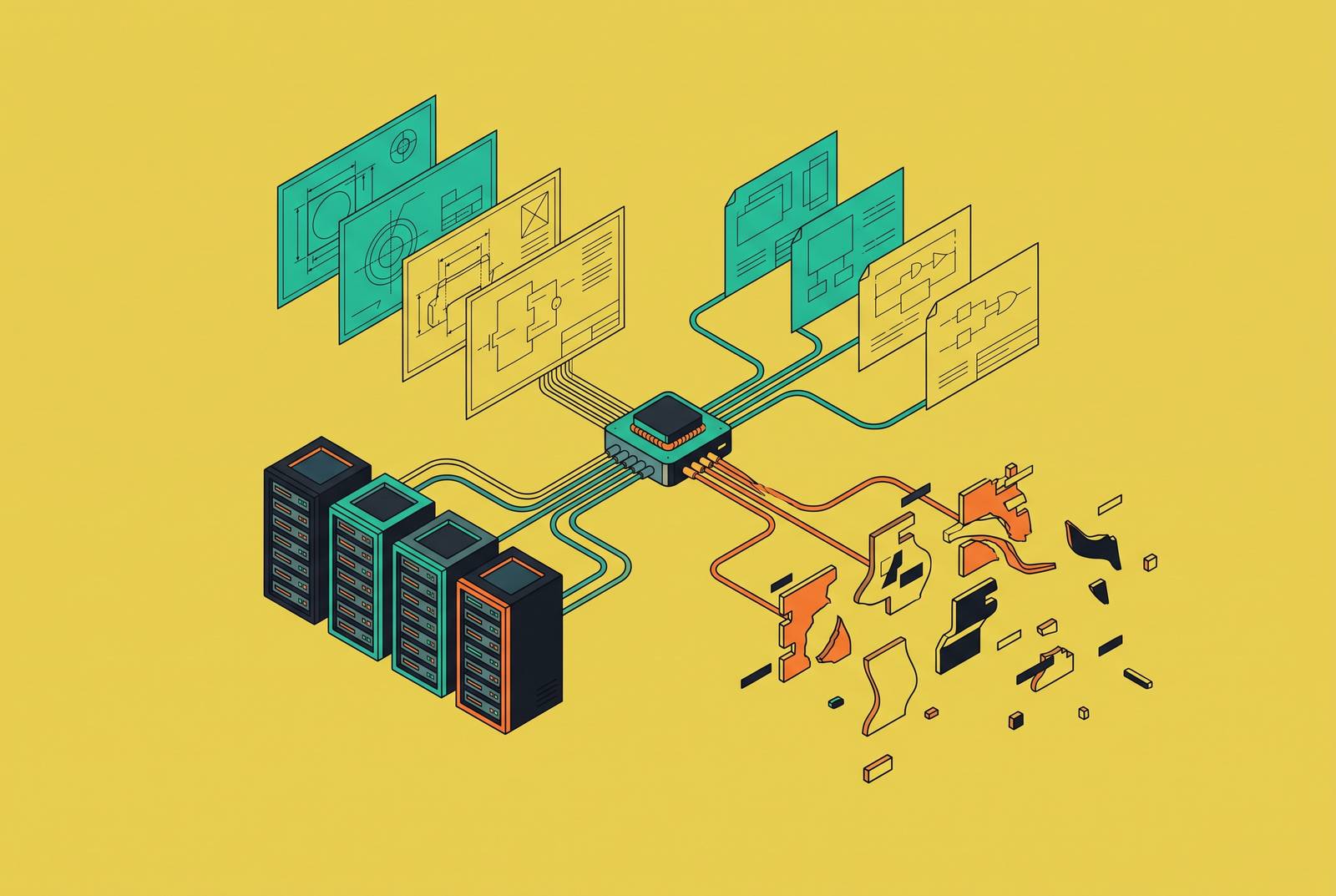
In critical-facility engineering, a hallucinated fact doesn't stay a language problem for long. It becomes a load schedule, a conduit route, an equipment tag, and from there it becomes concrete, copper, and steel. The fix is to know exactly which rooms AI is allowed into, and which ones need a locked door and a rulebook instead. It's to know exactly which rooms it's allowed into, and which ones need a locked door and a rulebook instead.
Why AI hallucination is a structural problem, not a reliability footnote
Start with what a hallucination actually is, because the word gets used too loosely. It's a genuine model output produced with full mechanical confidence, not a typo or a moment of the model "getting confused."" It's an output that reads as correct, sits comfortably in context, arrives with full confidence, and is simply false. Oxford's language for this is blunt: the model invents facts that sound plausible but are imaginary. Nothing about the sentence signals doubt, because there's nothing inside the model built to signal doubt.
The distinction between confidence and accuracy matters. A language model is trying to produce the next most probable word, given everything that came before it. It's trying to produce the next most probable word, given everything that came before it. Confidence and accuracy are two separate variables that happen to travel together most of the time, and when they split apart, the output doesn't look any different on the surface; rising AI rack densities are now forcing operators to coordinate power, cooling, facility design, and grid constraints more closely, so the interdependency graph that a hallucinated output can corrupt has more nodes than it did even two years ago.
The numbers back this up at a scale that's hard to wave off. Stanford's 2026 AI Index documented 362 AI incidents, cases where systems caused real harm, failed in production, or produced outcomes nobody intended Stanford 2026 AI Index Report. That's not a handful of anecdotes traded at a conference. It's a measured, growing corpus. Layer in the money: industry estimates put the global business cost of AI hallucinations at $67.4 billion in 2024, climbing toward $112 billion in 2025 as adoption keeps accelerating Axis Intelligence. And adoption is accelerating: 78% of organizations now use AI tools, up from 55% just a year before IntuitionLabs Report arxiv.org. The exposure is close to universal. It's close to universal.
Engineering teams specifically should worry about this. Artificial Analysis ran a benchmark called AA-Omniscience across 40 models in 2025, testing them on difficult questions. All but four of those models were more likely to answer confidently and wrong than to answer correctly. That's not a rounding error in model design, it's the design incentive working exactly as built: guess fluently, don't abstain. ISACA said in 2025 that hallucinations aren't quirks, they're safety risks, and any high-impact AI system needs to be built on the assumption that it will sometimes be confidently wrong.
How the cost of false confidence varies by domain
Not every hallucination costs the same. A wrong fact in a marketing email is annoying. A wrong fact in a load calculation is a different category of problem entirely, because someone downstream is going to trust it and build on top of it.
The research on this is direct: what matters isn't the raw hallucination rate, it's the cost of being wrong with confidence. A given error rate might be perfectly tolerable in creative writing and completely unacceptable in medical advice. Critical-facility engineering sits right next to medicine on that scale because the failure mode matches: a wrong load schedule, a misrouted conduit, a mislabeled piece of equipment can slide straight into construction documents or live operational systems before a single human notices.
Agentic workflows make this worse, not better. Microsoft Research's VeriTrail paper, accepted at ICLR 2026, found that in multi-step AI workflows, errors don't stay contained. They propagate. A single hallucination introduced early in a chain of automated steps can quietly corrupt every output that follows, and none of it gets flagged until a person finally looks at the finished product.
None of this is an argument for keeping AI out of engineering work. It's an argument for being precise about where its probabilistic nature is genuinely useful, and where that same trait turns into a liability that needs a completely different kind of control. To see why that line matters so much in this industry specifically, it helps to look at what's actually being built right now, and at what speed.
The build environment that makes engineering errors catastrophically expensive
The scale of construction underway right now sets the stakes. JLL's 2026 Global Data Center Outlook projects close to 100 gigawatts of new data center capacity coming online between 2026 and 2030, effectively doubling global capacity in that window JLL Data Center Outlook. Every gigawatt of that is expensive, and getting more expensive fast: average shell-and-core cost now runs $11.3 million per MW, up 6% from $10.7 million in 2025, and nearly double the $7.7 million per MW figure from 2020, a compound growth rate of about 7% a year JLL Global Data Center Outlook 2026.
Electrical systems eat the biggest share of that budget, typically 40% to 50% of total project cost, and AI-optimized tenant fit-outs can push spending to $25 million per MW ConstructElements JLL DCNT Global. That's the part of the build where an engineering mistake does the most financial damage per square foot.
Procurement has become its own risk multiplier. Lead times for switchgear and other critical electrical equipment have stretched to roughly three years, with cost increases of 20%–100% JLL Data Center Outlook. Teams routinely have to commit to orders before specifications are fully locked down. A hallucinated spec that triggers an early order doesn't just create a paperwork correction. It creates rework that the schedule has no slack to absorb JLL Data Center Outlook.
Coordination tolerances shrink across every discipline as a result. And the standards themselves aren't holding still long enough to be memorized: cooling approaches, structural loading assumptions, and power train configurations are shifting in months, not years. A model trained on last year's design conventions can produce something that sounds authoritative and reflects an assumption nobody uses anymore. AI data centers now commonly target rack densities of 50–100 kW+, requiring liquid cooling, high-capacity power distribution, and low-latency network fabrics, a density shift that compresses coordination tolerances across every discipline, per DCNT Global 2026 analysis JLL Data Center Outlook.
Where hallucination risk concentrates in critical-systems coordination
Data centers rank among the most coordination-heavy construction types that exist. Power distribution, cooling, cable routing, security systems, and structural elements all converge in tight physical space, with effectively zero tolerance for a conflict discovered after the fact.
Routing is the highest-frequency target for this kind of error. Conduit fill limits, cable tray loading, bend radii, fiber protection zones, and the separation required between power and data lines are all governed by deterministic code, not judgment calls. An AI generating a routing layout without checking those constraints can produce something that looks geometrically fine on a drawing and still violates NEC requirements or basic constructability, and that kind of error is typically caught only once fabrication or commissioning is underway. At $11.3 million per MW, a routing conflict caught at commissioning is a schedule and budget event JLL Global Data Center Outlook 2026. It's a schedule and budget event JLL Global Data Center Outlook 2026.
Power system coordination carries the same weight, just concentrated in different numbers. Load schedules, panel schedules, and circuit assignments involve exact arithmetic and tag-to-tag traceability, precisely the kind of low-frequency, highly specific factual recall where hallucination rates run highest. An incorrect load number that flows into generator sizing, UPS selection, or a switchgear order placed under a three-year lead time doesn't stay a small error JLL Data Center Outlook. It compounds fast, in both schedule and capital.
Cooling coordination adds another layer. The shift from perimeter air cooling toward cold-plate and immersion systems demands precise hydraulic calculations, structural load inputs, and floor penetration coordination that all have to agree with each other. Schneider Electric's 2026 analysis notes that rising rack densities are pushing operators to coordinate power, cooling, facility design, and grid constraints more tightly than before. The web of dependencies a single hallucinated number can corrupt has more connections in it than it did two years ago.
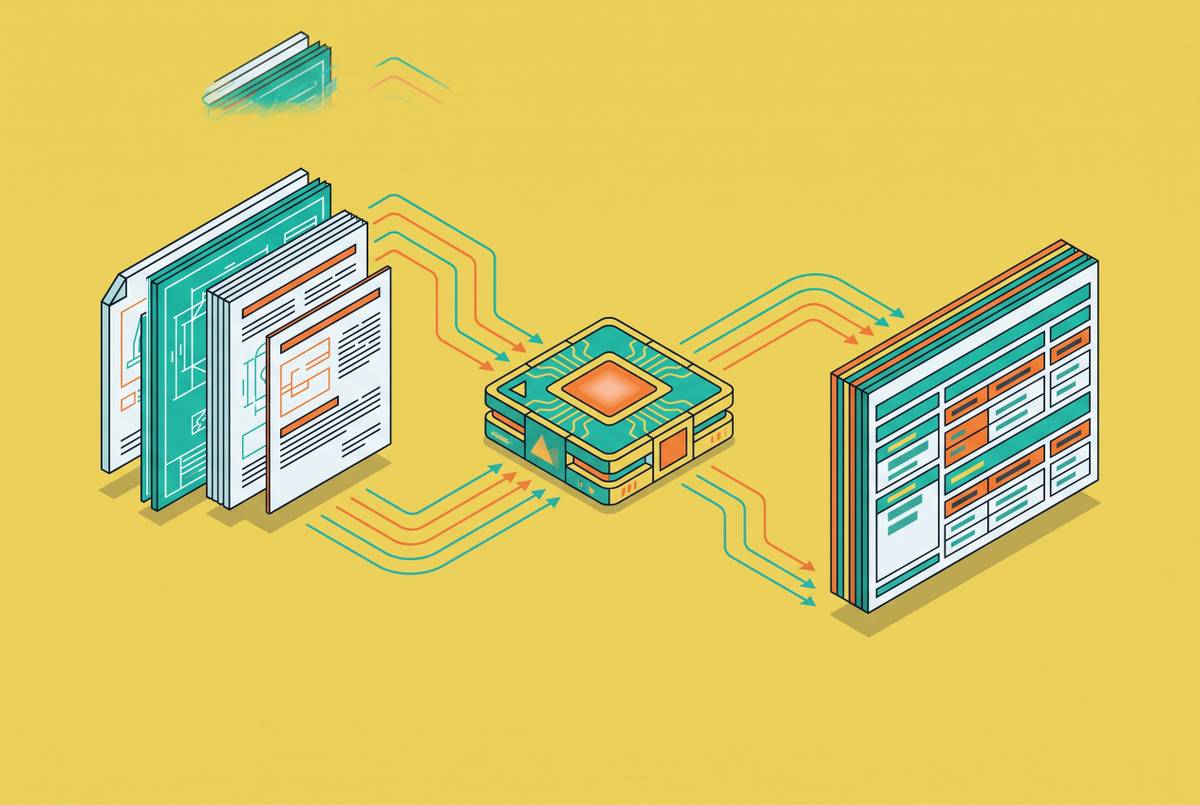
Equipment data pulled from manufacturer PDFs deserves its own mention, because it's a near-perfect setup for confident error. Asking a model to extract or interpret specs from a poorly structured document puts it squarely in low-frequency, high-specificity factual territory, exactly where confident wrong answers occur most often: a wrong weight, a wrong footprint, a wrong electrical rating, all flowing quietly into models and schedules.
Design-stage coordination failures are painful but recoverable, generally at some cost. What's harder to recover from is a hallucinated fact that survives design entirely and ends up in the systems running the building. Electrical systems represent 40%–50% of budget, making them the highest-value target for design error ConstructElements DCNT Global.
What happens when hallucinated data reaches operations handoff
Handoff is where a design error stops being a design error. Asset data moves out of drawings and specs and into DCIM, EPMS, and BMS, systems that treat whatever they're given as ground truth for monitoring the power chain, controlling the environment, and planning capacity. Each one does something different, and mixing them up leads to misapplied fixes or missed failures. BMS handles facility-level HVAC and environmental control. EPMS covers electrical distribution and energy metering. DCIM sits above both of them, aggregating power chain telemetry, environmental data, and asset lifecycle information across every site, operating as a cross-site layer in a way that BMS and EPMS individually don't.
A hallucinated equipment tag or a wrong rated capacity that makes it into DCIM becomes the basis for a capacity planning decision somewhere down the line. A wrong load figure in EPMS quietly sets alarm thresholds and skews energy reporting. A wrong footprint in BMS throws off environmental zone configuration. None of these appear as an obvious failure right away. Instead they appear as decisions that look reasonable given the data, except the data was wrong from the start.
The risk gets sharper as facilities automate further. Softweb Solutions' autonomy spectrum tracks the move from scripted rule engines (Level 2) through predictive machine learning (Level 3) toward closed-loop autonomous response (Level 4). Corrupted asset data sitting in that pipeline can trigger automated action with no person checking it first. A survey by the EY/AIUC-1 Consortium found that only 38% of organizations have end-to-end AI monitoring, and just 17% monitor agent-to-agent interactions JLL EY/AIUC-1 Consortium survey. Most facilities simply don't have the visibility to catch a bad input before it propagates through an automated workflow.
There's a useful financial parallel here from cybersecurity. Same pattern: a known risk, an infrastructure gap that could have closed it, and nobody closing it in time. The IBM/Ponemon 2026 Cost of a Data Breach study puts the average breach cost at USD 4.99M, with 92% of organizations experiencing AI-related breaches lacking proper AI access controls, a pattern of known-risk infrastructure gaps going unaddressed that maps directly to the monitoring gap at operations handoff.
Drawing the hard line between probabilistic AI and deterministic rules
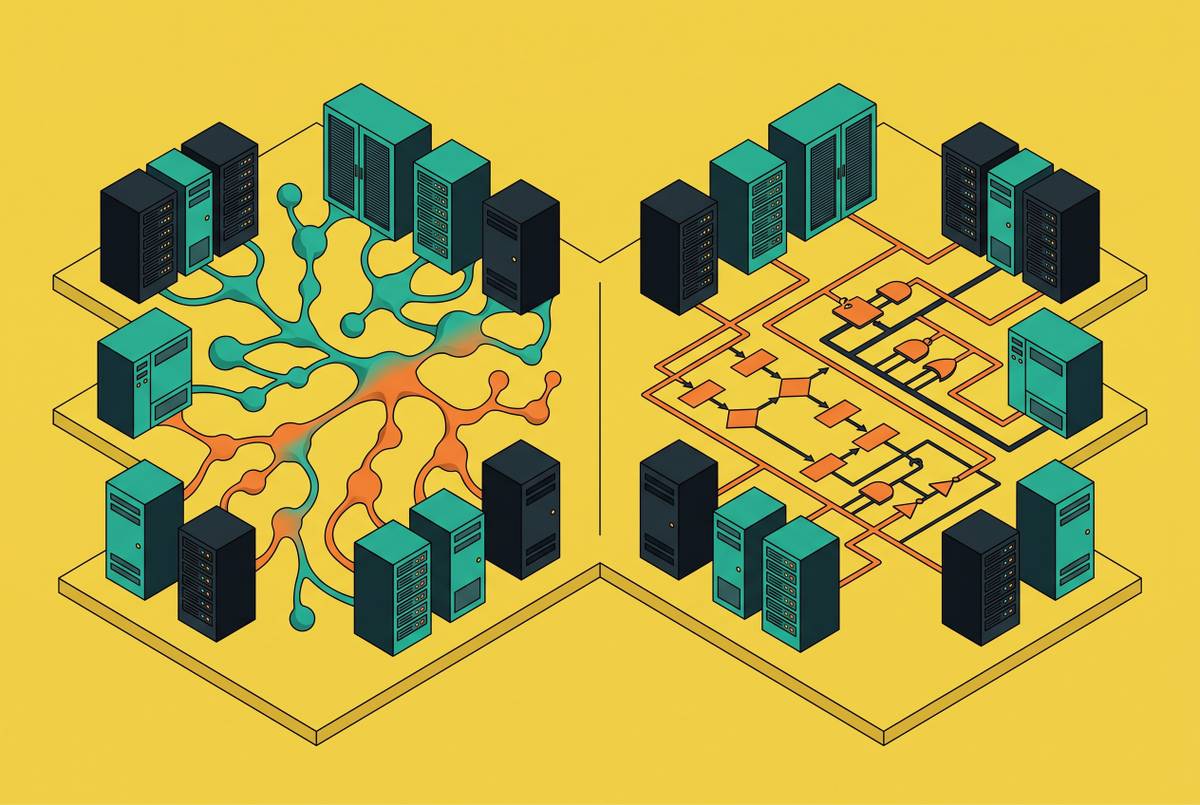
Having laid out what breaks across design, construction, and operations, the obvious next question is what to actually do about it. The answer is to put AI and deterministic rules in the specific spots where each one is reliable, and stop asking either to do the other's job. It's to put AI and deterministic rules in the specific spots where each one is reliable, and stop asking either to do the other's job.
Probabilistic AI earns its place in a few clear spots. Reading RFIs, parsing submittal language, drafting response text, summarizing a specification change, these are jobs where fluency and contextual flexibility drive the output quality, while exact arithmetic is not the determining factor. Pulling equipment specs out of manufacturer PDFs is another good fit, as long as everything extracted gets checked against schema rules before it enters the model. Documentation search and cross-reference works well too: surfacing the likely relevant section of a spec or a prior RFI is genuinely useful even when it's not a perfect match, because a person reviews it next anyway.
Deterministic rules need to own everything else, without exception. Load schedule math and circuit-to-panel assignments have one correct answer, so a probabilistic model has no business being the final say on any of them. Conduit fill, cable tray loading, bend radii, and separation requirements are governed by code, with zero tolerance for a confident guess. Every equipment tag that eventually flows into DCIM, EPMS, or BMS needs to be generated and checked by rules, not inferred by a language model, because traceability depends on it. And redundancy logic, N+1, 2N, whatever the fault-tolerance scheme, has to be verified against the connected model by deterministic rules, not produced by a system that's pattern-matching its way to something that looks right.
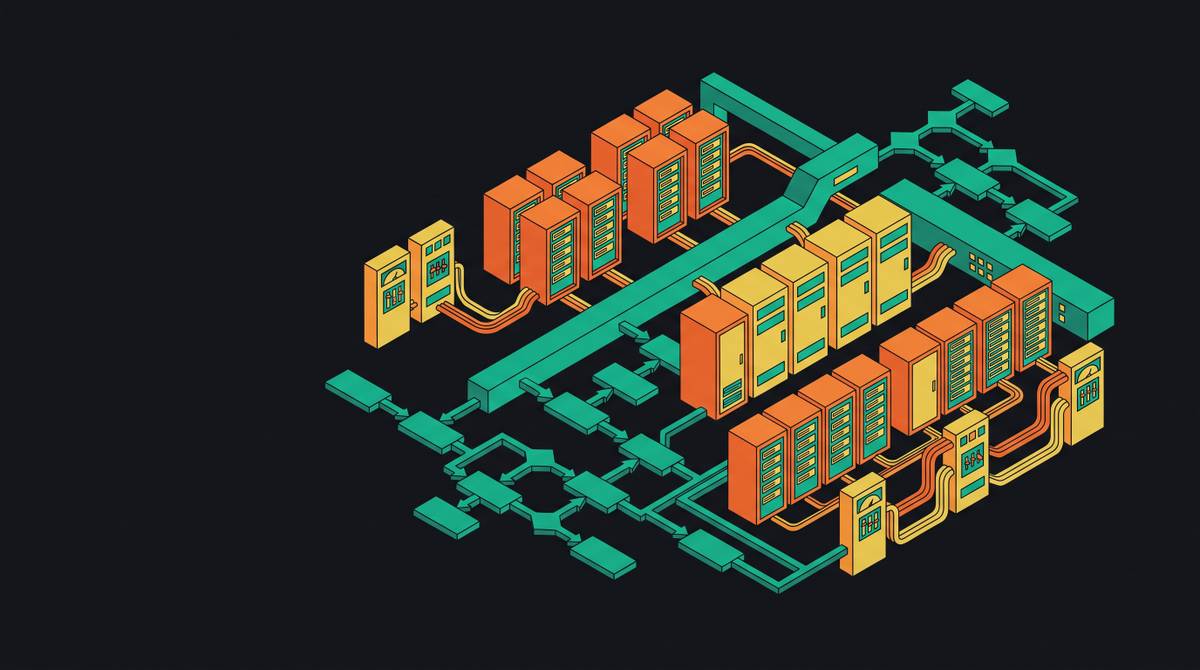
The cascade principle ties this together. In a properly built workflow, moving a rack automatically ripples through power, cooling, cable, schedules, and sheets, all handled by deterministic rules, not by an AI guess that might miss a tray conflict or hallucinate an updated load figure. Komprise's research identifies incomplete, unclassified, inconsistent, or context-stripped underlying data as the root cause: hallucinations get worse when this data condition is present. A single source of truth with schema-enforced asset records shrinks the conditions that produce hallucinations in the first place, regardless of which AI tool sits on top of it. The Bokkasam/Durgalakshmi 2026 governance paper makes a parallel argument for enforcement itself: policy checks need to run inline, at sub-100ms latency, not as an audit that happens after the damage is done JLL Data Center Outlook. Design workflows need the same discipline: constraint checking runs inline, as the work happens, not as a review step bolted on afterward. Probabilistic AI earns its place in critical-facility workflows.
What a connected, constraint-aware workflow looks like in practice
Most critical-facility projects today carry a structural data problem that makes all of this worse. The same information gets manually rebuilt across separate models, spreadsheets, PDFs, and operational systems, and that fragmentation, incomplete data, inconsistent formats, missing context, is exactly the condition under which AI hallucinates most aggressively.
A connected workflow closes that gap in a few concrete ways. Layouts, power calculations, cable routing, and equipment records share one source of truth instead of a fragmented, multi-format estate, so any AI tool touching that data is working from something grounded and consistent rather than an estate that invites hallucination. Change propagates through deterministic rules rather than inference: move a rack, and power, cooling, cable, and sheets recalculate automatically, producing an output that's traceable and auditable instead of a probabilistic best guess. AI still does the heavy lifting at intake, accelerating spec extraction from manufacturer PDFs, but nothing extracted reaches a schedule or a model until it clears deterministic validation. And at handoff, DCIM, EPMS, and BMS receive asset data generated by that same rule-governed process. In RFI and submittal traceability, natural-language AI assists drafting and cross-reference, with every decision tracing back to the structured data and documentation that supports it. ArchiLabs Studio is purpose-built for exactly this.