Engineering Lock-In Points in Modular Data Center Projects
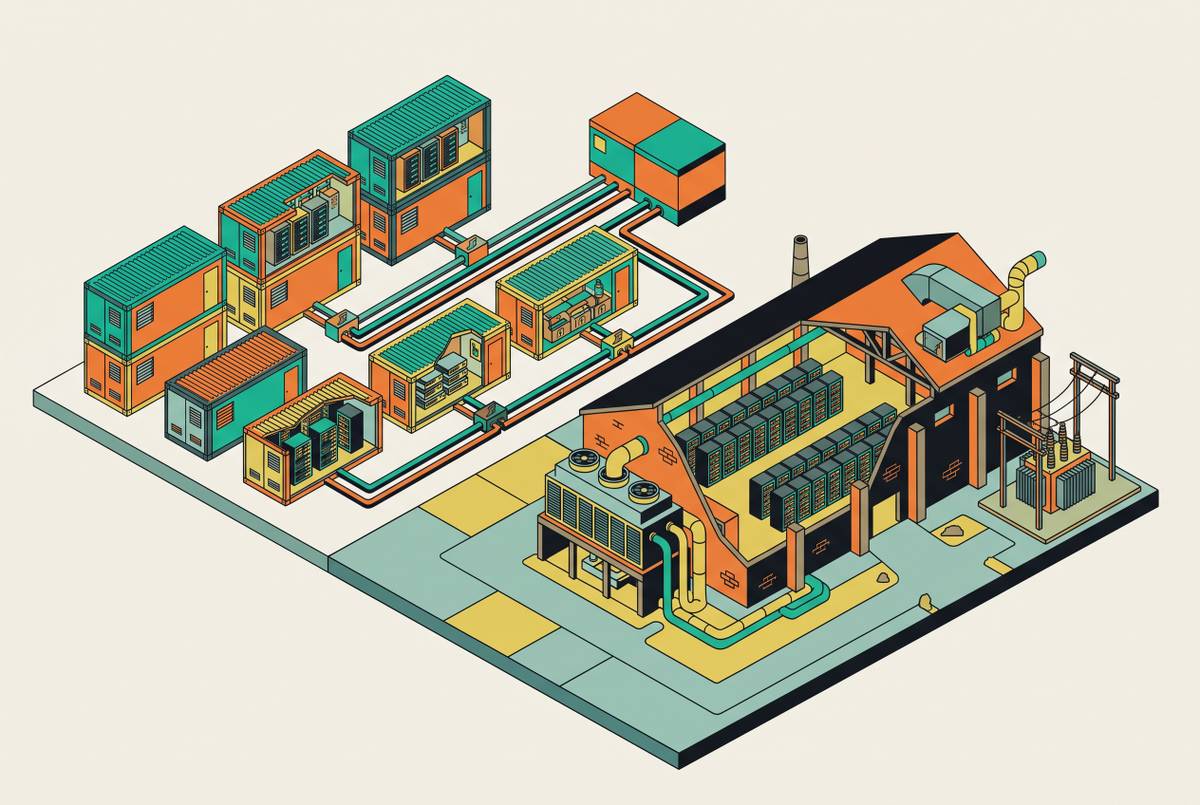
Modular data centers lock engineering decisions before site conditions are fully known.
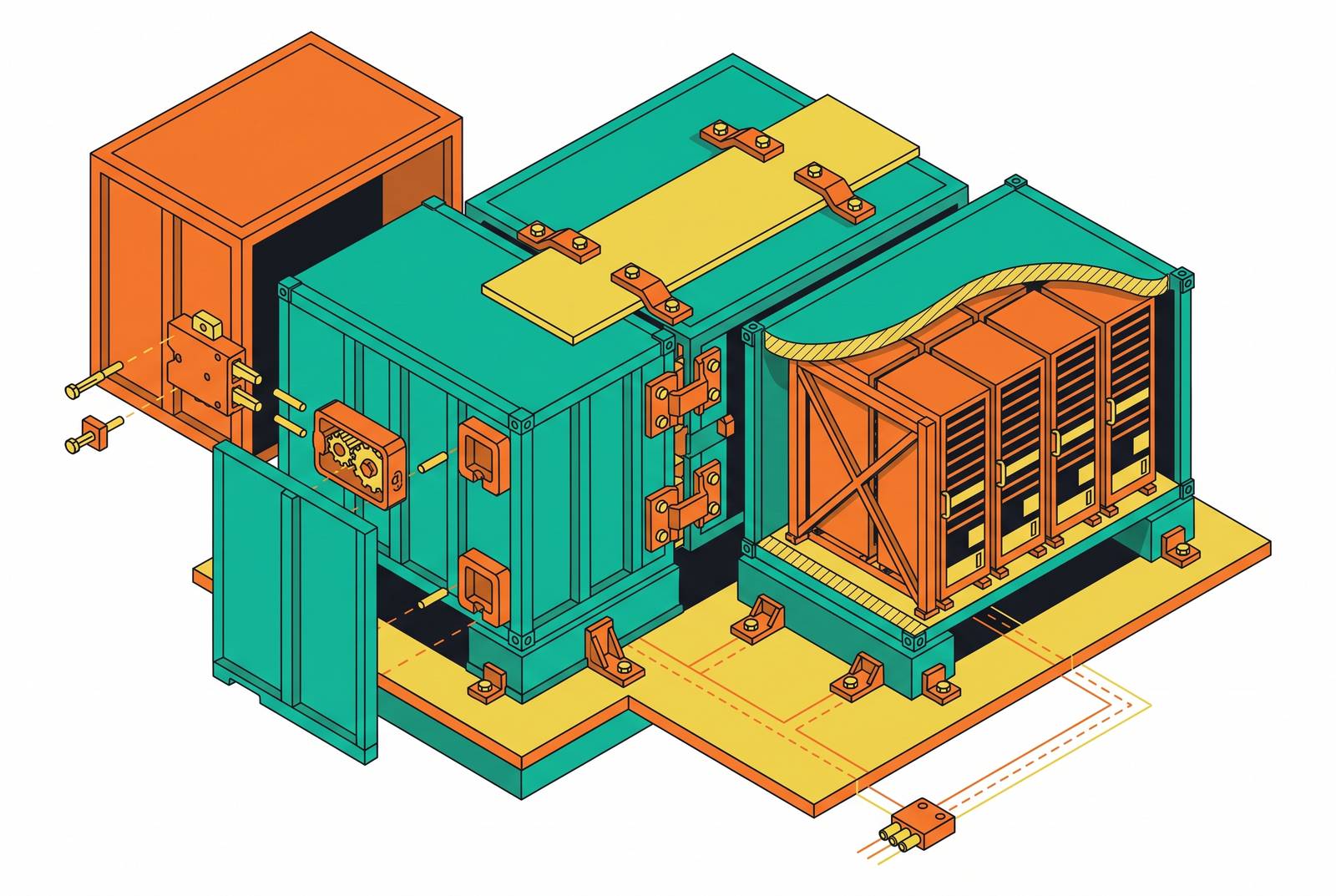
Modular data center delivery earns its reputation honestly. Compressing a build timeline by 30 to 50 percent, as industry analysis of 2026 delivery programs confirms, is a genuine advantage for any owner racing to bring capacity online. Factory conditions produce more consistent quality control than a muddy site, and parallel fabrication lets owners build while permits and utility work still move forward, which makes both the speed case and the cost case concrete. None of that is in dispute.
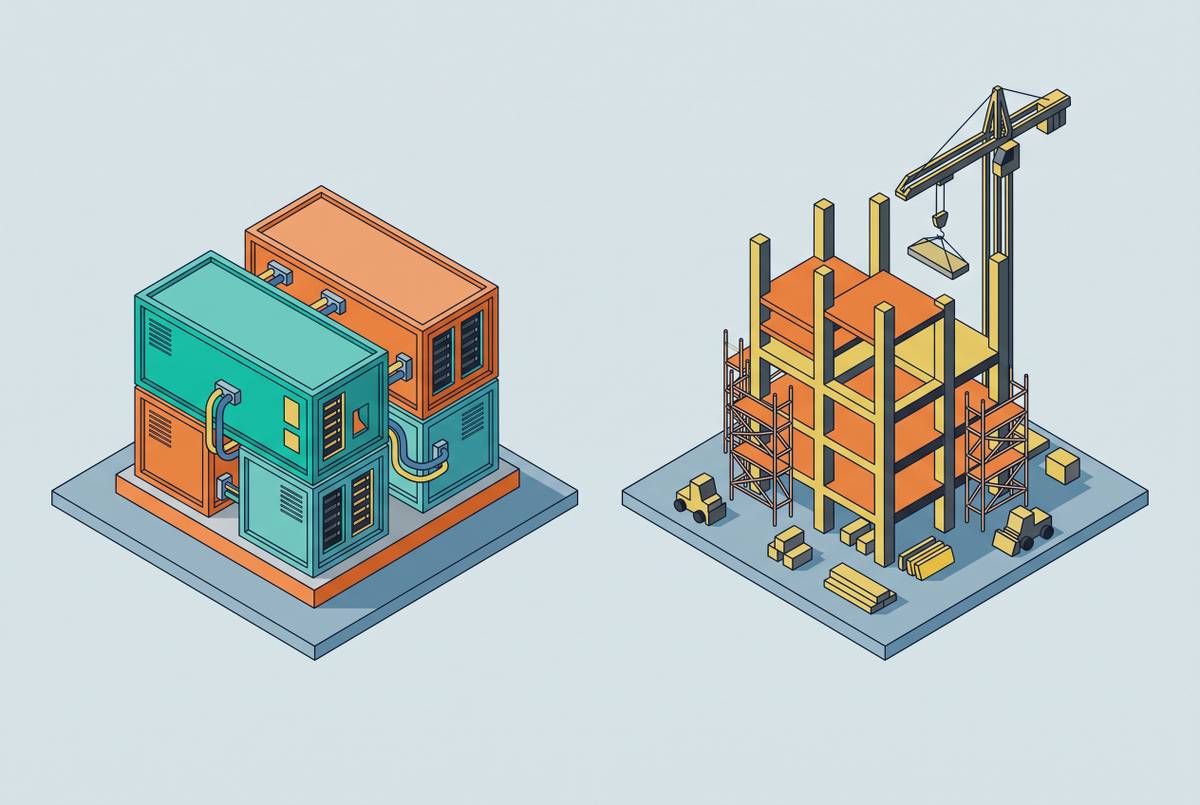
What that compression actually does is relocate the moment of commitment. Traditional, site-centric construction lets design, procurement, and field coordination overlap. An error discovered on-site in month eight can still be corrected, because the systems it touches haven't been built yet. Modular delivery removes that overlap. Design completion, procurement decisions, and vendor coordination have to happen earlier, and with far less room for revision, because factory production starts before the site conditions those modules must eventually meet are fully resolved. Factory pricing locks in before the building around it is finished being figured out.
The schedule and the decision window move in opposite directions. When a project moves faster toward occupancy, it also moves faster toward the point where you can no longer change its engineering assumptions without real cost. That trade is the one the delivery model makes, and every section that follows is a consequence of it: the industry hasn't yet built the coordination discipline to match the speed it has already achieved.
How AI workload requirements make the timing problem worse
The lock-in window created by modular delivery was always tight. What's changed is how expensive it is to guess wrong inside that window, because the thing being locked in, the rack itself, is moving faster than the construction cycle that has to accommodate it.
Current construction programs are designing for rack loads between 15 and 50 kilowatts. Five years ago, 5 to 8 kilowatts was the norm. That's not a narrow band an engineer can split the difference on. A facility built to serve the low end of that range looks nothing like one built for the high end, and a module optimized for one point in it is hard to repurpose for another. Campus-scale developments now target total power envelopes exceeding 100 megawatts, putting electrical and mechanical coordination at the center of planning. Some owners now ask for design loads above 100 to 200 kilowatts per rack, and that number forces a full rethink of a site's mechanical and electrical architecture, because the infrastructure has to serve a facility-wide average density while still provisioning for pockets of extreme demand.
Layer onto that the generational cycle of GPU platforms, which refresh roughly every 12 to 18 months. The hardware a facility will actually host may not be fully specified at the moment module layouts have to be frozen. Liquid cooling has gone from scattered pilot projects to planned adoption across entire facilities, bringing piping tolerances, pressure testing, and controls coordination that have to be resolved during installation rather than at the comfortable, flexible end of a project.
The gap between a wrong density assumption made at module specification, and the moment that assumption becomes visible on-site, is precisely the window in which the factory has already built to a different spec. In conventional construction, that gap was an inconvenience. In a modular AI data center project, it's a redesign.
The five interface categories where lock-in concentrates
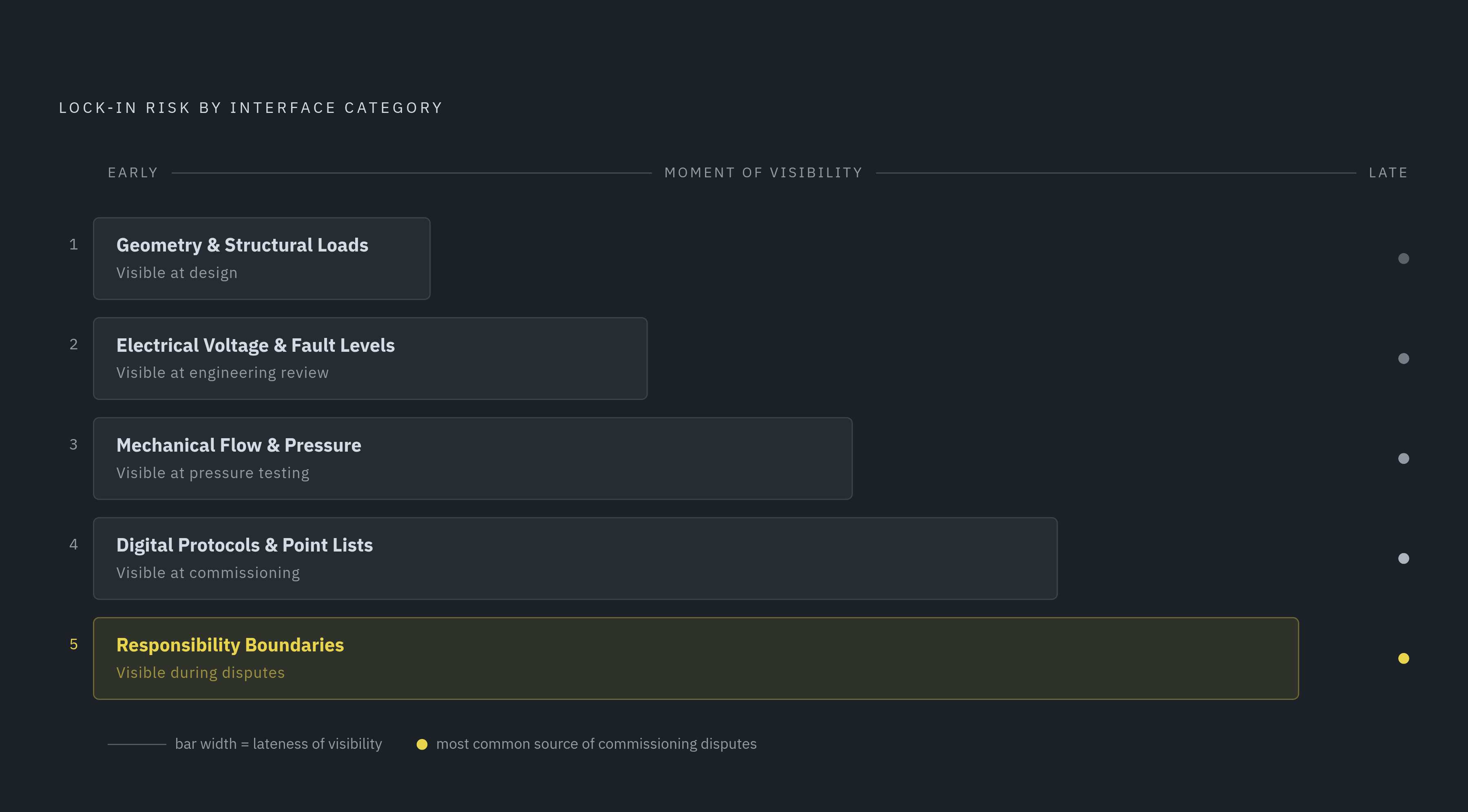
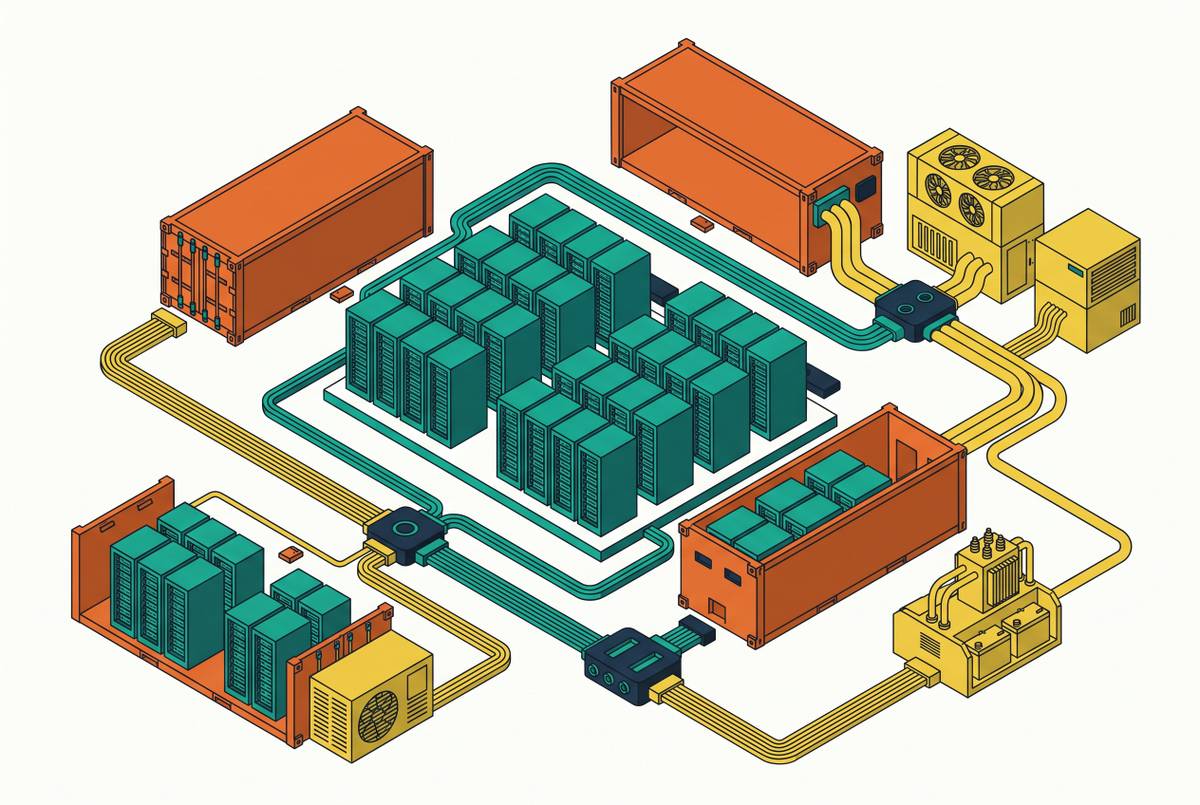
Lock-in doesn't spread evenly across a modular project. It concentrates at the seams, the specific boundaries where a factory-built assembly has to connect to a system it wasn't built alongside. Five categories cover where that risk lives, and a project team can use them as a checklist before any module layout gets frozen.
Geometry and structural loads come first: module dimensions, floor loading, and the structural interface to civil works. Once foundations are poured and structural steel is committed, those assumptions are fixed for the life of the building.
Electrical voltage and fault levels follow: the medium-voltage boundary, protection coordination, and the fault-current assumptions built into a module's switchgear and UPS. After the factory build is complete, changing any of that forces the protection scheme across the entire distribution path to be redesigned.
Mechanical flow and pressure make up the third category: coolant supply temperature, flow rate, and pressure drop assumptions baked into CDUs and rack-level cooling. A mismatch against the site's actual plant appears during pressure testing, by which point installation is already finished.
Digital protocols and point lists are the fourth: the BACnet, Modbus, or SNMP point lists a module's controls export to the BMS, EPMS, and DCIM. A mismatch here stays invisible until commissioning, and it can delay energization.
The fifth category is responsibility itself: exactly which tests, certifications, and acceptance criteria belong to the module vendor, and which transfer to the EPC or owner. Ambiguity here is the single most common source of commissioning disputes on modular projects.
Five common project forms, complete modular facility, IT or data-hall module, power or cooling module, compact edge facility, and hybrid campus, each leave a different combination of these five interfaces unresolved at handoff. Buyers need to compare exact delivered scope against each other, not the advertised dollars per megawatt. And because large generators, transformers, and switchgear carry lead times of 12 to 18 months, the electrical interface assumptions have to be locked before procurement even starts, which itself usually precedes most site coordination by a year or more.
What a reference design like NVIDIA DSX reveals about lock-in as a deliberate strategy
Reference-design ecosystems make lock-in concrete, because some vendors have built it into their architecture on purpose, as a feature.
NVIDIA's DSX platform is the clearest current example. It was first unveiled as an Omniverse digital-twin blueprint at GTC Washington in October 2025, formalized as the Vera Rubin DSX AI Factory reference design in March 2026, and has since expanded into the full DSX platform. The ecosystem now extends to more than a dozen companies, including Cadence, Dassault Systèmes, Eaton, Jacobs, Schneider Electric, Siemens, and Trane Technologies, each contributing platforms, simulation-ready digital assets, and software integrations. Trane Technologies announced Reference Design #501 on October 28, 2025, described as the industry's first comprehensive thermal management system reference design for gigawatt-scale AI data centers, engineered specifically for the NVIDIA Omniverse DSX Blueprint. That single announcement makes thermal architecture a defined parameter of the ecosystem.
The value proposition is genuine: these interface decisions get resolved inside the reference design before a project team ever touches them, which accelerates delivery and reduces the risk of a mismatched handoff between vendors. Committed deployments prove the ecosystem is operational. IREN's Sweetwater campus in Texas is the flagship DSX site, with plans supporting as much as 5 GW of DSX-aligned infrastructure across IREN's global pipeline and Sweetwater itself totaling 2 GW. CoreWeave and Hut 8 have also committed to DSX.
The same argument that makes DSX valuable is the argument that makes it a form of lock-in. Eliminating iteration means embedding NVIDIA's stack as the engineering starting condition for the entire project. A future change to workload, hardware generation, or cooling technology has to be negotiated against a reference design the owner didn't author. That doesn't make DSX, or ecosystems like it, the wrong choice. It makes adoption of a reference design a decision that deserves to be made explicitly, with a clear understanding of which interface categories are being pre-resolved, and on whose terms.
Why power and cooling sequence decisions are the earliest and least reversible
Of the five interface categories, power and cooling form earliest in a modular project's timeline, so they carry the longest downstream consequences. A wrong assumption here doesn't get absorbed by schedule float the way a minor cabling clash might, and it cascades.
High-voltage utility interconnections, on-site substations, redundant distribution paths, and standby generation all require early design lock paired with long procurement cycles. Civil work, structural installation, and equipment energization have to line up with precision, and a delay in any single package can stall commissioning across the entire facility.
Liquid cooling tightens the sequencing demands further. Piping tolerances tighten. Pressure testing becomes more extensive. Mechanical trades, controls teams, and IT vendors all have to coordinate during installation, ahead of the late-stage fit-out window where that kind of coordination used to happen. The cooling method itself becomes a fork in the road that can't be reversed once a module is fabricated: direct-to-chip and immersion systems carry different structural loading, different fluid management infrastructure, and different maintenance access than air-cooled equivalents. A module built for one cannot be converted to the other on-site.
Battery energy storage integration works the same way, just on a smaller scale. If onsite energy storage integration isn't resolved before civil scope is fixed, the critical path extends by several months, because structural loading, fire safety design, and electrical sequencing all need to be embedded in the module specification.
The common thread across all of it is sequencing. Whether liquid cooling delivers on its promise depends less on the cooling technology itself and more on how well it integrates with power, monitoring, and operational systems. That integration interface has to be specified before either the power module or the cooling module goes to the factory. And when the power module, the cooling module, and the civil works come from different vendors on overlapping schedules, the interface between them is the exact parameter that governs whether the facility commissions on time, and it belongs to no one unless a project team explicitly assigns ownership of it.
How RFIs and submittals signal that lock-in decisions were not resolved in time
A spike in RFIs and submittal rejections on a modular project is a diagnostic signal, not a paperwork backlog. It's evidence that interface decisions got left open past the point where they could still be answered cheaply.
The RFIs that actually threaten schedule on a modular project are rarely about large engineering unknowns. They're about interface parameters that were assumed instead of resolved: voltage levels, point lists, flow rates, responsibility boundaries. Those assumptions become visible during installation, at the moment a factory-built assembly meets site conditions for the first time. The management failure isn't answering RFIs slowly. It's failing to score each one for what it actually threatens: a low-dollar clarification can still block electrical energization or integrated systems testing if it touches an unresolved interface assumption underneath it.
Every RFI deserves evaluation against five dimensions: schedule, procurement, cost exposure, commissioning, and downstream coordination risk. On a modular project, the commissioning and coordination dimensions are where the real damage concentrates, because that's where factory work and site work finally meet. Submitted equipment that doesn't match a module's interface specification, because the specification was underresolved at the time of procurement, generates rejected submittals that add weeks at exactly the phase where the schedule has no float left to give.
Fragmentation is the deeper issue. When module specifications, procurement records, RFI logs, and commissioning plans live in separate tools with no shared data model, a project team can't see that three open RFIs are all pointing at the same unresolved interface assumption. They look like independent items until one of them blocks energization. A connected workflow, where a change to a module interface parameter propagates automatically through the procurement record, the commissioning plan, and the relevant RFI log, is the structural answer to that problem. Manual reconciliation across disconnected tools cannot catch the pattern in time to act on it.
Why the handoff to operations is itself a lock-in event
The lock-in that begins at module specification doesn't end at energization. It completes at turnover, when the asset data structure inherited by DCIM, EPMS, and BMS becomes the operational baseline the facility runs on, often for a decade.
These three systems aren't redundant with each other. The BMS controls and monitors the mechanical and environmental plant. The EPMS monitors the electrical path from utility incomer to rack. DCIM manages IT assets, rack space, power capacity, and network connectivity in the white space. DCIM consumes data from the other two rather than replacing them, and the outages that matter most happen in the gaps between the three systems, not inside any one of them.
That multi-system stack needs structured asset data at turnover. Digital handover means validating the as-built model, the assets, the warranties, the settings, and the O&M data, with an asset information model and digital twin dataset as the output. On most programs, that data is still manually transcribed from paper submittals or unstructured PDFs. Accuracy degrades every time it passes through a manual step, and the operations team inherits the construction team's nomenclature schemes, asset hierarchies, and coordinate assumptions. Those inherited assumptions persist for years, because correcting them means a physical audit of the facility.
A BIM model that reaches turnover incomplete, or disconnected from the operational systems that are supposed to run on it, hasn't done its job. The model held the design intent. You still have to ask whether the structured data connecting that model to live operational systems was authored systematically during construction, or reconstructed after the fact under schedule pressure. Equipment data trapped in manufacturer PDFs during design, never extracted into the model, never validated against the module's interface specification, arrives at turnover as a gap the operations team has to close manually, at the same moment they're trying to bring the facility into service.
Regulatory pressure on this is building. The European Commission adopted a Delegated Regulation on September 21, 2026 that establishes a rating-scheme data-center package, while it consults on possible minimum performance standards. Structured handoff is becoming a compliance consideration in some markets, not just an operational preference.
What resolving lock-in points requires from a project team
Lock-in is manageable once a team knows where it concentrates and what information has to be resolved before each point of no return. Teams that succeed in modular delivery can't avoid lock-in entirely, because no one can. They're the ones who know exactly which decisions are irreversible, gather the right information before each one, and keep a connected record so a change in one parameter cascades correctly instead of silently.
The first discipline is sequencing decisions by reversibility. Some decisions that feel like late-stage details, digital point lists, responsibility boundaries, asset naming conventions, are functionally irreversible once factory production starts and need to be treated as early-phase requirements instead.
The second discipline is interface ownership. Every boundary between a factory-built module and the systems it connects to, power, cooling, controls, civil works, needs a named owner accountable for resolving ambiguity before procurement, not after installation.
The third discipline is connected data. When a rack density assumption changes, that change has to propagate automatically through the power module specification, the cooling interface parameters, the cable and fiber routing, and the commissioning acceptance criteria. If teams coordinate this across disconnected spreadsheets and PDFs, the cascade appears as an RFI during installation, and by then it costs real money and real time.
The fourth discipline is operations-ready authoring from day one. Equipment parameters, point lists, naming conventions, warranty boundaries: all of it needs to be structured and validated during design and procurement, not reconstructed from paper at turnover. The operations system that will run the facility should function as a design input, not as the recipient of whatever paperwork survives the construction process.
Software built around this coordination logic exists for exactly this reason: connecting layouts, critical-systems engineering, cable routing, documentation, RFI management, and operations-ready handoff inside a single workflow, so a change to one module interface parameter propagates across power, cooling, cable, and sheets automatically. The structured asset data built during design should arrive at DCIM, EPMS, and BMS integration as a clean, validated record, not as a documentation reconstruction project undertaken under deadline pressure.
The modular market is growing, and the delivery model is maturing alongside it. But if teams and tools stay organized around conventional, sequential delivery, they will keep finding that factory speed outpaces their coordination capacity. Modular delivery's promise depends on the coordination discipline standing behind it.