What a Modular Data Center Is and How It Differs From Traditional Build
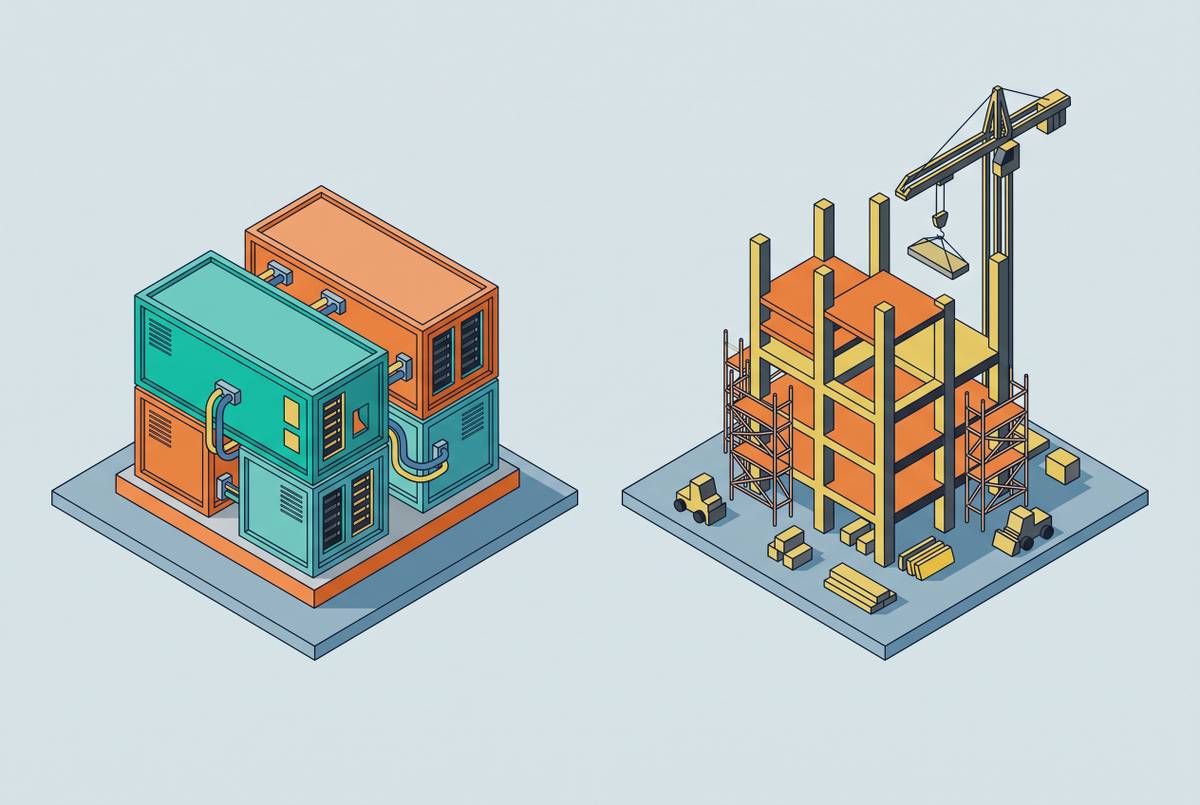
A modular data center is not a smaller or faster cousin of a traditional build. It runs on a different production and delivery model entirely, and treating the two as points on the same scale leads teams to judge them by the wrong measures. Most comparisons stop at deployment speed or cost per megawatt, which skips over the structural differences that actually decide where each approach works and where it doesn't. What matters is which underlying logic, factory manufacturing or site construction, parallel workflow or sequential workflow, incremental capacity or committed capacity, fits the constraints of the project in front of you. AI infrastructure demand has turned this into a live operational decision for more teams than ever: gbc engineers' June 2026 analysis found that on current projects, the choice increasingly comes down to rack density, program urgency, and supply-chain resilience, three factors that carried far less weight five years ago.
What a traditional data center actually is as a construction system
A traditional data center treats the building and its infrastructure as one site-executed decision. The electrical, mechanical, and cooling systems get built into the structure itself, and each phase of work depends on the phase before it finishing first. That sequence runs in a fixed order: site selection, permitting, foundation, building envelope, MEP installation, commissioning. A delay at any one stage pushes every stage after it.
Capacity gets locked in at design time. The facility is engineered around a projected peak load, and that investment happens upfront whether demand actually fills the space on day one or not for years. Once built, the structure and its systems are permanent. There's no separating the building from its infrastructure and no relocating it later.
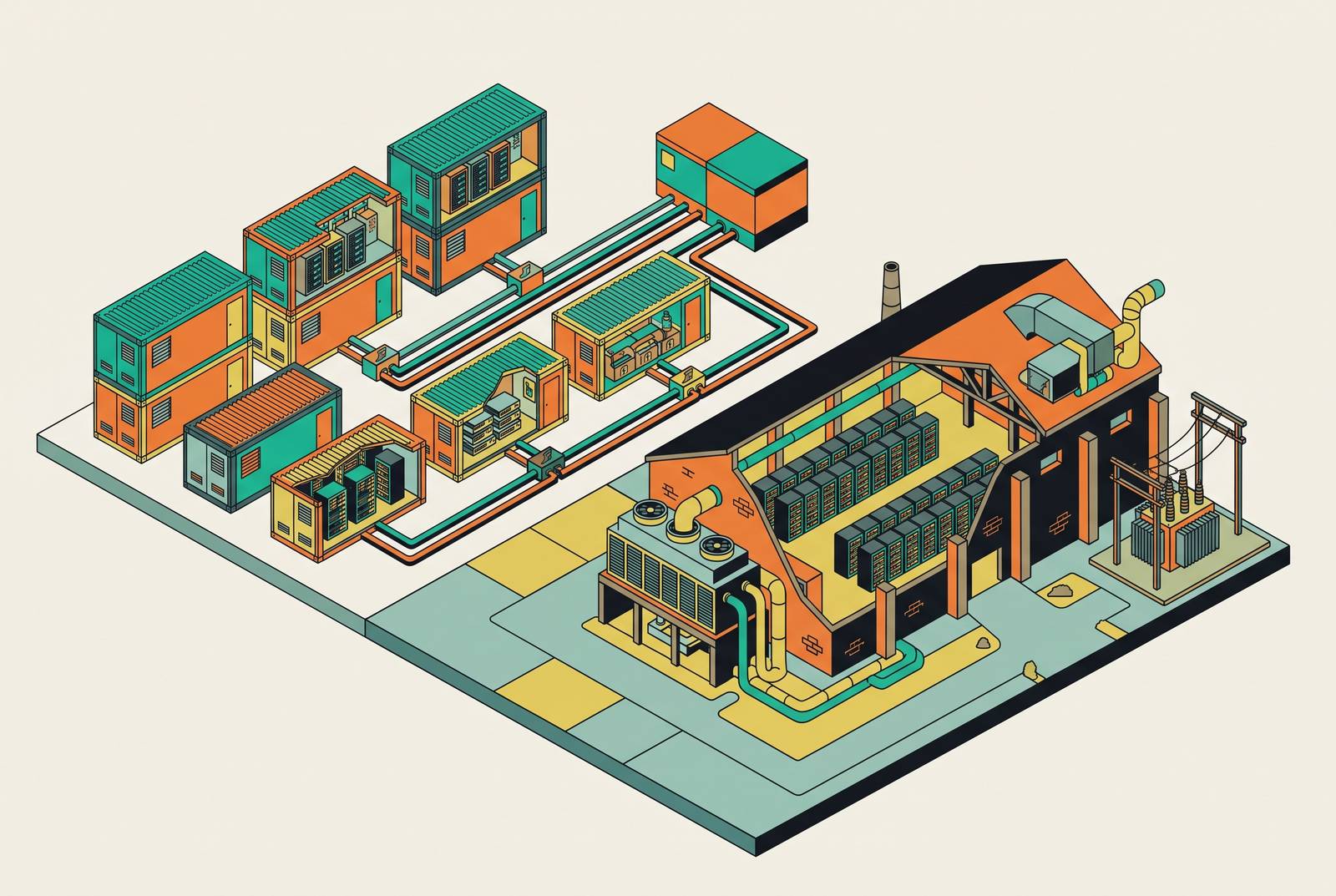
None of this makes traditional construction a worse choice by default. At gigawatt-scale hyperscale campuses, it still holds real advantages. Procurement at that volume allows direct negotiation with equipment manufacturers, and site-specific tuning of cooling and power architecture pays off when the design gets replicated across millions of square meters. The scale is what makes the added complexity worthwhile.
How a Modular Data Center Is Defined
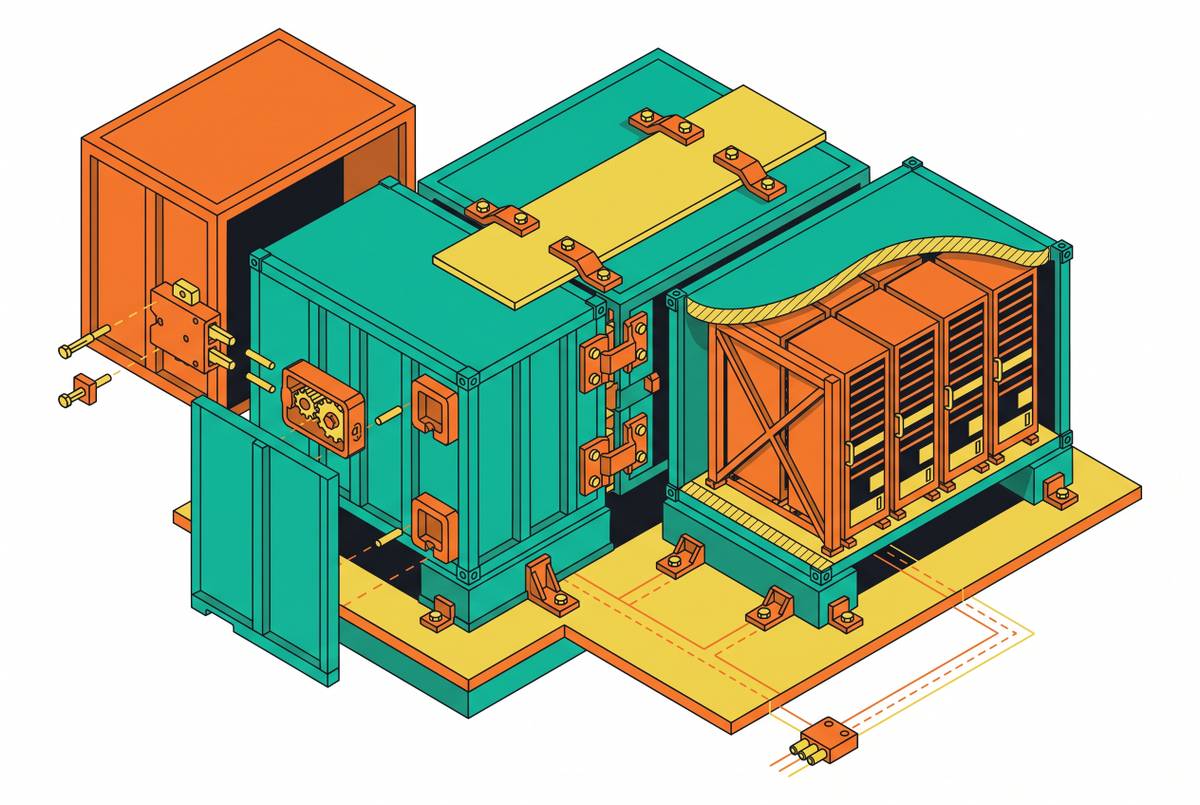
A modular data center is built from pre-engineered, factory-manufactured components, power, cooling, and IT systems, that get assembled and tested before they ever leave the factory floor. Integration happens on-site. Construction, for the most part, does not.
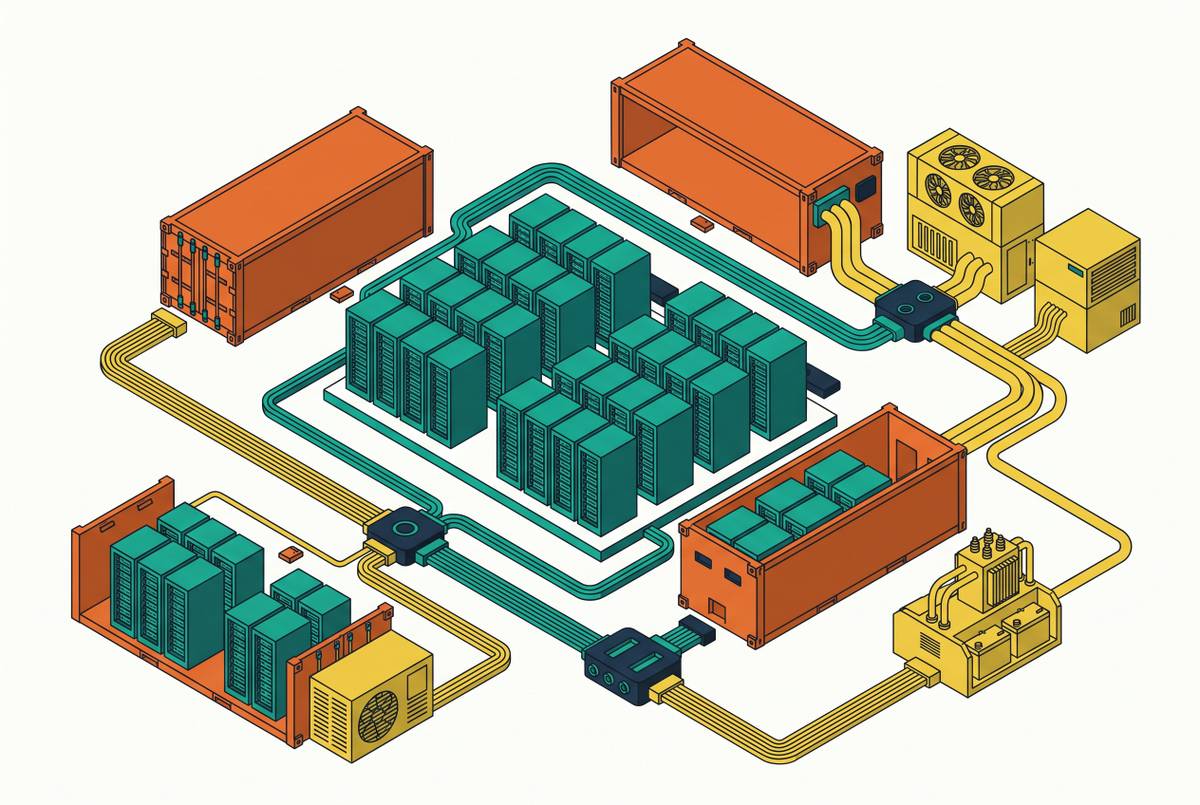
Three form factors fall under this label, and each one serves a different purpose. Containerized data centers are purpose-built inside an ISO shipping container, typically 10, 20, or 40 feet, housing IT load, power distribution, cooling, and physical security as one integrated unit. They suit edge deployments, disaster recovery, remote sites, and temporary capacity where a conventional build simply isn't practical. Skid-mounted systems pre-assemble power or cooling equipment on a structural steel frame, without an enclosure, and pair with a separately built or existing IT hall. They typically handle larger per-unit capacities than containerized units, but they remain limited to power and cooling infrastructure. Prefabricated data halls are fully enclosed, factory-built rooms that house IT and networking equipment and attach to or integrate within a larger campus. This is increasingly how hyperscalers add capacity in discrete blocks without re-engineering an entire facility every time they need more room. A fourth category, micro modular data centers, covers small self-contained units generally under 100 to 150 kW, built for edge computing at retail, telecom, and manufacturing sites where latency rules out sending traffic back to a central facility.
Inside these modules, components split into two groups. Passive components cover switchgear, UPS systems, transformers, distribution equipment, and cooling infrastructure, including direct-to-chip and immersion systems. Active components cover server racks, networking, and compute hardware housed in a standardized enclosure. Some projects use a semi-prefabricated design, so factory-built power and cooling pair with a conventionally built IT hall. Others go fully prefabricated, where power, cooling, and IT modules all join together on a prepared foundation.
Parallel Workflow Replacing Sequential Construction
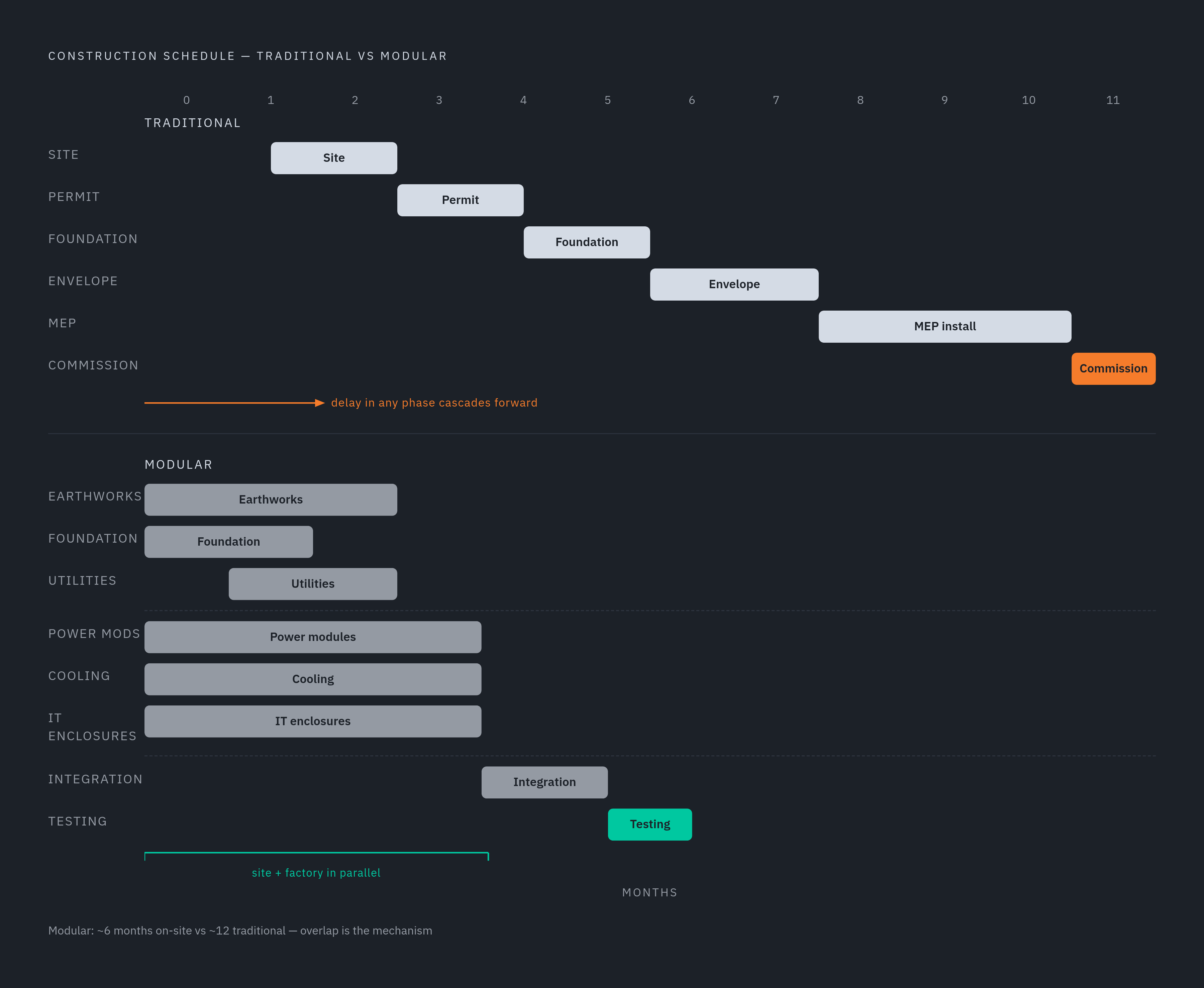
Factory manufacturing and site preparation can happen at the same time, which compresses the calendar by overlapping work that a traditional build has to run one step after another.
In a conventional sequence, permitting comes before the foundation pour, which comes before the structure goes up, which comes before MEP installation, which comes before commissioning. Each phase gates the next one. A supply-chain delay in switchgear, for instance, doesn't just slow that one piece. It pushes every phase that follows.
In a modular sequence, the site team handles earthworks, foundations, and utility connections while, at the same time, the factory integrates power modules, cooling assemblies, and IT enclosures, testing and validating them before anything ships. That overlap is the entire mechanism. Defects and integration problems that would normally surface during on-site commissioning in a traditional build get caught and resolved earlier, inside the factory, well before the module reaches the site. Final installed-facility testing and integrated systems testing still happen on-site in a modular build. What changes is how much gets resolved before that point.
This approach has moved well past edge deployments. Vertiv's OneCore platform is a hybrid prefabricated system built to operate at scale, designed for projects running from roughly 10 MW up to 250 MW and beyond. That range shows modular construction now competes for projects that used to belong to traditional builds by default.
What the Modular Form Factors Make Possible
Because modular units are discrete, self-contained, and deployable one at a time, they change the basic relationship between capital and capacity. An operator can start small, commission quickly, and add modules as demand actually appears instead of paying for demand that's only been projected.
Traditional construction asks for the opposite bet. It commits capital to the full projected capacity at design time. Years three through ten of expected demand get paid for in year one, whether that capacity ever gets used or not. A modular approach spreads that bet out: deploy the first unit, run it close to its efficiency point from day one, and add capacity only when demand justifies it. Capital expenditure gets pushed back until it's actually needed.
Site flexibility adds a second advantage, separate from the capital timing. Containerized and skid-mounted units can go to remote industrial sites, edge locations, and markets where qualified construction labor is hard to find, places where a conventional build is either too expensive or practically impossible. Containerized units travel by road, rail, or sea, and in principle they can be redeployed somewhere else later. A traditional building stays exactly where it was poured.
Below hyperscale scale, at enterprise, colocation, and edge deployments, modular construction keeps gaining ground because operators can specify an outcome rather than a design, shifting project risk onto the module supplier. The trade-off involves supplier concentration and some limit on how much a facility can be customized long-term. For a five-to-ten-year horizon, most operators below hyperscale scale can manage that limit without much difficulty.
Separating CAPEX from Total Economics
Modular construction does not automatically cost less upfront; what it changes is where the cost risk sits, how early that risk is known, and when capital actually has to go out the door.
Schneider Electric's February 2026 white paper makes this point directly: prefabricated modules can be faster to deploy and more predictable, and they can be delivered at a cost similar to traditional stick-built facilities. The paper does not claim a universal discount on construction cost, and treating modular as inherently cheaper misreads what it actually offers. A developer who expects a big drop in initial construction CAPEX simply because equipment shows up pre-assembled on skids is building a business case on the wrong assumption.
The real cost case for modular appears in schedule predictability and phasing, not in a lower price per megawatt. In markets where avoiding site congestion and schedule risk carries real financial weight, that predictability has value on its own. Factory pricing is typically fixed at contract signing. Traditional construction stays exposed to labor market shifts, material costs, and site-specific conditions for the full length of the build, and that exposure is a genuine risk to the budget over time.
Modular carries its own hidden cost on the other side of the ledger: logistics. Factory-integrated modules need transport engineering, module handling, and logistics management that a traditional build never has to account for. Any accurate cost model for a modular project has to plan for that line item from the start, not discover it partway through.
Where AI rack density is stressing both models and reshaping the decision
AI compute workloads have pushed past what facilities built for conventional enterprise rack loads can support, and the two construction models are responding to that pressure in different ways.
Classic enterprise racks were sized for moderate per-rack power loads. Today's GPU-centric AI cluster racks routinely exceed those old norms by a wide margin, with some approaching or surpassing 300 kW per rack, a load legacy raised-floor infrastructure was never built to carry. Retrofitting an existing traditional facility to handle that kind of density is expensive, disruptive, and in a lot of cases limited by what the physical structure can actually support, full stop on what engineering can do after the fact.
Purpose-built modular systems designed around high-density liquid cooling can be configured for these loads from the start. The module gets designed around the rack's thermal and power needs, rather than forcing the rack to fit a cooling system built for something else. Matching that same density through traditional construction means a fully custom design process, and that process can take just as long as modular procurement does, which erases the speed advantage that traditional site-built approaches used to hold.
Liquid cooling has shifted from an option to a baseline requirement for high-density AI systems. Modular manufacturers can design cooling infrastructure around a specific workload's density from day one. Traditional facilities, by contrast, often run oversized and mismatched cooling systems until the facility reaches its design load, so they waste capacity in the meantime. Grid interconnection adds another layer of pressure: in many markets, interconnection timelines now run multiple years before ground even breaks, a constraint that decides which deployment model is realistically viable for organizations trying to meet AI-driven capacity needs on a business timeline.
Where Traditional Construction Retains a Genuine Case
Each model's logic fits a particular scale and use case better than the other, and picking the wrong one for the wrong context brings on exactly the costs and risks the other model was built to avoid.
At very large AI campuses, gigawatt-scale hyperscale developments, traditional construction still holds real advantages. Procurement volume at that scale allows direct negotiation with manufacturers and per-unit economics no modular supplier can match. Site-specific optimization of cooling strategy, power architecture, and heat reuse earns back its added complexity when it gets replicated across millions of square meters.
Modular construction has limits of its own. AI demand is straining modular factory capacity and stretching modular lead times while also driving more teams toward modular. In some cases that strain erases the speed advantage that made prefabricated construction attractive, particularly as demand surges create bottlenecks at the factory level. Modular construction also centralizes labor into factory facilities and logistics operations. Manufacturing capacity, transport engineering, and module handling all become more important, and they need to be planned for explicitly.
Traditional construction fits best at large, long-horizon single-site campuses, where an operator's scale justifies bespoke procurement, site conditions reward custom cooling and power design, and the investment timeline is long enough to absorb a longer delivery schedule. Modular construction fits best at edge deployments, projects under real time pressure, markets with labor or grid constraints, and phased growth scenarios where pushing capital spend toward demonstrated demand actually reduces financial exposure.
Design and Delivery Workflows in Both Models
Whichever model a project uses, the hard part doesn't go away: coordinating power, cooling, cabling, fiber routing, and the eventual handoff to operations stays just as complex. What changes between modular and traditional is where that complexity gets resolved, not whether it exists. Fragmented design workflows create the same rework costs no matter which model carries them.
In a modular build, power, cooling, and cabling get resolved together at the factory. Design decisions that would otherwise surface as site conflicts during a traditional build have to get settled earlier, during engineering, before manufacturing starts. Errors caught late cost far more in a factory model, because by that point the module may already be built and sealed.
In a traditional build, the sequential chain of dependencies opens the door to late-stage coordination failures. A single rack move, for example, can cascade into rework across power calculations, cooling load, cable routing, and documentation if those systems live in disconnected tools.
The handoff from design data to operations is a weak point in both models. Design data that reaches turnover incomplete, or disconnected from DCIM, EPMS, and BMS systems, leaves the operations team without a usable, live asset register. Fixing that gap after handover costs far more than planning for it before construction even starts. Structured automation, connecting layout, critical-systems engineering, cable routing, documentation, and operations-ready handoff inside one workflow, addresses the fragmentation causing rework in both models. ArchiLabs Studio is built for exactly this coordination problem, whether the project in question is site-built, fully modular, or some hybrid of the two. The construction method may decide where the work happens. The need for coordination follows either way.