Modular Data Center vs Traditional Construction for Enterprise Operators
Total cost of ownership across a decade determines which model actually wins.
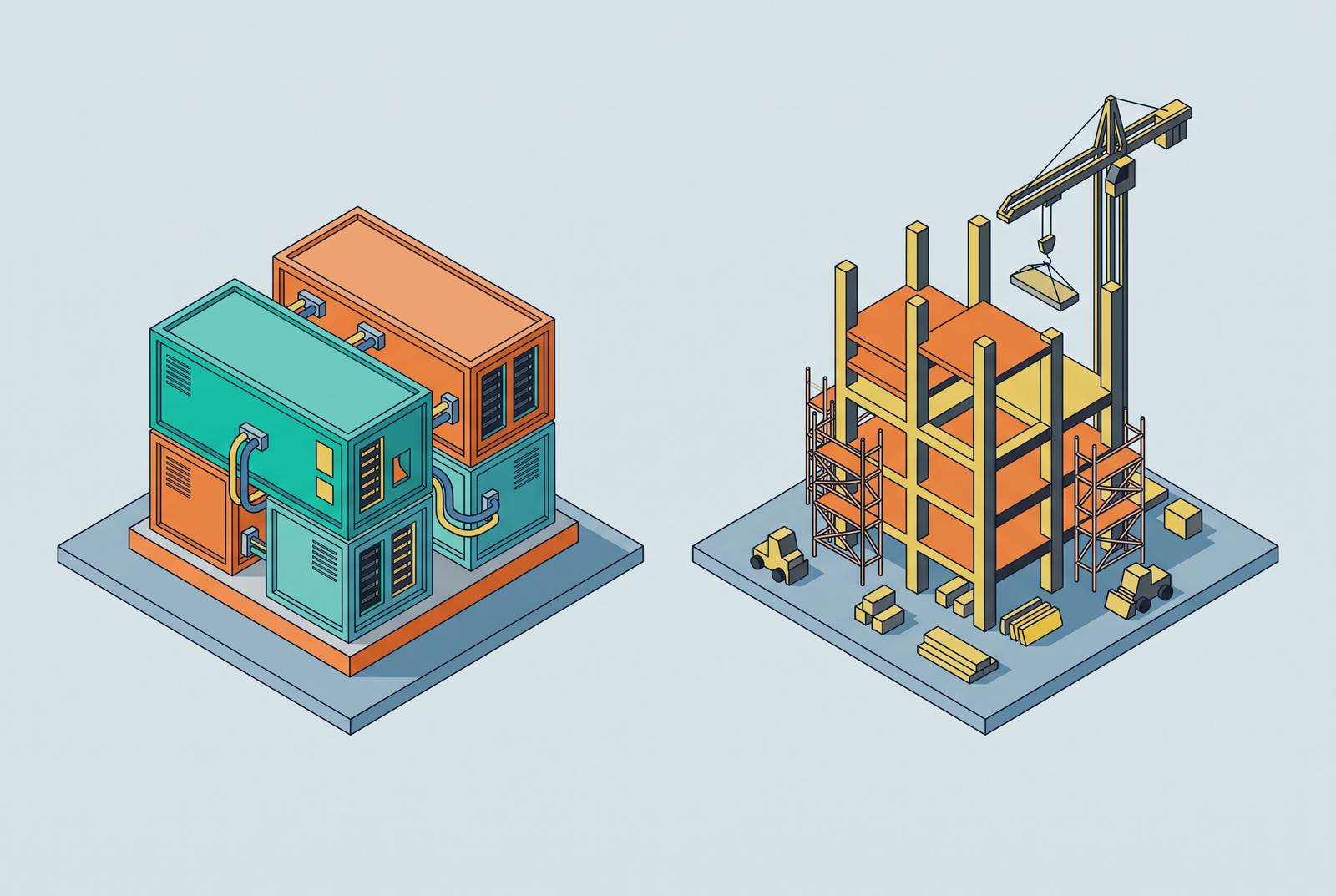
The question an enterprise operator actually needs answered is which model costs less to own and run over ten years, not which one goes up faster or which one quotes a lower number per megawatt. The real decision runs across six cost dimensions at once: capital spend, time to first use, energy cost, operating cost, the cost of scaling, and the risk of paying for capacity nobody uses. A facility can win on one of those and lose badly on another, and only a total-cost-of-ownership view across all six tells an operator which one actually wins.
Changes in the data center delivery environment over the past five years
Rack density has moved faster than most facility plans. A facility designed five years ago simply was not built to carry that much heat.
Density changes what gets built, not just how hot it runs. Liquid cooling, both direct-to-chip and immersion, is now standard in high-density halls, and it can cut facility power use by 20 to 40 percent compared with air-only systems. That gain comes with tighter piping tolerances, pressure testing requirements, and coordination between mechanical trades, controls teams, and IT vendors that has to start much earlier in the schedule.
Long-lead equipment now sets the pace for both delivery models. If you miss a factory release date, the whole assembly sequence slips, no matter whether the project is modular or stick-built.
Power access has become its own constraint now, and it stands apart from construction. If you plan BESS integration late, the critical path can stretch out by several months.
Structural differences between modular and traditional construction
Traditional data centers are engineered as one-of-a-kind buildings.
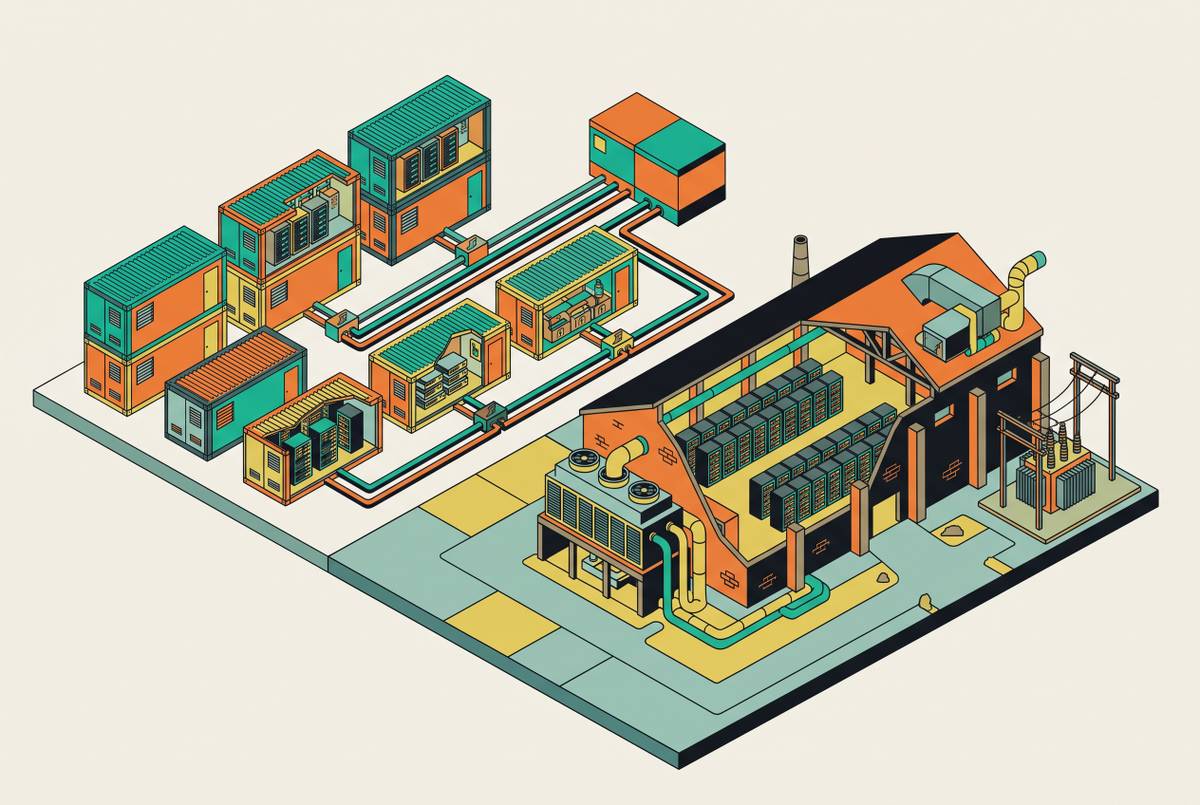
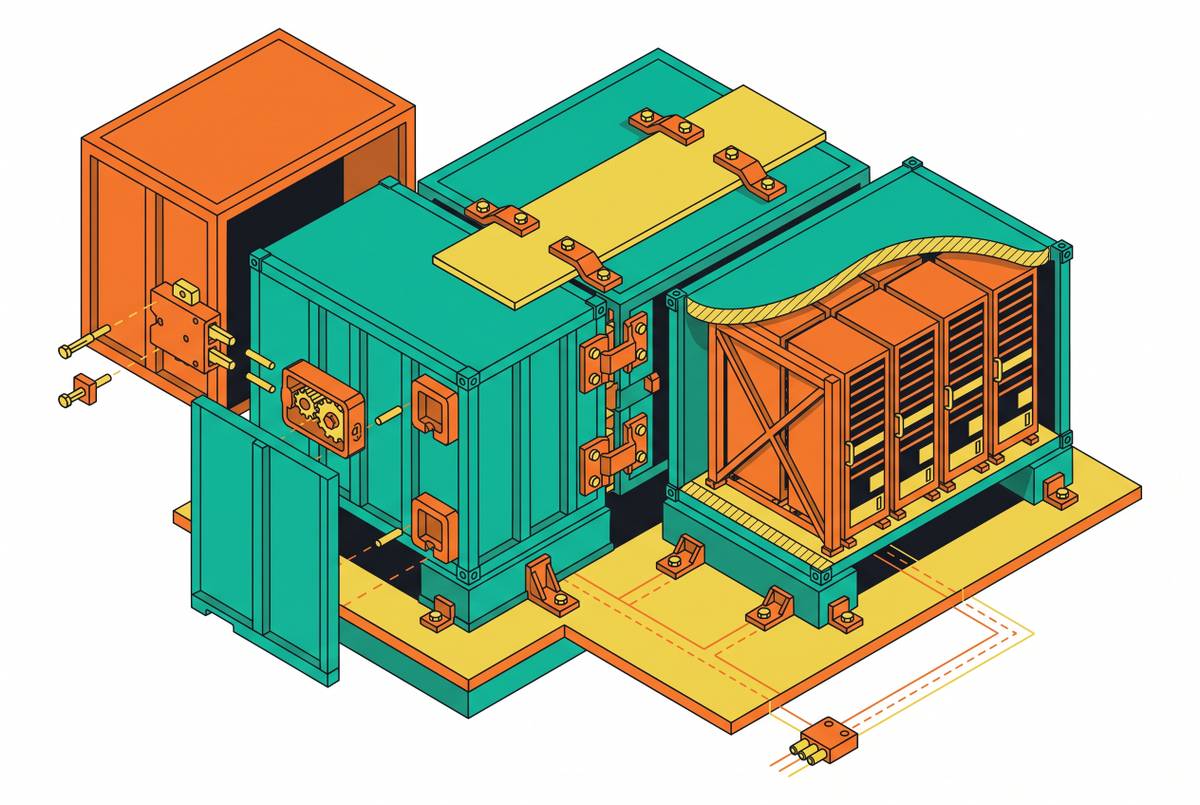
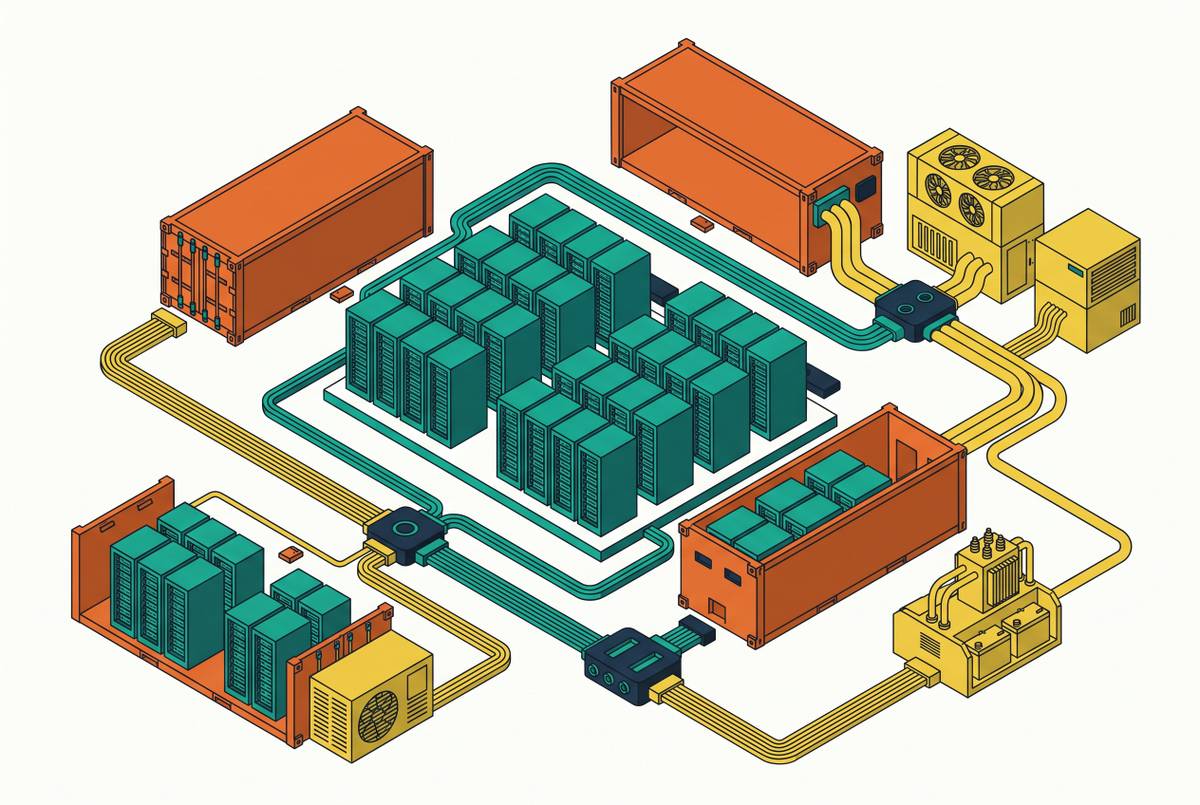
A modular data center is assembled from standardized infrastructure modules, built off-site, that package IT racks, power distribution, UPS systems, cooling, networking, fire protection, monitoring, and physical security into repeatable units. Those units can be deployed alone or combined into larger installations.
Modular and prefabricated are related terms, not the same thing. A modular facility can use prefabricated parts, but a prefabricated facility can also follow a modular layout.
Risk sits in different places depending on the model. Factory conditions tend to produce better quality work, but the trade-off appears at the interface points, where modules connect to each other and to site infrastructure during installation and commissioning.
Scaling also works differently. With a modular architecture, an operator can deploy the capacity needed now and add modules as demand grows. A traditional facility gets built to a projected future capacity, and that capacity has to be paid for up front whether the demand materializes on schedule or not.
Capital expenditure: what modular and traditional construction cost per megawatt
Modular construction tends to win on cost per megawatt, but once Tier III equivalence enters the picture, the margin is tighter than vendor comparisons suggest, and an AI-optimized traditional build can flip the comparison.
Modular deployments typically run $7 to $9 million per megawatt, depending on configuration and location. That is a real gap against traditional construction, but not an order-of-magnitude one at enterprise-grade reliability. Some industry sources point to savings as high as 30 percent for modular over traditional stick-built work, but most estimates land closer to 10 to 20 percent. That savings comes from factory prefabrication removing on-site labor variability, standardized designs cutting custom engineering costs, and controlled manufacturing conditions reducing waste.
Traditional construction carries a cost variance that modular avoids. Modular pricing, by contrast, locks in before production starts, and it covers 80 to 90 percent of total project cost. That predictability matters on its own, separate from whatever the absolute price difference turns out to be.
None of this is static. Tier III builds are often planned on 16 to 24 month schedules, and large or complex projects can stretch to 18 to 24 months or more from notice-to-proceed to a fully commissioned facility, driven by long-lead electrical and mechanical equipment, utility interconnects, permitting, and tight construction markets. The longer a project takes, the more cost exposure it accumulates along the way, so CapEx numbers alone cannot determine which model costs less overall. The time a facility takes to come online carries its own financial weight, and that's the next piece of the TCO picture.
Time to first utilization: where delayed capacity has a real financial cost that CapEx comparisons ignore
An enterprise operator staring at a capacity shortfall can lose more money to 18 months of construction delay than the entire capital cost gap between modular and traditional construction.
A traditional build averages 18 to 36 months. Projects that lean heavily on modular strategies cut schedules by 30 to 50 percent compared with conventional delivery, so a 24 to 36 month timeline becomes closer to 16 to 20 months.
That speed has a dollar value, and it belongs in the TCO model. If you add that cost to the CapEx comparison, the picture looks different than a simple price-per-megawatt chart suggests.
The schedule advantage isn't guaranteed. AI-driven demand has stretched modular factory lead times in some configurations, and equipment lead times for generators, switchgear, transformers, and cooling systems often run 12 to 18 months no matter which delivery model is chosen. Geography also shifts the comparison: modular units can reach remote industrial sites, edge locations, and markets where construction labor is scarce, places where traditional construction would be slow or prohibitively expensive to begin with.
Scalability and stranded-asset risk: the capital efficiency case for modular that compound over years three through ten
Traditional construction commits money against a demand forecast that may or may not show up on time. Modular deployment ties spending to demand that has already materialized. That gap compounds across a ten-year ownership period.
A traditional facility is built to a forecasted capacity that has to be paid for in year one. The cost of powering, cooling, and maintaining that capacity for years three through ten starts accruing immediately, whether the space gets used or not. Organizations that get that stranded capacity cost wrong pay for powering, cooling, and maintaining unused capacity for years.
Modular systems cut that exposure down. Growth happens when you add modules, not when you trigger a major facility expansion project.
Traditional construction still has a strong case in one scenario: when demand is large-scale and highly certain from the start, such as a committed hyperscale program or a long-tenured enterprise campus with predictable growth. The decision comes down to how confident the operator actually is in that demand forecast.
AI workloads have made that forecast harder to trust, not easier. Enterprises that sized their facilities for general-purpose compute are now finding that production AI workloads need far more power and cooling than their original models assumed. That uncertainty makes the incremental flexibility of modular deployment worth more than it would have been in a steadier demand environment.
Energy costs and PUE over a ten-year horizon
If a facility gets built cheaply but runs at a poor power usage effectiveness, it pays for that inefficiency every year, and over ten years that cost can outgrow the original capital cost gap between the two models.
PUE measures how much of the power a facility buys actually reaches the IT equipment. A PUE of 1.2 versus a PUE of 1.6 produces a recurring energy bill that scales with IT load and with whatever energy costs in a given market.
Modular deployments often post competitive PUE numbers because factory integration allows precise sizing of power and cooling against actual IT load, letting the facility start near its efficiency point from day one. PUE isn't baked into either model, though. It comes down to design, cooling technology, and operating conditions, and both modular and traditional facilities can get it right or wrong.
Liquid cooling, whether direct-to-chip or immersion, can cut facility power use by 20 to 40 percent compared with air-only systems, and you can get that technology in both delivery models. The energy comparison depends on the design choices made inside each model. That's also the argument for locking in the cooling architecture and the delivery model together: the cooling system sets the PUE, the PUE sets the ten-year energy cost, and that energy cost belongs in the same financial model as the CapEx comparison, not a separate conversation that happens later.
Power, cooling, and critical-systems coordination difficulty by delivery model
The delivery model shifts where coordination difficulty concentrates. It does not make that difficulty go away, and projects in both models lose schedule and budget control when that complexity gets underestimated.
In a traditional build, coordination risk spreads out across a long site sequence. A delay in one package, a generator, a transformer, a switchgear unit, can stall commissioning for the entire facility, because the critical path is long and the dependencies run deep.
In modular delivery, that risk moves to the front of the project. Quality tends to improve in controlled factory conditions, but the rework risk concentrates at the interface points, where modules connect to each other and to site infrastructure during installation and commissioning.
A rack move, in theory, should cascade automatically through power, cooling, cable routing, and documentation. Platforms like Archil Labs, which connect layouts, systems engineering, and cost drivers in one workflow, help operators trace the full TCO impact of a design decision before it spreads through the rest of the project.
Compounding risk from fragmented design workflows in both delivery models
Fragmented design tools create a data center delivery problem that compounds under either model, and that is where the most preventable schedule and cost risk in the industry lives.
RFI and submittal management is where that fragmentation turns into measurable schedule risk. The cost of rework from these information gaps is a significant, recurring share of total project value in data center delivery, which makes fast RFI turnaround a rework-prevention strategy as much as an efficiency gain.
Modular delivery makes the problem sharper in one specific way.
ArchiLabs Studio was built around that exact gap. It operates as the central workspace for data center projects, connecting layouts, power and cooling coordination, cable routing, documentation, RFIs, and operations-ready handoff inside a single workflow, so a rack move cascades automatically through power, cooling, cable, and sheets instead of forcing manual rework across disconnected tools. The automation is deliberately split in two: AI handles the creative and responsive work, pattern recognition, metadata extraction, spotting coordination gaps, while deterministic rules govern anything where precision and compliance can't bend. Those two modes don't substitute for each other in critical-facility delivery, and treating them as interchangeable is how coordination gaps turn into expensive rework.
Operations-ready handoff: why the delivery model decision affects what happens after commissioning, not just during construction
The delivery model decision shapes more than construction cost and schedule. It shapes how completely the finished facility connects to the systems that will run it, and a weak handoff generates cost and risk for the entire life of the asset.
DCIM doesn't replace the other two systems, it depends on their data, and outages tend to happen in the gaps between them.
The handoff from BIM to DCIM is where most digital twin projects run into their first real technical problem. Trying to retrofit that integration after turnover costs significantly more and rarely gets finished properly.
A clean handoff needs more than as-built drawings. Operations teams need validated alarm logic, documented threshold reasoning, trend baselines, and a clear RACI chart before they can run the infrastructure safely, and neither construction model delivers any of that automatically.
Modular delivery opens a specific opportunity here. Structured handoff to DCIM, EPMS, and BMS is the actual finish line, and whichever delivery model produces a more complete handoff produces a lower operating cost for the rest of the asset's life.
The shift toward higher rack densities, liquid cooling, long-lead equipment, and multi-megawatt BESS installations means design decisions lock earlier, and rework cascades faster once they do. A cooling topology change or a power sequencing revision now ripples through mechanical coordination, controls engineering, and installation schedules, where there used to be more slack. Integrated design platforms connect cooling strategy, power distribution, and critical-systems coordination, so they can surface those dependencies before the design is finished and cut the rework risk that today's tighter schedules can't absorb.
A decision framework for enterprise operators evaluating modular vs. traditional construction
The modular-versus-traditional choice comes down to matching the delivery model to an operator's actual conditions: timeline pressure, how confident the demand forecast is, site constraints, and how deeply the facility needs to integrate with existing operational systems. Both models can be the right answer, depending on how those conditions line up.
Modular tends to win the TCO argument when capacity is needed within 12 months and the cost of waiting is real and can be calculated in dollars, when demand growth is uncertain or expected to arrive in phases, so incremental deployment cuts stranded-asset risk by more than it costs in per-unit premium, when the site itself creates construction obstacles such as a remote location, a tight labor market, or heavy permitting requirements for permanent structures, and when the operator values budget predictability enough that avoiding the 15 to 25 percent cost variance common in traditional construction outweighs other factors.
In both cases, design and procurement set the conditions that determine the TCO outcome, not construction itself. A platform that keeps one source of truth for layouts, cooling logic, and electrical coordination across the full design-to-handoff process makes it easier for a team to see which model's constraints are actually tighter for their specific facility and timeline.
The fragmentation of power, cooling, cable, and documentation across disconnected tools is the same problem whether an operator builds modular or traditional. That is where ArchiLabs Studio delivers value no matter which model gets chosen: it connects those systems inside one workflow and makes sure design data flows into operations without getting rebuilt by hand along the way. The delivery model matters less to total cost of ownership than the quality of the design process behind it and the completeness of the handoff that follows it into operations.