RFI Traceability Requirements in Critical-Facility Construction
Untraced RFI answers ripple across redundant systems and silently undo uptime guarantees.
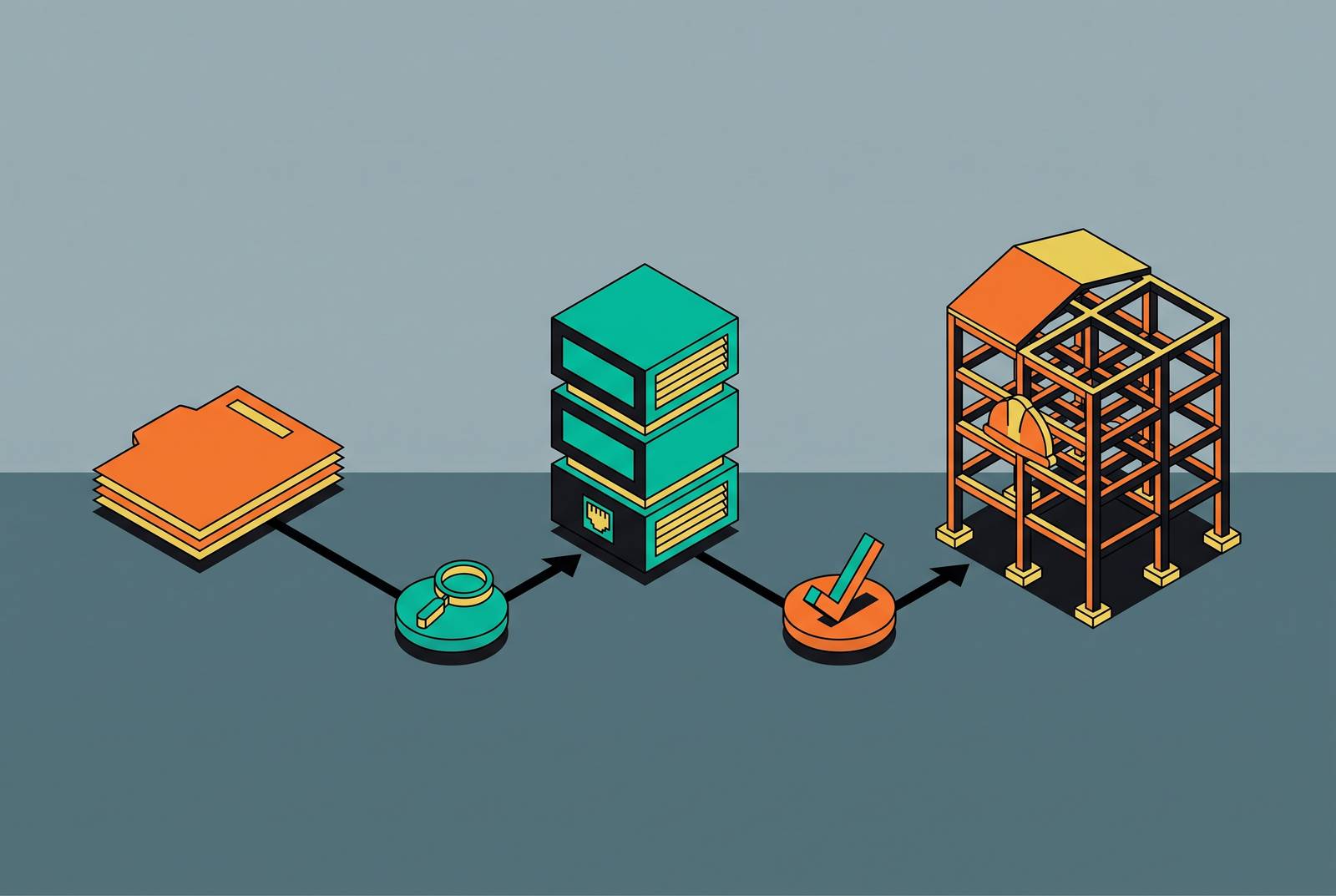
An RFI, in standard construction practice, is a formal written question that creates a documented chain: someone asked, someone answered, and the record shows both. In most commercial buildings, that chain matters mostly for billing disputes and liability questions after the fact. In data center construction, the same chain decides whether a facility engineered to run continuously, with zero tolerance for unplanned downtime, actually holds up once it goes live. An unanswered or poorly traced RFI in this setting is a direct threat to schedule, to the integrity of redundant systems, and to whether the facility is ready to operate the day it's handed over.
The asymmetry starts with cost. A two-week delay on a commercial office building is an inconvenience, absorbed into a schedule with some slack built in. A two-week delay on a data center can mean millions of dollars in lost revenue, contractual penalties, and consequences that cascade down to the owner's own customers who were counting on that capacity coming online. An RFI that sits untraced, bouncing between inboxes or buried in an email thread nobody can find later, creates exactly this kind of exposure. It's a revenue problem wearing a paperwork costume.
Density raises the stakes further. A modern data center can consume 150 to 200 watts per square foot, and AI-optimized facilities push well past that figure. At that density, a clarification about a single power or cooling detail touches multiple redundant systems at once instead of remaining a minor annotation. A change that would barely register in a commercial project can ripple across an entire mechanical or electrical plant.
Tier classification turns that ripple into a contractual obligation. Tier III requires every system to be maintainable without shutting the facility down. Tier IV requires fully redundant paths with zero single points of failure. An RFI that resolves a coordination conflict incorrectly, or whose answer never makes it to every trade that needs it, can quietly undo the redundancy the owner paid to build. Nobody notices until the system that was supposed to have a backup doesn't.
What an RFI Is and Its Paper Trail
An RFI is a formal written question submitted during construction when something in the project documents is unclear, incomplete, or contradictory. The word formal carries real weight here: it's the paper trail, not the resolution itself, that determines who absorbs the cost when something goes wrong later. A documented chain shows what was asked, by whom, and what the answer was. That record is what separates a contractor who ends up stuck with the cost of rework from one who can prove the mistake wasn't theirs to begin with. In a dispute or a change order conversation, that documentation gives a contractor standing, and it gives everyone a way to answer an owner who wants to know why the schedule slipped.
RFIs come in four basic types, and each carries its own routing requirement. Design clarification RFIs go to the architect or engineer of record, raised when drawings conflict, dimensions don't add up, or a spec is too vague to act on. Coordination RFIs need input from multiple design team members at once, typically arising from clashes between disciplines, such as HVAC ductwork that runs straight through a structural beam. Constructibility RFIs question whether something can actually be built as drawn, since a design can be technically correct on paper and still be impractical given the sequence of work or physical constraints in the field. Site condition RFIs document the moments when reality doesn't match the drawings at all: unmarked utilities, unexpected soil conditions, or existing structures the original documents never captured.
Routing failure is a traceability failure in its own right. An RFI sent to the wrong party sits in the wrong inbox doing nothing. A reviewer forced to guess what's actually being asked will either send it back for clarification or offer a non-answer, and neither one moves the job forward. What makes an RFI answerable quickly is specific: a drawing or spec section reference, one or two sentences describing the conflict, and a proposed solution. Without those three things, a reviewer can't even pull the right document before trying to respond, and the clock keeps running.
Volume and Cross-Trade Complexity in Critical-Facility Projects
A single RFI is a contained problem. A data center project generates hundreds of them, moving across trades that depend on each other in ways a commercial build rarely does. High volume combined with tight cross-trade dependency means a single untraced answer doesn't stay local. It propagates silently across power, cooling, cable, and structural systems before anyone catches what happened.
The cascade plays out in a predictable pattern. A subcontractor hits a conflict between the structural drawings and the MEP coordination plan. Work stops. The architect takes days to respond. Crews move to other tasks to stay productive. By the time the answer finally comes back, the schedule has already shifted, three other trades are now affected by a decision none of them were part of, and the real cost shows up in the rescheduling, the remobilization, and the conversation with the owner about why the dates moved again.
The chain that runs from RFI to submittal to change order is where this gets expensive fastest. At Tier III and Tier IV, every system has to stay maintainable, or fully fault-tolerant. A Tier IV facility carries an uptime requirement of 99.995 percent under industry tier standards. An RFI that resolves a spec conflict in power or cooling can trigger a revised submittal, and that submittal references a product that was coordinated with several other trades, each of which now needs a revised submittal of its own. One question can set off a chain of paperwork that touches half the job site.
Accountability gets diluted the moment this process runs through email threads or disconnected trackers. The design team holds part of the picture. The general contractor holds another part. Each trade holds whatever piece landed in its own inbox. Shop drawings get reviewed against specifications that are already out of date, and the rework only becomes visible once installation is underway. RFIs that quietly change the scope of work don't make it into the change order pipeline until weeks later, by which point cost forecasts are already wrong.
The field engineer role shows how this plays out on the ground. Field engineers translate design intent into field instructions, manage the RFI process, process submittals, and act as the technical go-between for the trades and the design team. When that role has no connected system to work from, the translation work happens in email and spreadsheets, and something gets lost at every handoff along the way.
What genuine RFI traceability requires at each stage of the lifecycle
Genuine RFI traceability is a connected record that links the original question to the drawing revision it references, to the response and the name of whoever wrote it, to every downstream document that response touches, and to the cost or schedule impact it triggers, captured at the moment each of these events actually happens.
At intake, a defensible record needs an immutable timestamp of submission, so nobody can later dispute when the question was raised. It needs a specific drawing or spec section referenced, so the reviewer isn't left guessing from a general topic description. It needs a clear statement of the conflict or gap, routed to the correct party based on what type of RFI it is. And it needs a cost impact flag captured right at intake, not added retroactively once someone realizes the answer is going to cost money.
During the response phase, the answer has to be linked directly to the drawing revision it produces, not parked in a separate email thread that someone has to go hunting for later. Version history has to show exactly which revision of a drawing the response was written against, so that anyone reviewing the record months later knows whether that answer still applies. Markups, responses, and version history need to stay together without someone manually stitching them back into alignment after the fact. The RFI effectively belongs on the drawing itself, because the context and the question can't be pulled apart without losing something.
After resolution, traceability requires propagation. Someone has to identify which submittals, change orders, and downstream trades the response actually affects, and each of those needs a formal update rather than a verbal heads-up passed along informally. Immutable timestamps, drawing revision links, and cost impact flags captured at intake are what give an RFI log real weight once it ends up in a dispute or a change order negotiation. Without that structure, the log is a record of activity. With it, the log is evidence.
The RFI Chain Break at the Critical-Systems Coordination Boundary
The most expensive RFI failures in data center projects don't happen inside a single trade's scope. They happen at the boundary between critical systems, where power, cooling, and cable routing all meet, and where a clarification answered correctly in one trade's context carries implications for the other two that nobody acknowledges, because no single party has visibility across all three.
Power is the clearest example. Every critical system, power included, needs backup designed into the building from the start, because a failure in any one system can't be allowed to take the whole facility offline. That redundancy is written into the contract, not left to good intentions. An RFI that modifies a power distribution path without tracing what that change does to the redundancy model can violate the contractual tier requirement without anyone noticing until commissioning, or later.
Cooling carries its own version of the problem, intensified by liquid cooling systems. The building management system is designed for facility mechanical systems. It is not designed to correlate CDU secondary loop performance with IT workload, and it doesn't provide rack-level visibility into what the compute equipment is actually doing. An RFI that resolves a cooling specification question using only the BMS's assumptions can create a monitoring gap between the facility view and the IT view, a gap neither organization can close without manual coordination after the fact.
Cable and fiber routing create a quieter version of the same failure. At high-density AI facilities, fiber deployments are what give the operator agility to reconfigure later, and the routing decisions made during construction determine which reconfigurations are even possible. An RFI that changes a routing path without updating the as-built record takes away flexibility the operator was counting on, without the operator ever being told it was gone.
The underlying failure is systemic rather than a matter of one contractor dropping the ball. The mechanical contractor delivers the BMS. The electrical contractor delivers the EPMS. The client's own IT team buys and installs the DCIM. The integration between those three systems sits in nobody's contracted scope. An RFI answered correctly within one contractor's scope can directly contradict the assumptions built into another contractor's system, and that conflict surfaces on-site because no formal mechanism in the process is designed to catch it beforehand.
Why BIM Does Not Automatically Solve the Traceability Problem
BIM is the coordination backbone of modern data center construction. It enables clash detection and MEP coordination at a level of detail no 2D drawing set ever could. But BIM resolves conflicts at the model level, not at the decision level. An RFI answer that gets buried in a response log, never propagated back into the model and never carried forward into the operational record, is invisible to everything BIM is built to coordinate. The model can be perfectly clash-free and still be wrong, because the question that got asked and answered off to the side never made it back in.
The handoff failure that follows is structural. Developers often deliver a construction BIM model that the facility operator can't actually use for facility management without significant rework, because the model format, the asset tagging structure, and the data requirements for the operator's CMMS and DCIM systems were never defined back at project kickoff. The model was built to coordinate construction. It was not built to run a facility.
This is where RFI traceability becomes an operations problem, not just a construction one. An RFI that changes an equipment parameter, a UPS rating, a cooling capacity, a cable path, has to propagate into the BIM model and the as-built drawings, and it has to propagate into the asset identifier structure that the DCIM, EPMS, and BMS will all consume once the facility goes live. If that change stops at the drawing revision, the operational record is already wrong before a single server gets powered on.
Operations handoff needs more than a clean set of as-built drawings. The O&M team needs validated alarm logic, documented reasoning behind every threshold, trend baselines to compare future performance against, and a clear RACI showing who owns what. Every one of those depends on knowing exactly which version of a specification, or which equipment parameter, the facility was actually built to. That's only knowable if RFI traceability held through every stage of construction. The standard is simple to state: the asset identifier structure and data schema the operator's systems will use have to be agreed before construction starts, and design-to-as-built reconciliation has to be a formal workflow with defined acceptance criteria, completed well before closeout.
What a
A data center's operational record is only as reliable as the RFI chain that built it. Every tier requirement, every redundancy claim, every alarm threshold the O&M team will rely on for years traces back to a question someone asked on a job site, and an answer someone gave in response. When that chain holds together, from intake through resolution through propagation into the asset structure the operator will actually use, the facility goes live with a record that matches reality. When it doesn't, the gap between what was built and what was documented becomes the operator's problem to discover, usually at the worst possible moment. Traceability is the mechanism that keeps a facility's design intent, its contractual tier commitments, and its day-two operations connected to the same set of facts.