Change Order Impact Analysis in Connected Data Center Design Workflows
One rack density change cascades across power, cooling, and procurement simultaneously.
Most project teams still treat a change order the way they treated one a decade ago: a line item, a negotiation over dollars and days. That habit no longer fits the building. A change order on a modern data center project is a disturbance that moves through every connected discipline at once, often before anyone has signed off on the cost.
Three shifts in the industry explain why. Rack loads that used to run 5 to 8 kW now run from 15 to 140 kW and higher for AI workloads, so a layout change touches electrical, mechanical, and cooling systems simultaneously in a way a lower-density building never forced. Speed has overtaken cost as the priority metric, because whoever energizes capacity first captures the revenue, and every day of delay adds to that math. And long-lead equipment, generators, switchgear, transformers, cooling plants, often carries lead times past 12 to 18 months, so a change that lands after a vendor order is placed is a cost problem, a schedule problem, and a manufacturing problem all at the same moment.
None of this means change orders are new. It means the blast radius of a single change has grown faster than the tools teams use to track it.
Construction sequencing and cascade exposure
Cascade risk doesn't start with a change order. It starts with how the project is sequenced, long before anyone writes one up.
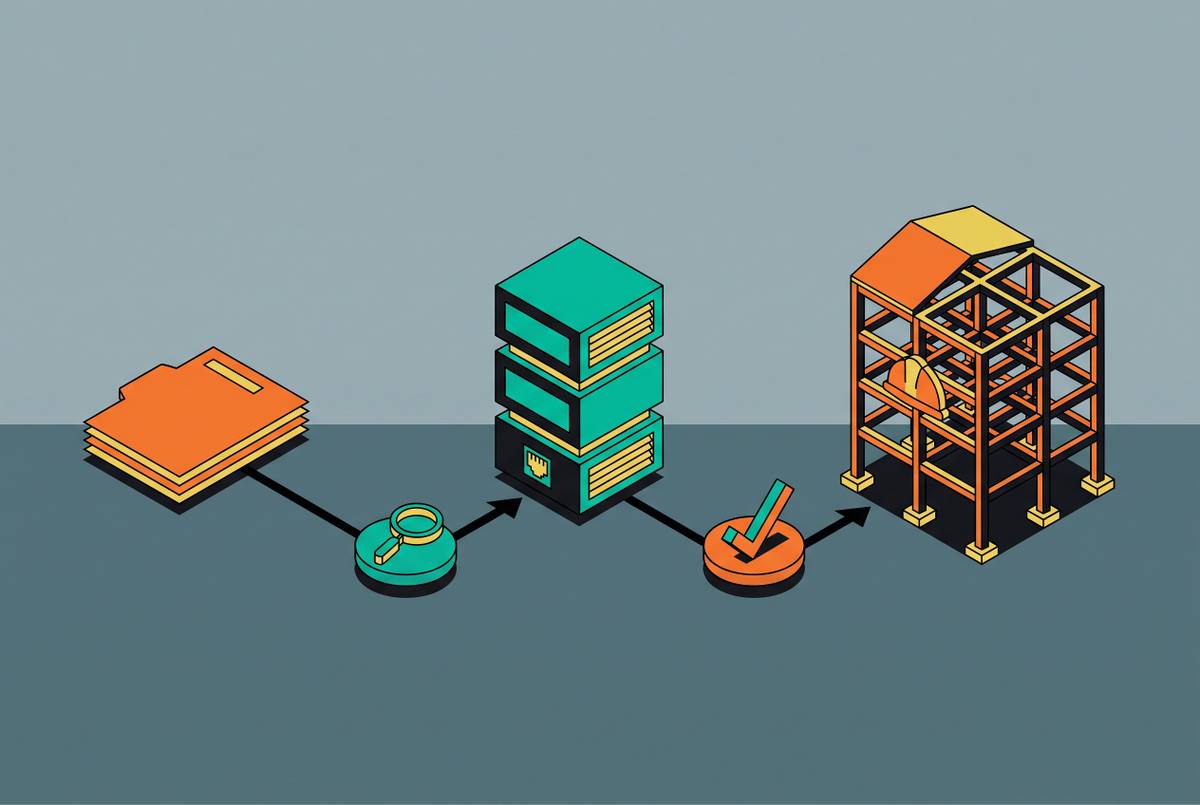
Data center delivery today runs fast-track: procurement starts before design is finished, and MEP installation begins on finished sections of the building while other sections are still being designed. A change made at this stage doesn't land on a clean slate. It lands on work already in motion downstream. Every change has to be reconciled both backward, against decisions already locked, and forward, against work not yet started.
The phase dependencies that make this true are mechanical. A delayed utility route holds up site work. A late generator delivery delays electrical installation behind it. When structural crews and MEP teams don't coordinate well, you get access conflicts and rework that have nothing to do with the original design intent. And as installation moves forward, completed systems block access to areas that an earlier change now needs to reopen, so if you revise something installed early, you may have to tear into work that's already finished.
Modular and prefabricated delivery tightens this window further. Design has to lock earlier, procurement decisions have to happen earlier, and vendors have less room to revise anything after the fact. The faster the delivery model, the narrower the window in which a change can be absorbed without rippling outward, and that rework concentrates hardest around the interface points where modules connect during installation and commissioning. This is a structural feature of how these buildings get built, not a symptom of a project team moving carelessly.
Change impact across power, cooling, cable, and documentation
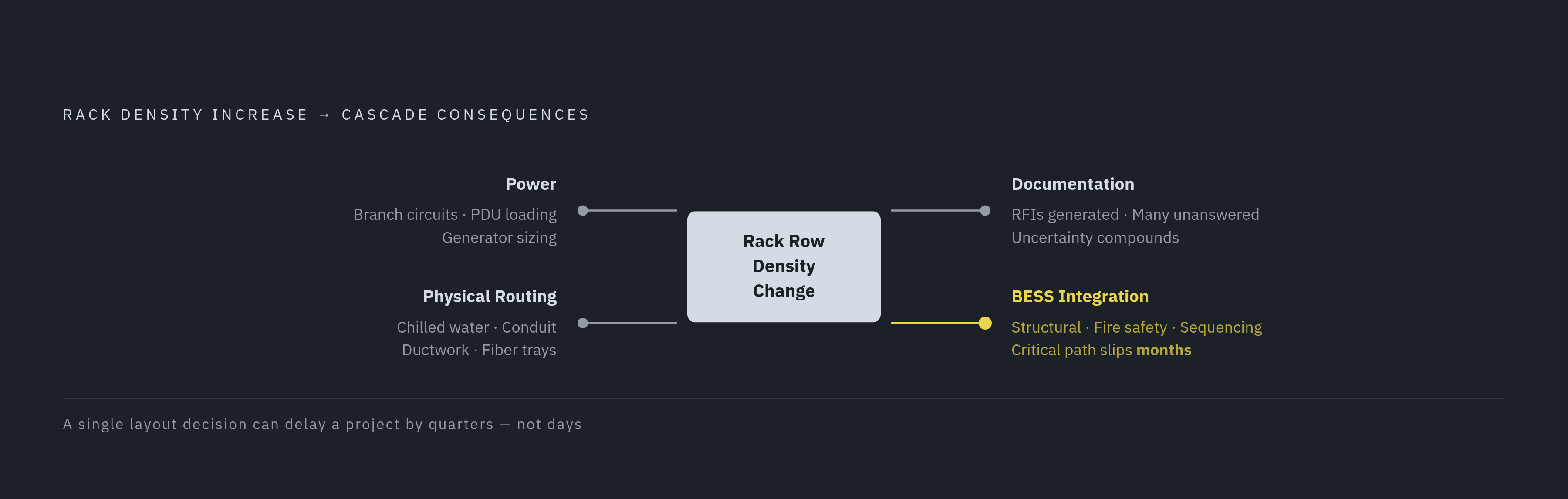
Picture a single, ordinary change: a rack row needs to be denser than the original design called for, to accommodate a new workload. That one decision does not stay contained to the rack.
On the power side, it reopens design on high-voltage utility interconnections, on-site substations, redundant distribution paths, and standby generation, all of which were sized and locked early precisely because their procurement cycles are so long. If a rack density changes, you have to recheck branch circuit capacity, PDU loading, and generator sizing, because the load profile the entire power chain was built around has shifted.
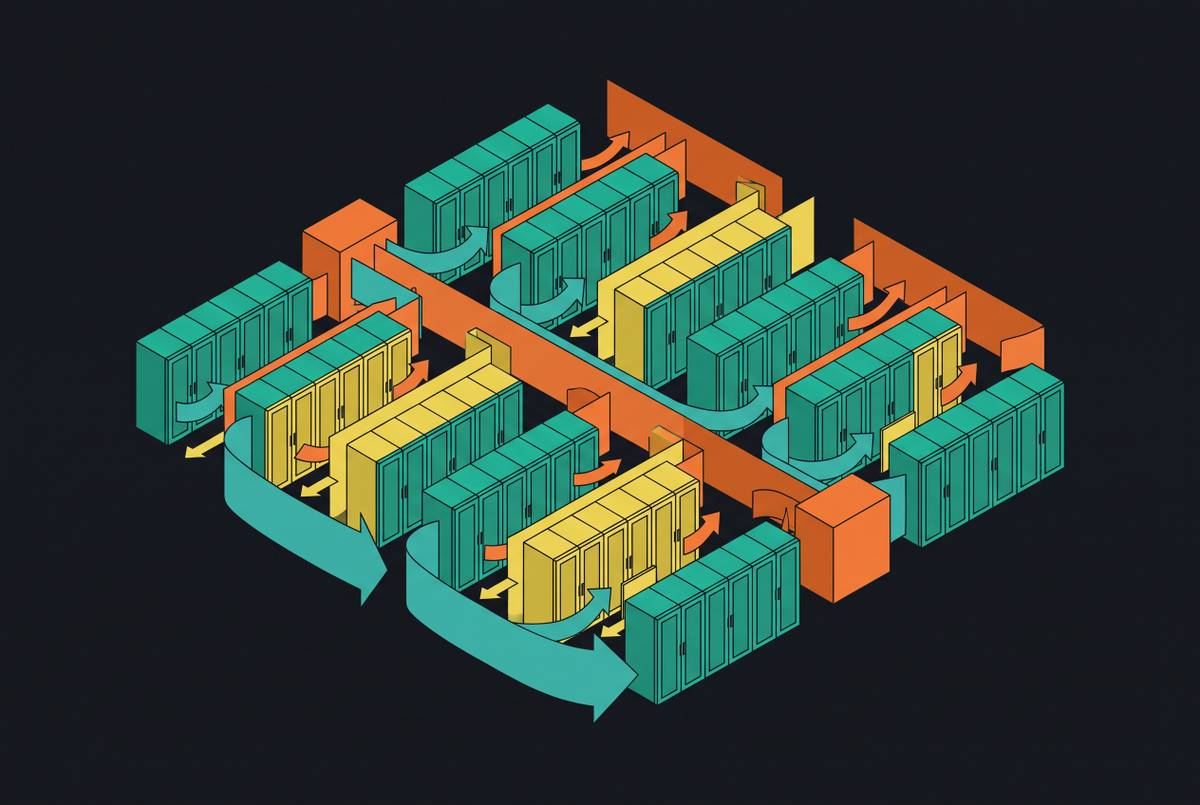
On the physical side, chilled water piping, heavy electrical conduit, large ductwork, and hundreds of fiber optic trays all share the same limited pathways through the building. Moving even one rack row forces re-routing across all of them, in spaces that were never designed with slack to spare.
Every one of those changes produces paperwork. Field changes generate RFIs, and some of those RFIs ask questions the contract already answered, so the documentation process adds friction instead of resolving the uncertainty it's meant to clear up. A meaningful share of RFIs never get a reply.
And if battery energy storage is part of the design, a density change can touch that too. BESS systems bring structural loading requirements, fire safety design, and electrical sequencing, and you have to time all of them right. Plan it late, or revise it late, and BESS integration can push the critical path back by several months, so a rack layout decision turns into a schedule event measured in quarters, not days.
Fragmented tools and hidden blast radius
None of this information is actually missing from the project. It exists somewhere, in some tool, held by some discipline. The tools holding it don't talk to each other, so no single person sees the full picture until a field crew runs into it directly.
BIM workflows typically span separate tools for authoring, coordination, and document management, and data loses fidelity moving between them unless the exchange formats and processes are managed with real discipline. But in practice, that discipline rarely holds up on a fast-moving project.
Three specific failure modes drive the late-stage changes that turn into field rework. The first is insufficient level of development: teams carry habits suited to early design, sketch-level detail, into project phases that need installation-grade precision, and the resulting ambiguity becomes field errors and RFIs directly. Procore found that unjustifiable RFI expense averages $113,400 per project, a cost that traces straight back to documentation that wasn't detailed enough for the stage it was used in. The second is model-to-reality divergence: field conditions, product substitutions, and late design changes create a gap between what the model says and what's actually installed, and on fast-track schedules the model updates lag behind the field decisions, so the gap keeps growing. The third is software fragmentation: a change made in one tool has to be rebuilt by hand in every other tool that touches the same information, so nothing propagates automatically.
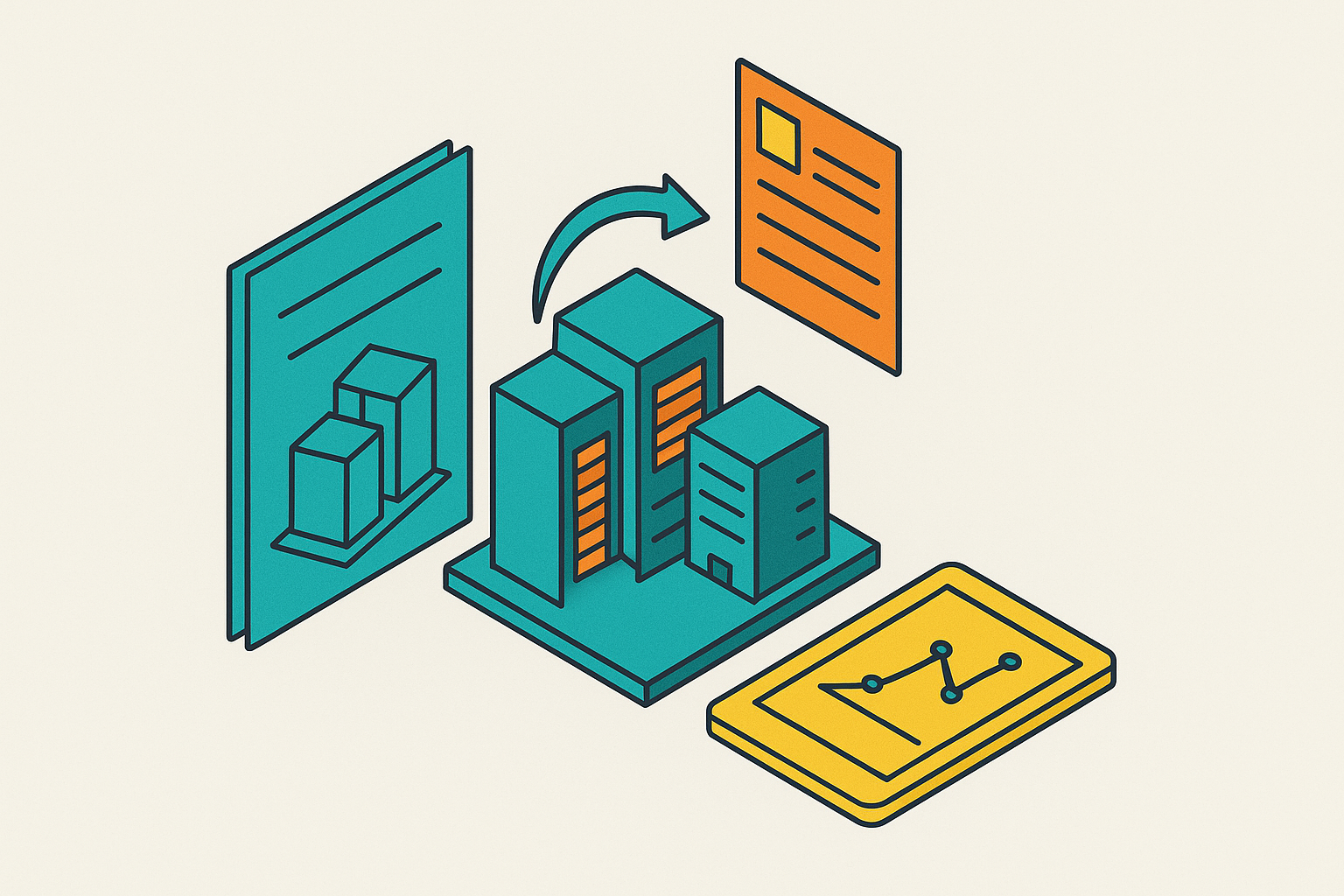
With 3D design and BIM, you can build a data center virtually before anyone breaks ground, so you catch conflicts on screen instead of on site. But that value holds only as long as the model stays current and connected across every discipline using it. If the model drifts out of sync with the field, it stops functioning as a planning tool and starts functioning as outdated documentation.
The handoff at the end of construction compounds all of it. A handover package can include O&M manuals, as-built drawings, test reports, and warranty information, but when these arrive as separate, disconnected documents rather than structured data, the operations team inherits a change management problem it never created and has no way to trace back to its source.
Coordination meetings and clash detection catch some of this, but clash detection only finds geometric conflicts in a model. It does not surface the scheduling, procurement, or documentation consequences that follow a change, so those stay invisible until someone sits down and traces them by hand across every system involved.
AI-assisted and deterministic schedule tools for cascade risk
Schedule intelligence tools address this problem, but they address different pieces of it, and picking the wrong tool for the situation leaves the most dangerous risks sitting undetected.
Three types of tools solve three different parts of schedule risk. nPlan forecasts uncertainty by comparing a project's schedule against patterns drawn from historical projects. ALICE generates and tests alternative construction plans against different constraints. Foresight monitors live progress and alerts stakeholders when work is falling behind pace. None of these does the other's job, so if you treat them as interchangeable, you miss whatever risk category the chosen tool wasn't built to catch.
For cascade analysis specifically, the timing of the tool matters as much as its function. nPlan's Schedule Integrity Checker automatically flags issues like negative floats, incorrect logic, and unusually long durations, and its Insights products identify risky activities and compare them against the project's risk register. That's most useful before a change order is formally issued, while float and mitigation options still exist to act on. Foresight, by contrast, is built for live control: centralized dashboards, automatic alerts, and completion forecasting that work best when the need is visibility across many stakeholders rather than deep analysis of one specific change event.
But none of these tools can replace judgment about the physical constraints a project actually faces. BRG identifies data center delivery as constrained by skilled labor availability, utility interconnection timelines, supply chains, and physical site logistics, constraints that no historical forecast fully captures on its own. A forecast should open the conversation about risk, not close it.
AI genuinely speeds up document review and timeline organization once you need to analyze a change order. It does not replace the schedule analysis itself. Forensic delay analysis still requires an accepted method, Time Impact Analysis, as-planned versus as-built comparison, windows analysis, carried out by someone competent to apply it. BRG identifies governance and schedule defensibility as strategic imperatives for data center owners, so decision records matter: connected tools that log decisions as they're made create the audit trail that an AI analysis, or a human one, can interrogate later.
A connected design workflow's response to a change
A connected workflow doesn't stop change orders from happening. It changes what happens in the seconds after one is entered.
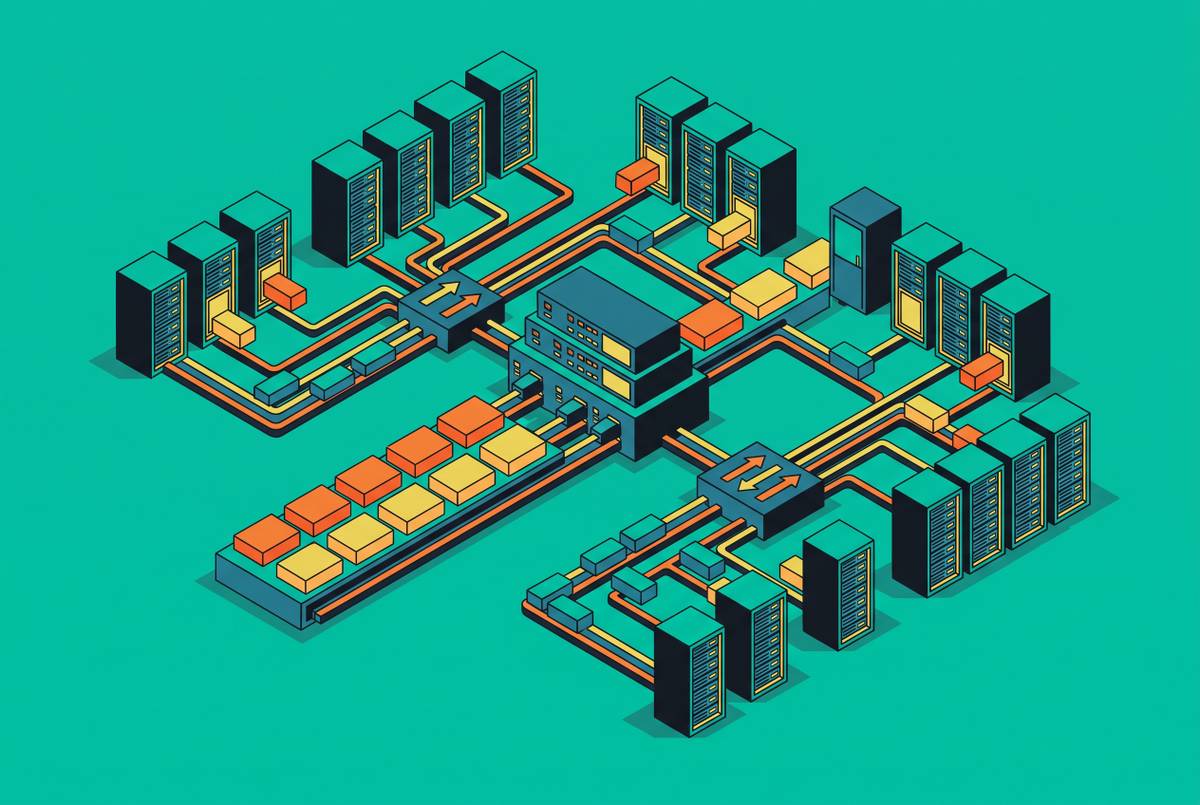
In a fragmented workflow, a rack move triggers hours of manual tracing: someone checks power, someone else checks cooling, a third person checks cable routing, and a fourth updates documentation, usually in that order, usually with gaps. In a connected workflow, where layout, critical systems, routing, and documentation share a single structured data model, a change to one element propagates to the others automatically instead of waiting for each discipline to update its own separate copy.
A rack move that changes load recalculates branch circuit capacity, PDU loading, and generator sizing without a power engineer having to reopen a spreadsheet to catch up. The cooling consequences surface in that same action: cooling load per zone updates, any zone that now exceeds its thermal budget gets flagged, and affected piping or cooling unit assignments get marked for review. Cable and fiber routing updates the same way, recalculating against the new layout and flagging conflicts with existing tray assignments instead of requiring a separate tool and a manual re-entry. RFI and documentation traceability closes the loop: every decision, every equipment parameter, every change event stays linked back to the information that justified it, so when a contractor asks why a layout changed, the answer sits in the same system as the change itself.
ArchiLabs Studio is built around this logic. It connects layout, critical-system coordination, cable routing, documentation, RFIs, and operations-ready handoff inside one workflow, so a rack move cascades automatically across power, cooling, cable, and sheets instead of generating hours of manual rework spread across disconnected tools.
What makes this work is a division of labor between two different kinds of logic. AI handles the flexible, interpretive side: it flags which downstream items need a second look and surfaces conflicts a human might miss in a dense model. Deterministic rules handle the precision side: load calculations, compliance checks, routing constraints, the kind of math that can't tolerate approximation on a critical facility. Teams get speed from the first and accuracy from the second, and neither one substitutes for the other.
Operations-ready handoff and change order traceability
A change order can be managed well through every phase of construction and still become a liability the moment the building is handed over, if the as-built reality isn't reflected in the systems that actually run the facility. Handoff is the final test of whether the change management process held together from the first revision to the last.
The core failure here is well established: developers often deliver a construction BIM model that an operator can't use for facility management without substantial rework first. If the operational BIM requirements for CMMS and DCIM systems aren't defined at project kickoff, the handover package can't serve the operator's needs, no matter how carefully the construction phase itself was managed. A connected workflow that tracked every cascade through design and construction only pays off in full if you carry that same structured data forward into the systems the operations team will run for the next twenty years.