Automated Power Load Scheduling in Data Center Design
Power constraints now drive facility design from day one, not just operations after construction.
Automated Power Load Scheduling in Data Center Design.
Power load scheduling as a design-phase problem, not just an operational one
AI workloads are the most power-hungry thing computing has ever built, and that is a structural shift in demand, not a marginal one. The kind of power draw these facilities need changes what a building has to be designed to carry in the first place, long before anyone flips a breaker. The International Energy Agency projects data center electricity use roughly doubling from 485 TWh in 2025 to 950 TWh in 2030, landing around 3% of global electricity demand. Gartner puts 2026 consumption at 565 TWh, a 26% jump over 2025, and lays most of that growth at the feet of AI workloads specifically PJM.
At this scale, power stops being a utility hookup the building plugs into once construction wraps. It becomes the organizing constraint that the whole design has to bend around. The old sequence, design the facility first and figure out power scheduling once it's operational, doesn't hold anymore. Power budgets, rack assignments, and grid interconnection terms all have to get locked down before a shovel touches dirt.
What makes this unforgiving is how far downstream a design-stage decision travels. A power budget set (or left vague) at the design table doesn't stay contained. A design-stage decision left vague or wrongly set appears later as an EPMS threshold, a DCIM capacity model, a BMS setpoint, and by the time it does, there's no clean way to walk it back. Fix it after the equipment's installed, and now it's a construction change order instead of a line on a drawing.
The design environment that makes manual load scheduling unsustainable
Rack density is the thing forcing all of this. Five years ago, 5 to 8 kW per rack was a normal design target. Now general AI workloads are pushing facilities toward 15 to 50 kW per rack, and AI-specific builds are targeting 50 to 100 kW or more. That's not an incremental bump; it's a different category of building.
At those densities, power distribution stops being a line item buried in the electrical scope. It becomes the sequencing logic. It decides where a rack can physically go, what cooling architecture has to sit next to it, and what the whole facility's capacity envelope ends up looking like. AI facilities are increasingly designed cluster by cluster rather than row by row, with compute, cooling, and power engineered together as one integrated system. That changes how load gets assigned at the layout stage itself, not later.
Then there's the timeline mismatch, and it's a brutal one. A data center can go from ground breaking to operational in 12 to 18 months. Grid connection, meanwhile, is running 5 to 7 years. So the power budget has to be committed to years before any operational tool exists to help manage it in real time. EPRI projects U.S. data center peak load reaching 45–94 GW by 2030 under alternative scenarios, up from 21–22 GW in 2024 (more than a 110% increase). Design teams are effectively working inside a capacity race where every committed megawatt has to be right the first time, because there's no slack left to redo it.
What fragmented power load scheduling costs a design team
On almost every project, power budgets live in one model, rack assignments in another, electrical schedules in a third, and none of them talk to each other in real time. Moving one rack means the power circuit, the cooling load, the cable path, the panel schedule, and the capacity summary all need manual updates, each one in a separate tool, each one owned by a different discipline.
That's expensive in a very specific way. Problems caught during construction cost thousands of dollars to fix. The same problem caught after go-live costs millions, in delays and rework. The logic that applies to BMS integration mistakes applies just as directly to power load decisions that get flagged too late in the process.
Manual reconciliation also breeds version drift. The electrical engineer's load schedule, the mechanical engineer's cooling model, and the project manager's capacity summary are almost never in sync at the same moment in time. And when a load assumption gets questioned during commissioning, or worse, during RFI resolution, there's frequently no audit trail linking the rack assignment back to the power budget figure back to whatever decision established it in the first place. Nobody can point to the paper trail because there isn't one.
Much of the industry is still running on ticket queues, manual handoffs, and administrators pushing execution by hand, and that pattern doesn't stay confined to operations. It bleeds straight into design workflows too. The more disciplines stacked into a project, BMS, EPMS, DCIM, structural, cooling, the more manual reconciliation points exist, and those conflicts tend to surface later in the schedule. By the time someone notices, the fix is no longer cheap.
The core mechanics of automated load scheduling at the design stage
Research out of University of Massachusetts Amherst lays out a taxonomy that's worth understanding in detail because it maps almost exactly onto how rack assignments should be made. There are best-effort tasks, or BE, which are flexible enough to get scheduled across a full 24-hour economic dispatch window without hurting quality of service. Then there are latency-critical tasks, or LC, which need to run immediately, ideally instantly, and scheduling automation simply cannot touch them without breaking that requirement. Auxiliary power, cooling, network gear, lighting, gets handled as its own separate category.
At the design stage, that taxonomy isn't abstract, it's a rack-by-rack decision. Which racks carry LC workloads, meaning fixed, non-negotiable power commitments? Which carry BE workloads that can flex? And how do the auxiliary systems get sized to serve both without over-provisioning?
Automated platforms already coordinate data across EPMS, DCIM, and intelligent PDUs to enforce power caps at the rack and outlet level, prioritize critical workloads, and shed nonessential load when things get tight. The design-phase version of that same logic is rules that propagate automatically: change a rack assignment, and the power circuit updates, the cooling load recalculates, the panel schedule revises, all without someone retyping numbers into three different tools.
None of this works if deterministic rules and AI get treated as interchangeable, because they're not. Circuit capacity, cooling limits, power caps: those are precision and safety constraints, and they belong to rule-based enforcement, full stop. AI's job is somewhere else entirely, in the flexibility and pattern-recognition work that speeds up decisions within those guardrails. The output of a well-built system is a structured data model. It's a structured data model where every load assignment traces back to the design decision, the equipment parameter, and the constraint that governs it.
Flexibility limits design teams need to know before commissioning
Louisiana State University research reconstructed 4,439 hourly power observations from a 185-day trace covering 155,410 GPUs across 37,707 servers in 17 clusters ERCOT Beyond Scalar Flexibility: From Eligible AI Workloads to Dependable Load Relief. The headline number is sobering: time-averaged median facility demand sat at 55.8 MW, but immediate eligible curtailment averaged only 3.55 MW, which is just 12.1% of workload power and 6.35% of median facility power Beyond Scalar Flexibility: From Eligible AI Workloads to Dependable Load Relief. That's a much smaller flexibility pool than most rough estimates assume.
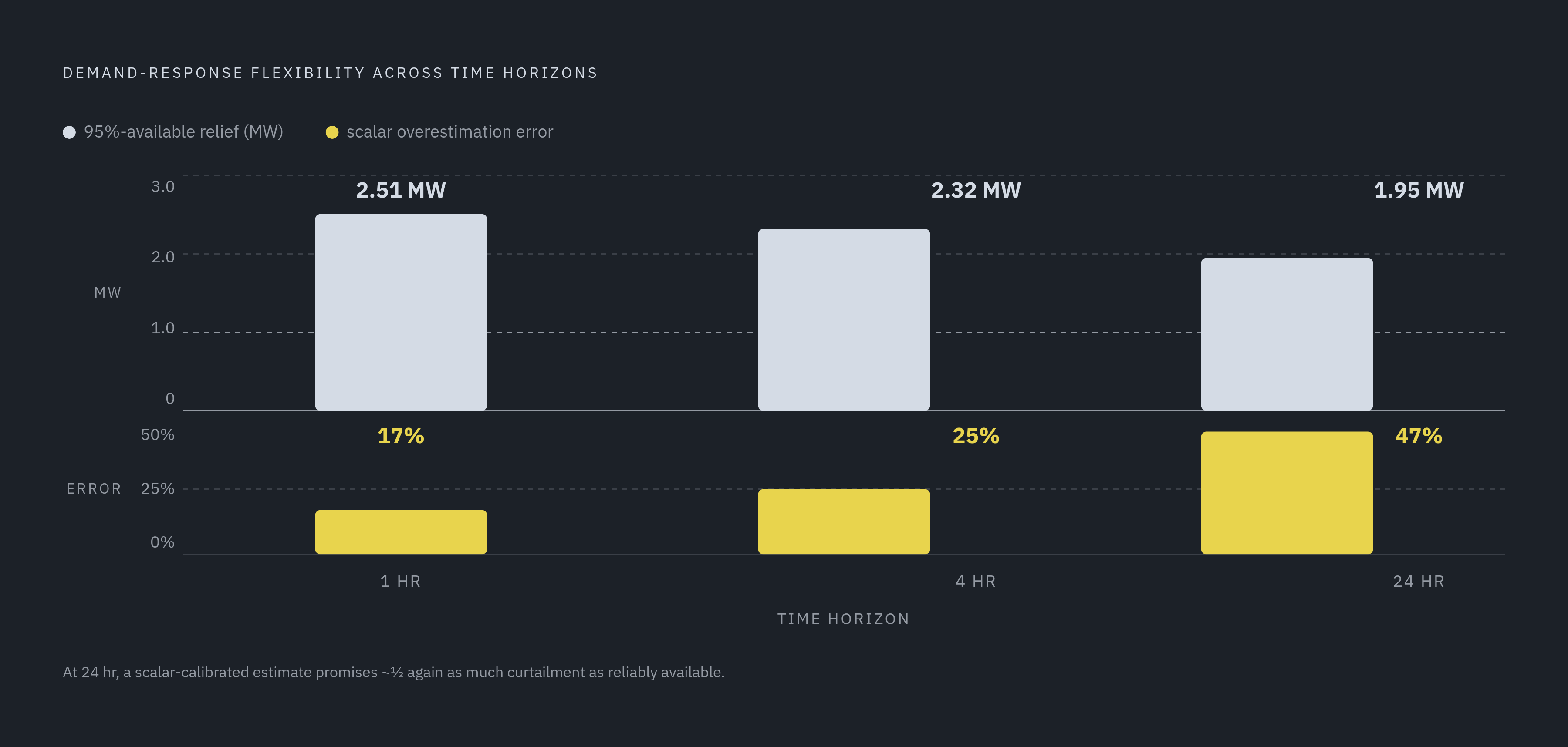
It gets worse the longer the time horizon stretches. Flexibility doesn't hold steady over time, it decays, and a flat percentage assumption completely misses that curve. Running the numbers on a simple mean-calibrated scalar instead of the real distribution overstates available flexibility by 17% at one hour, 25% at four hours, and a full 47% at 24 hours. Any design team using a rough "X% of load is flexible" shortcut is quietly overestimating how much headroom actually exists.
Pooling clusters helps, but only to a point. Aggregating 13 clusters together raises four-hour firmness from 0.38 to 0.66, yet cross-cluster covariance caps how much benefit portfolio diversification can actually deliver. And the scheduler itself doesn't have much slack left to give: newly deferrable arrivals average just 0.008 MW, with zero 95%-available capacity, meaning whatever flexibility looked available on paper has usually already been spent by the production scheduler.
The design implication is direct. Flexibility budgets written into power designs have to account for duration, reliability level, and portfolio composition, not a single scalar percentage, or the facility ends up designed around flexibility it can't actually deliver when a grid operator comes calling. This is exactly the kind of constraint that deterministic design rules can encode early, so a team never signs a demand-response contract the building physically can't honor. The 95%-available relief falls from 2.51 MW at one hour to 2.32 MW at four hours and 1.95 MW at 24 hours, showing that flexibility degrades with duration in ways that a simple percentage assumption does not capture Beyond Scalar Flexibility: From Eligible AI Workloads to Dependable Load Relief.
How power scheduling connects to grid-interactive design
The IEEE's Data Center Growth and Grid Readiness report, published in May 2025, makes a point that changes how these buildings should be treated on paper: facilities drawing hundreds of megawatts now sit in the same regulatory and grid-impact category as major generation assets. That's not a data center anymore in the traditional sense, it's closer to a power plant with servers in it.
The interconnection queue backs that up. As of March 26, 2026, roughly 410 GW of large loads were seeking grid interconnection, and about 87% of that was data centers ERCOT. ERCOT projects growth from 94.7 GW in 2026 to 154.1 GW by 2035, with 23 GW of that being data center load specifically, and PJM is projecting a 56 GW rise in summer peak demand by 2035 EPRI. Demand-response and flexibility commitments aren't optional add-ons anymore in this environment, they're becoming conditions of the interconnection agreement itself.
Regulators are writing that expectation directly into policy. Texas Senate Bill 6 sets large-load reliability requirements, and PJM and MISO have each proposed their own connect-and-manage and flexible-service paths. MIT research modeling a 100 MW data center paired with a 36 MWh, 12 MW battery storage system found that increasing the schedulable share of workload cuts mean daily operating cost by up to 20.7% under binding peak-load limits, and the daily value of that co-located storage more than doubles when interconnection limits get restrictive. That's real money attached to a design decision made months or years before commissioning.
The known responses are on-site generation co-location, battery storage, and hybrid AC and DC architectures, and each one requires power distribution, cooling, and structural scope to be coordinated together, not bolted on after the layout is already fixed. Electrical engineers now have to design systems that can act as controllable grid assets, exchanging data with utility relays in real time instead of just pulling power passively off the line, and the load scheduling logic has to be built into the design model to support that from the start.
The three-layer control problem: BMS, EPMS, and DCIM must be coordinated before construction, not after
Data center BMS integration means coordinating three distinct control layers, BMS handling cooling, SCADA giving operators unified visibility, and EPMS handling electrical monitoring, and all three have to work together from day one or commissioning turns into a mess. A power event becomes a thermal event within minutes, so a load scheduling decision that ignores the BMS setpoints it's about to trigger isn't a finished decision at all, it's half of one.
DCIM takes telemetry from BMS and EPMS and turns it into a coherent capacity model, rack space, kW per rack, cooling capacity, circuit utilization. But it doesn't control anything directly. It watches and reports. That distinction matters, because system boundaries between DCIM, BMS, EPMS, and the individual power controllers need to be spelled out before integration work even starts. Telemetry authority and command authority are distinct design decisions that must be defined before integration work begins, not implementation footnotes to sort out later.
A protocol layer underlies all of this, governing how these systems communicate with each other. Northbound integration, from DCIM up to ITSM, the NOC, dashboards, and southbound integration, from BMS and EPMS down into DCIM, both need protocols like SNMPv3, Redfish, Modbus, BACnet, and OPC-UA specified. Those choices belong in the design model. They shouldn't be showing up on a commissioning punch list as an afterthought.
Cost makes the case on its own. BIM data that reaches turnover incomplete, or disconnected from the operational systems that need it, isn't BIM doing its job. The structured handoff to DCIM, EPMS, and BMS is the actual finish line, and load scheduling data is a core piece of what has to make that crossing intact. Integration cost context places commercial DCIM implementation at USD 35,000–250,000 per site and BMS integration at USD 80,000–600,000, with costs scaling according to the number of unresolved data mapping problems inherited from design.
A connected design workflow for power load scheduling in practice
The core requirement is a single data environment where rack assignments, power budgets, cooling constraints, cable routing, and documentation all share a live relationship. Moving a rack in a connected workflow cascades the change on its own: power circuit reassignment, cooling load recalculation, panel schedule update, capacity summary revision, no manual re-entry required across five different files.
Load classification has to get embedded right at the layout stage, with BE and LC workload designations attached directly to rack assignments, so the power scheduling rules apply the right flexibility envelope to each zone of the data hall automatically. Deterministic rules handle the hard constraints, circuit capacity limits, cooling thresholds, power cap compliance, while AI-assisted tools speed up layout generation and responsive design work inside those guardrails.
Traceability is a design output in its own right. Every load assignment, every RFI answer that touches a power decision, every equipment parameter pulled from a manufacturer's spec sheet, all of it should trace back cleanly to the information behind it. Design software built for this connects data hall layout, critical-systems engineering, cable routing, documentation, and RFI management inside one workflow, with the structured handoff to DCIM, EPMS, and BMS treated as the defined finish line rather than a separate integration project tacked on afterward. Equipment data pulled straight from manufacturer specs flows into the power model and validation rules directly, instead of getting manually retyped into a schedule somewhere, and manual retyping is one of the more common places a load budget error creeps in unnoticed.
The design that results shows up at construction already carrying its scheduling logic: power budgets that are traceable, flexibility envelopes that are honest about their limits, and operational system integrations that were planned in advance, before the equipment was already in the room.
Automated power load scheduling failures without the right design-stage foundation
Operational automation, EPMS, DCIM, intelligent PDUs, can only enforce whatever the design handed it. The load model underneath produces the automation's constraints, so if that model is wrong, the automation enforces the wrong constraints with total confidence. Automation doesn't catch a bad assumption, it executes it faster.
Flexibility overestimation sits right at the center of this. A mean-calibrated scalar overstates 24-hour demand-response capacity by 47%, and a facility designed around that number simply cannot honor the contracts written on top of it. That's a facility that promised a grid operator something it structurally cannot deliver.
Discipline silos at the design stage are where this usually starts. The EPMS integration team needs to know which circuits serve LC workloads and which serve BE workloads. If that distinction never got encoded back at the layout stage, it doesn't magically appear at commissioning. It just becomes another gap someone discovers the hard way, usually the expensive way, months after the building is already live.