Automated As-Built Documentation Generation From Design Models
Automating documentation keeps design intent aligned with what actually gets built.
Data center teams run some of the most advanced design software in the construction industry, then hand in documentation built the old way: spreadsheets, PDFs, and markups stitched together by hand at the end of the job. The model holds design intent. What actually gets built lives somewhere else, in field notes and change logs that are never formally tied back to the model that started the project. At closeout, someone has to sit down and reconcile the two, line by line, at the exact moment when schedule pressure is at its worst and patience for rework is thinnest. That reconciliation process is slow and prone to error by design, because it was never built into the workflow. It was bolted on at the end. The pattern isn't new, but data center construction volume has grown to the point where a workflow that used to be a manageable annoyance now functions as a structural bottleneck on every project of scale.
Scale and system complexity make the documentation gap expensive
A documentation gap that costs a few hours on a small commercial build turns into a multi-week liability on a data center project, because power, cooling, and cabling systems don't document independently of each other. A change to one ripples through the rest. Design loads above 100 to 200 kW per rack are becoming a routine request from operators, and that kind of load isn't a tweak you note on a field markup. It forces a full rethink of the mechanical and electrical architecture supporting that rack. Every downstream document, from cooling capacity calculations to electrical distribution schedules, has to change with it.
Operations teams inherit the consequences of that complexity through three systems: the building management system (BMS), the electrical power management system (EPMS), and the data center infrastructure management platform (DCIM). The BMS controls mechanical and environmental plant. The EPMS monitors the electrical path from utility incomer all the way to the rack. DCIM manages IT assets, rack space, power capacity, and network connectivity. DCIM doesn't replace the other two systems, it consumes their data, pulling from both to give operations a unified view of the facility. Outages happen in the gaps between these systems, where data that should have flowed from design through construction into operations instead got lost in a spreadsheet or a stack of unlinked PDFs. Every one of these systems is only as accurate as the as-built record that feeds it. When that record is reconstructed at the end of a project instead of maintained throughout it, the data populating BMS, EPMS, and DCIM at handoff is already stale before the facility goes live.
What the model produces and where automation already works
Modern BIM tools already generate real documentation automatically. The automation works well right up to the edge of the model, and stalls the moment someone needs to reconcile what the model says with what's actually standing on site. Scan-to-BIM workflows are a clear example of where this has matured: laser scanning captures a physical space, and that point cloud gets converted into a BIM model. AI now handles the most labor-intensive parts of that conversion, detecting defects and deviations between the scan and the model, and turning raw scan data into a usable model structure.
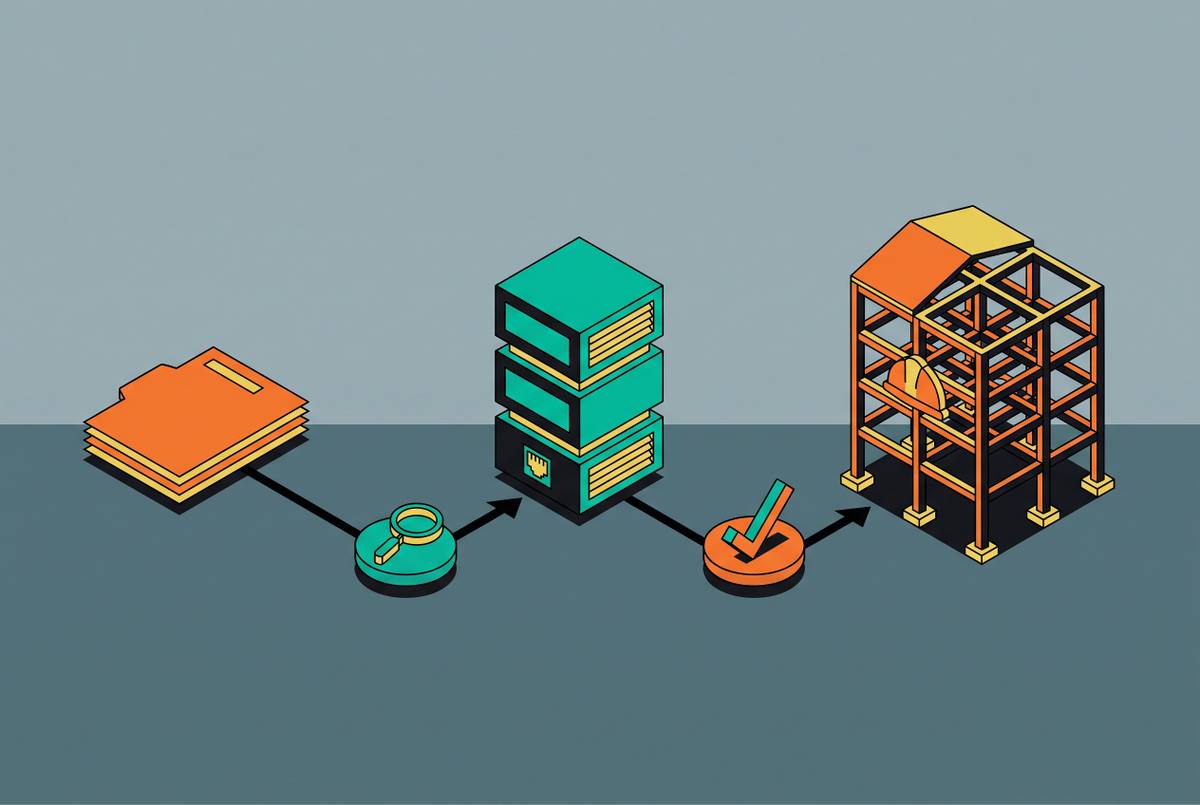
A similar approach is working at the documentation layer itself. One method links BIM elements directly to construction schedule activities, then uses algorithmic data processing to generate certificate fields automatically, so the model and the schedule produce the as-built record together instead of requiring a separate documentation pass once construction wraps.
These limits are visible in the tools most teams already use every day: Revit's parametric modeling is built for design work, and it does that job well. Automating beyond design typically means reaching for Dynamo, custom APIs, or pyRevit, though Revit 2026 has started building some of that capability in natively. Those workarounds can be clunky and error-prone, because the platform wasn't built from the ground up for code-first workflows. Laying out hundreds of server racks automatically, or generating a full cable tray network without custom scripting, remains a heavy lift. Meanwhile, a lot of the calculations that matter most, load calculations, compliance checks, cost estimates, still happen in spreadsheets outside the model entirely, so a change made in one place requires someone to manually update the other. AI applications built on top of BIM have moved past the pilot stage on large data center projects, but the honest read is that AI augments the engineers running the workflow. It doesn't replace them.
Structuring the model before automation can produce reliable documentation
Automated as-built documentation can't be added as a feature to a model that wasn't built to support it. The model has to be structured from the start, with computable data attached to every element, before any automation layer has something to read. The limiting factor isn't software capability, but data governance. Without structured element attributes, defined schedule linkages, and clear field mappings, an automation layer has nothing to work from. The model stays a drawing. It never becomes a record.
Equipment specifications trapped inside manufacturer PDFs make this concrete. That data doesn't flow into a model by itself. Spec extraction has to feed directly into model parameters, schedules, and validation rules, so the documentation stays accurate as real equipment shows up on site. This matters most when a submittal arrives with different specifications than the ones originally modeled, which happens routinely given current equipment lead times. An unstructured model has no way to propagate that change. A structured model, with parameter mappings defined in advance, does it automatically.
Spreadsheet dependency is a symptom of this same gap, not a separate problem. When load calculations, compliance checks, and equipment parameters live outside the model, any change requires manually reconciling two systems that should have been one, the same manual as-built problem, just happening earlier, at the design stage instead of at closeout.
Structured data also makes more advanced validation possible. Research frameworks like Phythesis combine large language models with physics-guided evolutionary optimization to generate energy-efficient data center layouts automatically. LLM-driven scene synthesis that ignores physical constraints, temperature, power usage effectiveness, load distribution, produces results that look plausible but aren't physically real. Physics-informed constraints are what keep that from happening, and enforcing those constraints requires structured parameters throughout the model. A model without that structure gives an automation layer nothing to validate against.
Where deterministic rules and AI belong in continuous documentation
Continuous as-built documentation needs two different kinds of automation working together, not one general-purpose system doing everything. Deterministic rules handle the decisions that need to be consistent and auditable every single time. AI handles the tasks where language, inference, and judgment about edge cases actually add value. Treating these as interchangeable is what produces the failures teams end up blaming on automation generally.
Deterministic rules are the right tool for populating inspection certificate fields, triggering approvals tied to schedule milestones, propagating parameter changes when equipment attributes shift, and running compliance checks against fixed standards. The value of a deterministic system is that the same input always produces the same output. No interpretation, no variance, nothing that behaves differently in production than it did in testing. In regulated and critical-facility work, that kind of traceability isn't a nice-to-have. Every RFI answer, every design decision, every equipment parameter has to trace back to the information that supports it.
AI belongs where the input isn't fixed: parsing unstructured manufacturer documentation, interpreting field observation notes written in plain language, flagging deviations found in scan-to-BIM comparisons, and handling the edge cases that fall outside any rule set someone wrote in advance. Deterministic systems fail precisely at those edge cases. When a rule-based system hits something it wasn't built to handle, it stalls or routes the decision to a person. On a project generating hundreds of RFIs and equipment submittals, that failure mode recreates the exact bottleneck the automation was supposed to remove.
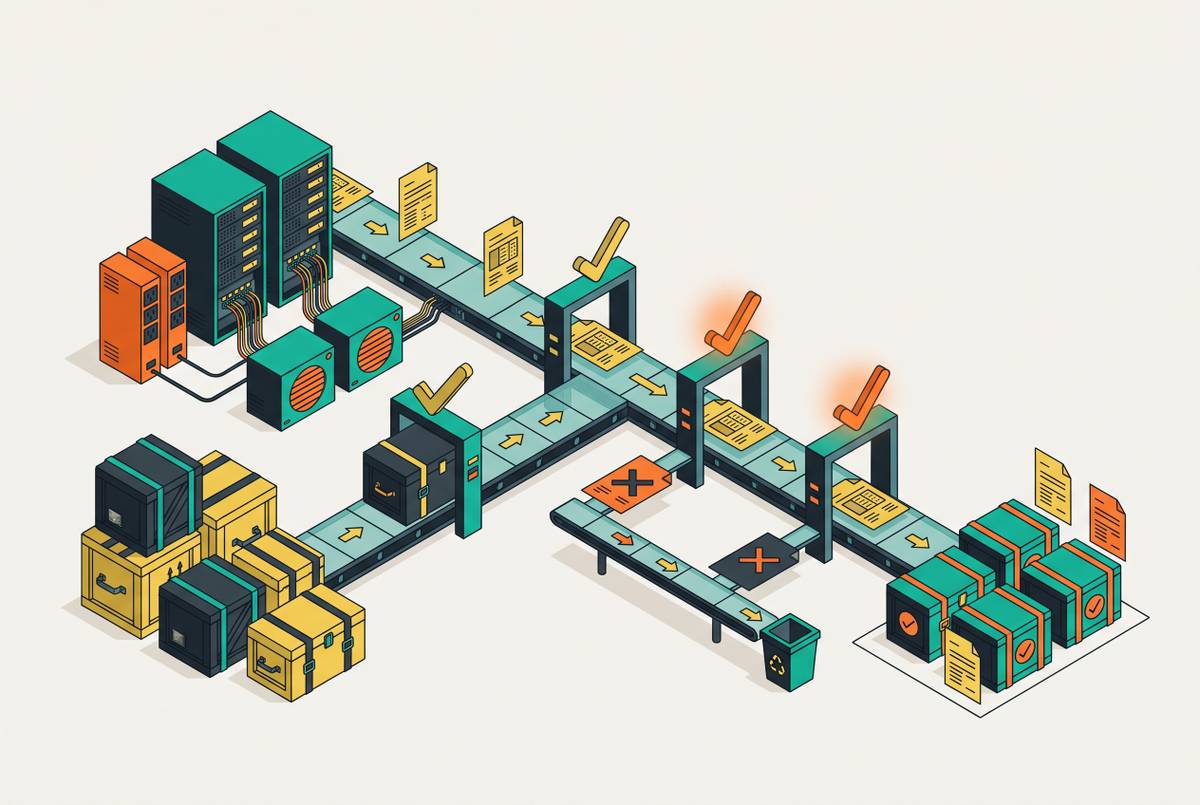
The practical architecture pairs the two: an AI task does the interpretive work, its output gets sanitized and structured, and only then does it move into a deterministic step. That combination gives a project the reasoning ability of a language model with the reliability of a rule-based system. AI closes the edge-case gap. The deterministic layer validates the result before it ever enters the record. Applied to a real submittal: AI extracts parameters from a manufacturer's document, a deterministic rule checks those parameters against the model specification and flags any mismatch, and a second deterministic rule updates the relevant certificate fields. A person reviews the exceptions the system flags, not every record that passes through it.
How RFIs and submittals shape the continuous as-built record
RFIs and equipment submittals are where constructed reality most often splits from design intent during delivery. Whether that split gets caught in the model in real time, or discovered only at closeout, decides whether the as-built record means anything or just exists on paper. In data center construction, transformers, switchgear, generators, UPS systems, and cooling equipment often get ordered months ahead of installation. An RFI that sits unresolved can freeze that procurement entirely, or push a field team toward a workaround that doesn't surface as a problem until commissioning, long after it would have been cheap to fix.
Large critical-facility projects generate hundreds or sometimes thousands of RFIs over the course of delivery. The hard part was never answering them. It's knowing which ones actually threaten schedule, cost, or turnover, and that kind of triage depends on a system that links RFI content directly to model elements and schedule activities, not a log sitting off to the side. When a submittal shows up with a different equipment spec than the model currently holds, three things need to happen in sequence: the model parameter updates, the documentation fields tied to that parameter update, and the deviation gets flagged for someone to review. In most current workflows, all three steps are still done by hand.
Early integration of commissioning and documentation workflows into the delivery process, rather than treating them as closeout activities, keeps this chain from breaking. The output of getting it right is traceability: when every RFI answer and every submittal review is linked to the model element it touches, the as-built record isn't something reconstructed after the fact. It accumulates on its own, continuously, for the length of the project.
What operations-ready handoff requires from the as-built record
A continuously maintained as-built record makes operations-ready handoff possible. Documentation that's accurate but unstructured still isn't enough for BMS, EPMS, and DCIM systems to actually ingest and use. Most DCIM platforms can already ingest the data that construction and commissioning teams produce. Defining, ahead of time, what data has to be captured, in what format, at what milestone, by whom, and to what standard of completeness is the real challenge before turnover gets accepted. Without that governance structure written into the contract and enforced through acceptance gates at each project milestone, handoff turns into a negotiation between parties instead of a deliverable that gets verified against a standard.
A commissioning package made up of vendor test reports and as-built drawings alone isn't enough to run a facility on. Operations teams need documented alarm logic, the rationale behind each threshold, escalation procedures, known limitations of the installed systems, and a plain description of what each monitored parameter actually means in operational terms. None of that lives in a drawing set. Each of the three operational systems needs its own structured inputs to function: the BMS needs control logic and alarm parameters, the EPMS needs the electrical path from utility incomer to rack mapped accurately, and DCIM needs IT asset attributes, rack positions, power capacity, and network connectivity, all captured in a form the system can actually read. A record built continuously throughout delivery arrives at handoff already in that form. A record reconstructed at closeout rarely does.