Automated Cable Routing Algorithms in Critical-Facility Design
Automated routing solves cable-density problems manual design cannot handle anymore.
Generative AI data centers now need ten times more fiber than a conventional facility to feed GPU clusters and hold interconnect latency down, and that single multiplier is why manual cable routing has stopped working as a design method. This isn't a story about incremental growth in rack counts, but a step-change in the density curve, the fiber curve, and the platform refresh cycle that has invalidated the assumptions built into manual routing practice.
Routing Complexity in AI Data Centers
Rack densities in new AI halls have climbed from a traditional average of roughly 8 to 10 kW up to a range of 40 to 250 kW, depending on the deployment, an Introl analysis found. That is not a gradual slope: it is a redrawing of the physical envelope every routing decision has to fit inside.
Fiber counts moved with it. A generative AI data center needs ten times more fiber than a conventional setup to support GPU clusters and low-latency interconnects, a multiplier that overwhelms the mental and spreadsheet models routing engineers have relied on. A single AI rack pushes enough east-west traffic that the fiber architecture connecting thousands of GPUs creates coordination problems traditional data center design never had to solve, because traditional designs never had to move this much data between neighboring racks in the first place.
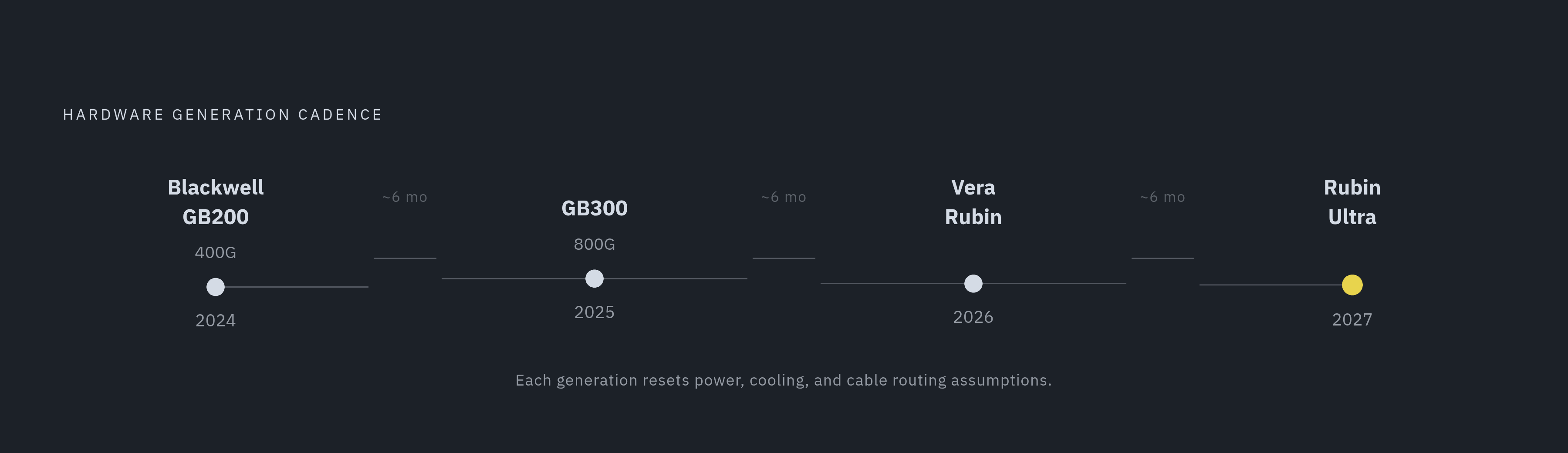
The hardware refresh cycle layered on top of that keeps the ground shifting under any design that took more than a few months to finalize. NVIDIA moved from the Blackwell GB200 platform at 400G interconnect speeds to GB300 at 800G, with Vera Rubin and Rubin Ultra generations already mapped out for 2026 and 2027, a cadence that resets infrastructure assumptions roughly every six months. Each new generation carries its own power draw, cooling profile, and interconnect spec, and those changes cascade straight into cable routing choices that design teams may have already locked in. Manual routing was built for a world where a design held steady for years. The routing method now has to match the pace of the hardware, not the pace of the drafting table.
Thermal and mechanical constraints as a coupled multi-domain routing problem
The path a cable takes and the thermal outcome it produces are no longer separate concerns in a high-density AI hall. They are the same decision, made once, and routing has become a multi-domain optimization problem that cannot be split into sequential steps handled by separate trades.
Cooling is a big part of why. As facilities move toward rear-door chillers and liquid-to-chip systems, coolant manifolds now sit in space that used to belong to cable trays, and designers have to route bundles through tighter radii to make room. That pressure has pushed the industry away from the raised-floor model and toward overhead routing, a structural shift driven jointly by cooling requirements and by the inability of underfloor pathways to accommodate the fiber density AI networking demands, Introl's analysis found. Cable congestion underfloor blocks airflow and creates hotspots that undercut cooling performance exactly where the facility can least afford it. Moving the fiber overhead and keeping it clear of the cold aisle fixes the airflow blockage and the cable-density crowding with the same design choice.
Meta's AI clusters run at a PUE of 1.1 using overhead routing. It's the direct result of routing and cooling architecture being planned together from the first drawing, rather than cable trays going in first and cooling getting fitted around them afterward.
There's a performance dimension too. AI workloads are latency-sensitive enough that physical cable distance between GPUs gets measured in nanoseconds, so a route that satisfies thermal rules but runs longer than necessary quietly taxes the very interconnects the facility exists to support. Every routing decision now has to clear three tests at once: does it fit the thermal design, does it fit the physical geometry, and does it keep the network fast enough. Academic work on optimal wiring diagram embedding, from Blanco, González, and Puerto, gives this its formal shape: routing through constrained three-dimensional space demands safety separation, obstacle avoidance, geometric feasibility, and constructibility all satisfied at the same time, and that combination is combinatorially hard by nature, not hard because engineers haven't gotten good enough at it.
What Automated Routing Algorithms Do
Automated routing algorithms solve a category of constrained spatial optimization that is mathematically intractable by hand once a facility reaches data center scale. Automated routing algorithms are not an efficiency claim: they state what a person with a whiteboard and a spreadsheet can and cannot compute in a reasonable amount of time.
Blanco, González, and Puerto formalized the layout task as a three-dimensional problem requiring topology, physical routing, safety separation, obstacle avoidance, and constructibility to all be optimized together, encoded as a mixed-integer linear programming model that the paper tests against real industrial cases. The method discretizes the feasible design space into structured network graphs, which keeps the engineering constraints intact while cutting the problem down to a size a solver can actually work through. That structure is the whole reason automated routing is tractable where manual enumeration simply is not. The objective is to minimize total cable or pipeline length while every technical spec is satisfied at once, a multi-constraint balancing act a manual process might approximate on a good day but cannot solve with any consistency.
The scale of the problem makes the case even more clearly. For reconfigurable data center networks, researchers from Xi'an Jiaotong University, Shanghai Jiao Tong University, and Huawei built a framework called ATRO (Alternating Topology and Routing Optimization) to handle joint topology and routing decisions. At a network size that matters in practice, the problem involves so many integer and continuous variables that commercial solvers choke on it directly. ATRO gets around that by splitting the problem into alternating rounds of topology optimization and routing optimization, running a solver-free pipeline that beats prior approaches on both runtime and worst-case link utilization across a range of workloads. In the simpler one-hop case, it guarantees the actual global optimum through accelerated binary search, a deterministic result no manual or rule-of-thumb method can promise.
None of this replaces engineering judgment. AI tools sit above the deterministic layer, scanning alternative routing configurations to surface options that cut conflicts, ease maintenance, or fit procurement constraints better, with a designer still reviewing and signing off on the final route. What AI buys back is iteration time, not authority. The distinction matters because deterministic rules produce outputs that are provably correct under stated constraints, while AI-assisted analysis explores the solution space efficiently without ever functioning as a compliance check. Separate research on BIM-based cabling automation, from Pogorelskiy and Kocsis at the University of Debrecen, backs this up from a different angle: standard design tools don't automatically populate equipment in cabinet models, so a purpose-built plug-in had to be written just to add connectors, corners, and fasteners and generate specs, because manual diagram creation introduces errors at the cabinet façade level alone.
Where BIM falls short of what automated routing requires
BIM gives a data center project its best shared pool of coordination information, and it deserves the investment engineering firms have made in it. But treating the model itself as the routing solution is how facilities end up back in manual rework, which defeats the entire point of adopting BIM in the first place.
Data centers rank among the most coordination-intensive builds in real estate: power distribution, cooling, cable routing, security systems, and structural work all converge in tight physical space with no tolerance for a conflict discovered during installation. The Pogorelskiy and Kocsis research shows exactly where the standard toolset stops. Available BIM methods don't include a function that builds a 3D cabinet model with equipment automatically filled in, so the researchers had to develop a new cabinet family from scratch just to automate equipment specification, plus a separate cable trays plug-in to place connectors, hangers, and consoles and generate specs on its own. That plug-in places elements at set intervals, handles wall, floor, and ceiling mounting, and writes specifications automatically, none of which BIM does natively. Without that extra layer, every cabinet façade scheme gets built by hand, and that's precisely the point where routing decisions turn into fabrication instructions, and where errors creep into instructions that a crew will follow literally.
The gap isn't only technical. Firms often fail to realize BIM's full technical potential because of organizational inertia, disrupted workflows, and resistance to changing how teams work. BIM earns its value where models built to consistent standards with fabrication-ready geometry make industrialized construction and prefab assembly possible, since repeatable design patterns depend on BIM maturity as their foundation. AI systems comparing site laser scans against the BIM model can now catch deviations from design intent, a capability already running on major data center projects in 2026, especially for verifying structural, precast, and prefab elements. None of that argues for walking away from BIM. It argues for building routing automation on top of it, adding purpose-built algorithmic capability, and recognizing that the model only pays off once it connects to the systems that run the facility after handoff.
How routing errors made during design become operational liabilities
Three systems run a live data center, and each one depends on getting clean data from design. The BMS handles the mechanical and environmental side: cooling, airflow, temperature, humidity, leak detection. The EPMS tracks the electrical path from the utility incomer all the way to the rack, covering switchgear, generators, UPS, PDUs, and busbar. DCIM manages IT assets, rack space, power capacity, and network connectivity, and it doesn't replace the other two systems so much as consume their data.
Outages happen in the seams between these three systems. When routing data captured during design isn't structured for all three to read directly, someone has to translate it by hand at handoff, and that's exactly where the errors design automation was supposed to eliminate get reintroduced. The Uptime Institute's Annual Outage Analysis 2025 found power was the primary cause of impactful outages for 54% of operators surveyed, and power routing traceability starts in the design phase, long before an operator ever sees the facility.
A cable tray path that creates a cooling bypass is a design mistake. Once that mistake reaches operations as mis-documented infrastructure instead of a flagged issue, it turns into an availability risk that a maintenance team has to track down under pressure, usually during an incident rather than a scheduled review. Facilities management systems are supposed to integrate directly with DCIM, BMS, and EPMS so alarms generate and route work orders without a human retyping anything in the middle, but that integration only works if the routing data feeding it was structured and complete at handoff. E Tech Group's approach, a repeatable BMS/BAS/EPMS architecture installed across more than 50 large-scale mission-critical facilities nationwide, shows that consistency in system architecture cuts project timelines and risk. Consistency in the routing data feeding those systems is the upstream condition that makes that architecture work at all.
The dollar figures involved aren't abstract. Construction costs per megawatt have hit record highs worldwide and are forecast to climb further in 2026, Turner and Townsend's Data Centre Construction Cost Index 2025 to 2026 found. At that cost per megawatt, a coordination failure that forces rework or triggers an outage becomes an eight-figure liability on a project of meaningful size.
Where AI belongs and where deterministic rules are required gets decided by the cost of being wrong, not by what the algorithm is capable of doing. DCIM does not replace the other two: it consumes their data.
AI has a legitimate, well-defined job on one side of that line. It can scan a BIM model for compliance with industry standards and flag issues before construction starts, and that's a sound use of AI precisely because the output is a flag for a human to review, not a certified routing decision. It can also comb through alternative routing configurations and surface options that cut conflicts, improve maintainability, or fit procurement constraints better, with a designer still reviewing and approving before anything moves forward. What that buys is speed. It doesn't substitute for engineering judgment on anything safety-critical.
Deterministic rules own the other side, and they own it because certain requirements simply don't tolerate a probabilistic answer: separation distances between power and data cables, fill ratios in cable trays, bend radii for fiber, clearances around cooling equipment. The Blanco, González, and Puerto model treats these as hard constraints inside its MILP formulation, not as objectives to be traded off against each other but as conditions a valid route has to satisfy outright. An AI model that proposes a route violating a separation requirement fails differently than a person would. It produces an output that looks plausible, passes a visual check, and hides the defect until something goes wrong later, which is a more dangerous failure mode than an obvious human error.
The practice taking shape across the industry follows that logic: use AI where it speeds the work up, deterministic rules where precision is non-negotiable, and structured project data across the whole pipeline. That's a design philosophy grounded in where errors do the most damage, and it maps cleanly onto a routing workflow: AI handles path exploration and conflict surfacing, rules enforce compliance, and structured data keeps the handoff intact. Industrialized construction and prefabrication raise the stakes on getting that split right, since a module has to be built to a routing decision that's deterministically correct before fabrication starts. A route that was AI-suggested but never rule-validated cannot be fixed once the module has already been manufactured.
Sources
- Cable Management Systems: Fiber Pathways and High-Density Routing for AI Data Centers | Introl Blog
- Automation for structured cabling system in data centers using Building Information Modelling in: International Review of Applied Sciences and Engineering Volume 13 Issue 3 (2022)
- ATRO: A Fast Algorithm for Topology Engineering of Reconfigurable Datacenter Networks
- Optimal Embedding of Wiring Diagrams in Constrained Three-Dimensional Spaces