Why PDF O&M Packages Fail Data Center Operators and What Replaces Them
Static handoffs sever asset data from the systems that depend on it.
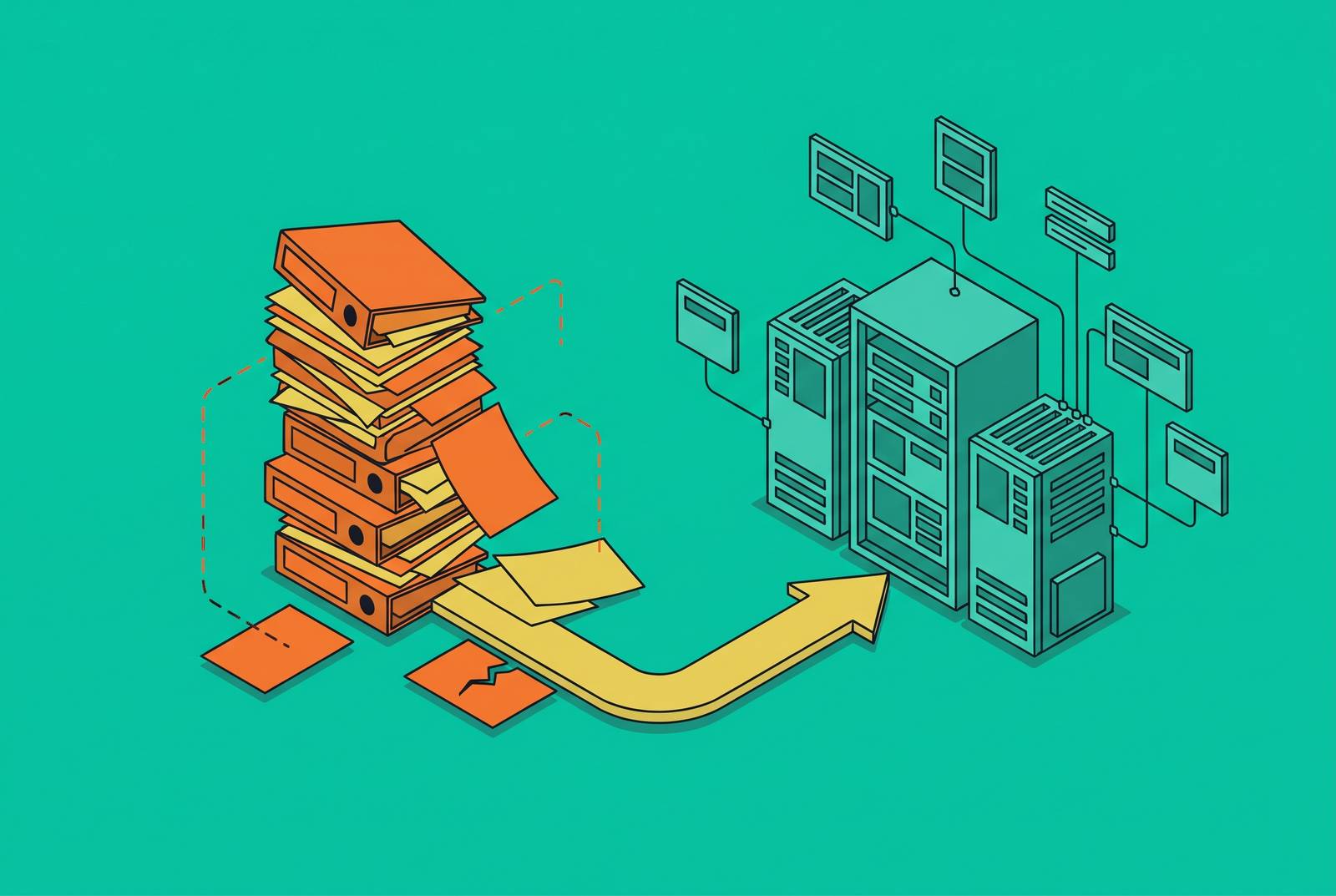
PDF O&M packages fail data center operators because they break the connection between asset data, system relationships, and the facility as it changes. A DCIM-ready BIM handoff from design models to operations requires structured asset records, shared identifiers, and maintenance parameters built continuously through design and construction.
Why PDF O&M packages are a structural failure, not a convenience problem
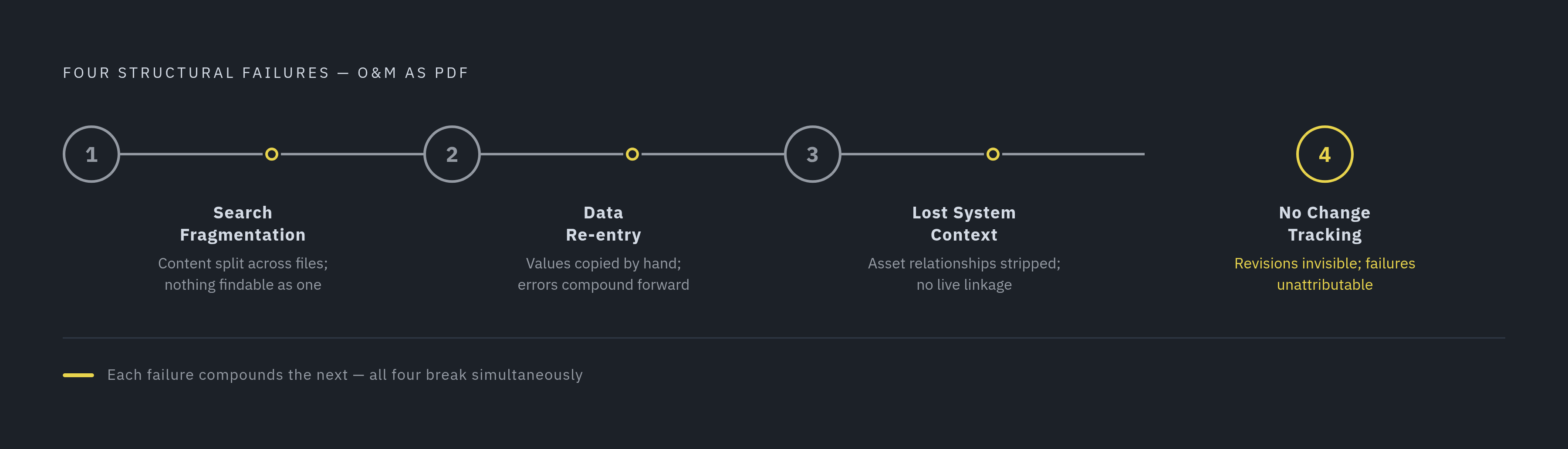
Structural failure is the right diagnosis for PDF O&M handover. The package breaks four links at once, which are search fragmentation, data re-entry, loss of system context, and inability to track change. Better search addresses only the first of those failures. It does not make the information usable by the systems that operations relies on, or keep that information aligned with the equipment on the floor.
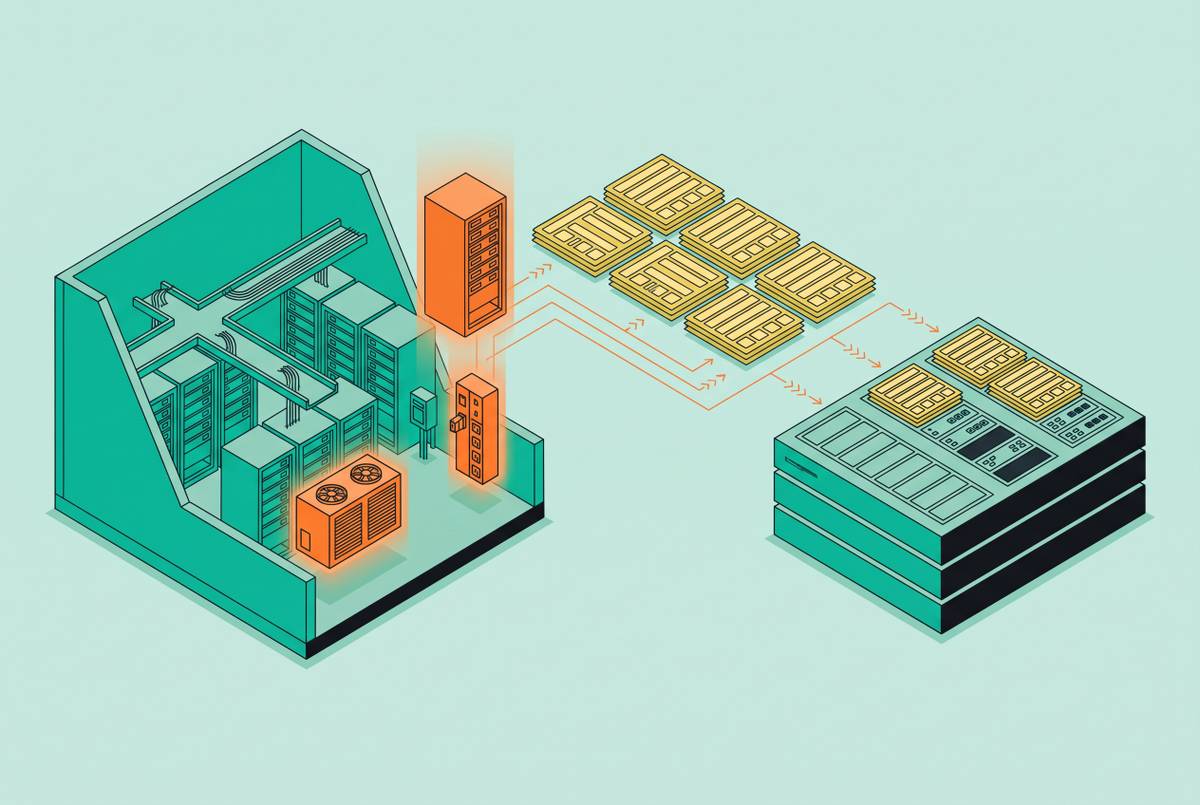
A PDF can describe equipment and include written explanations of its connections, but it does not provide live, structured relationships showing which space it serves, which system it belongs to, or what sits upstream and downstream. It also fails to link a shutdown sequence to every asset it affects in an operational record. Those relationships are part of how the facility works. Treating them as pages to consult rather than data to maintain turns a data architecture problem into a document delivery task.
What breaks when asset data arrives without its context
Technicians must retype asset data into DCIM and CMMS even though much of it already existed in the design model. That creates opportunities for transcription errors and inconsistent names. When document tags do not match field tags, BIM objects, or BMS points, integrations need a translation layer that must then be maintained indefinitely. The operator starts with competing versions of the same asset.
The record then begins to drift from reality. A rack moves, a component is replaced, or a circuit is modified, but there is no live mechanism pushing the change into the PDF package. Information the owner could use stays trapped in documents, where it is unavailable for planning maintenance and future modifications. A technician may find the original specification without finding a dependable account of the current installation. Search success is not the same as operational accuracy.
That distinction also limits what automation can achieve. Transforming Future Data Center Operations and Management via Physical AI describes most industrial data centers as operating at a reactive level and identifies structured telemetry as necessary to move beyond it. Document archives cannot supply that foundation on their own. Uptime Institute’s 2026 Annual Outage Analysis finds that power remains the leading cause of impactful outages and that outage costs continue to rise. That finding shows how much is at stake when the quality of a system’s data depends in part on the quality of the handover. Because BMS, EPMS, and DCIM depend on one another’s data, a documentation gap can spread beyond the system where it began.
Why the problem worsens as facilities scale to AI-era densities
Requests for design loads above 100–200 kW per rack are becoming more common. At that scale, maintainability, repeatability, and sequencing demand more than the approach used for smaller bespoke projects. Planners shift from asking how much space a hall needs to asking how much high-density compute the facility can support. Floor area alone cannot answer that question. Neither can a static document set that leaves power and cooling relationships disconnected from current asset records.
More money is at risk as the technical demands grow. Commissioning delays on a large data center project can cost developers millions per month in lost revenue. The Physical AI paper puts capital expenditure for a hyperscale data center with high GPU density in the billions and annual electricity operating expenditure in the hundreds of millions. With those sums at stake, teams can afford to lose little information as they pass it to operators. Reconstructing records after turnover consumes time at the point when the facility is expected to begin operating.
These are scale problems, but they are also coordination problems. At higher density, it is harder to manage the links between power delivery, cooling, and shutdown sequencing when each has its own records. A missing connection is no longer just an incomplete entry in a manual. It can leave teams without a traceable account of how a change affects another system.
Where BIM falls short as a handover solution on its own
BIM provides a necessary input, but geometry is not operational completeness. A model can show in detail where ducts run and equipment sits but still lack the structured fields that DCIM, EPMS, and BMS need. A mechanical unit may be shown in detail but have no usable fields for its rated capacity, maintenance interval, firmware version, or monitoring point identifier. More detail in the geometry does not fill those gaps.
The same limit applies to building automation systems. BIM representations can describe the physical setup of devices while leaving out control logic, sequences of operation, and operational intent. Open, vendor-neutral standards support interoperability with facility management systems, but incompatible schemas and non-standardized delivery still obstruct the handoff. A schema is simply the agreed structure of the data. Without agreement on that structure, two systems can describe the same equipment without being able to exchange a useful record.
The timing of that agreement is decisive. On federal data center builds where the BIM-to-DCIM specification arrives after construction has begun, integration teams can discover that the model satisfies the architect’s deliverables while leaving operations’ data needs unmet. The model was built against a different requirement. Schema alignment and shared asset identifiers therefore need to be defined before construction begins. BIM alone is not enough, but discarding it would discard a valuable starting point for the connected handoff.
How fragmentation during design and construction seeds the handover failure
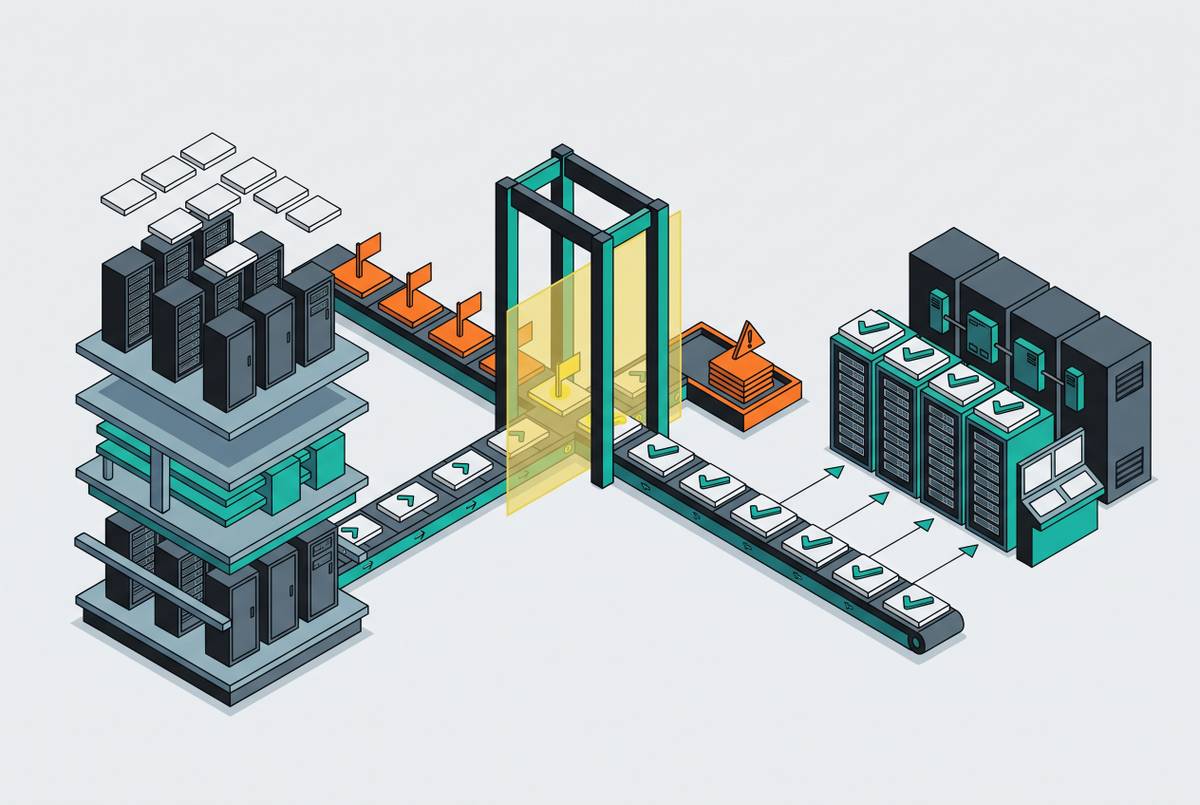
Information needed for handover becomes fragmented well before anyone assembles the O&M package. Equipment specifications arrive in manufacturer PDFs, then get manually entered into models, schedules, and separate checks. Each transfer takes time and can lose information. An RFI resolved in an email thread may settle a field question without attaching the answer to the asset or design decision it concerns. By closeout, the project may retain the answer but lose a usable connection to its reasoning.
That fragmentation has costs long before operations takes over. The Navigant Construction Forum study puts the cost of each RFI at roughly a thousand dollars, with closure taking days. A rejected submittal can add weeks and delay procurement of long-lead equipment already measured in months. The Construction Industry Institute estimates that rework makes up a large share of the total cost of projects across the industry. These costs are not all handover costs. They show how much work can accumulate when information must be reconciled or recreated between parties.
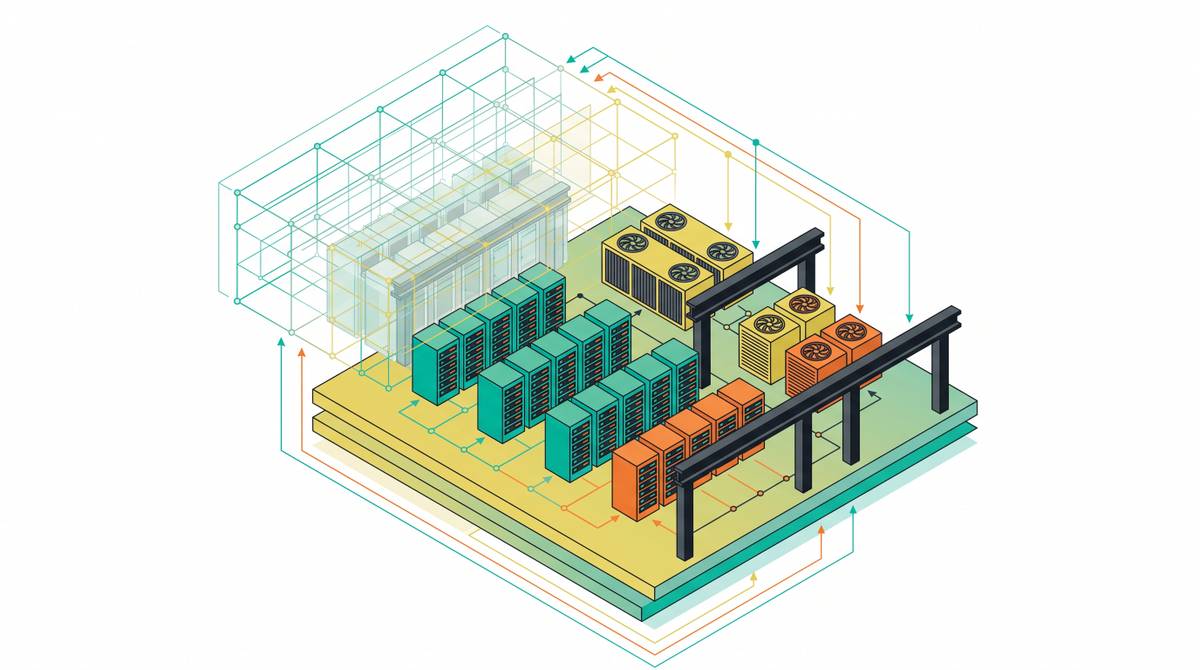
A rack move makes the mechanism easy to see. Power, cooling, cable routing, schedules, and sheets all need to reflect the change, but disconnected tools hold separate copies of the truth. Teams must manually rebuild the consequences of the change across the disconnected tools. The resulting O&M package inherits those differences. A usable digital O&M process therefore begins during design, defines the required asset information, validates it through construction, and preserves an as-maintained record after turnover. Closeout cannot restore a chain that the delivery workflow never maintained.
What does a DCIM-ready BIM handoff actually require?
A DCIM-ready BIM handoff requires asset information requirements to be defined before design begins. Each piece of equipment enters the record as a structured object with its operational attributes attached, and that record is updated and validated through construction. Maintenance parameters are part of the object from the outset. The record develops with the facility.
System relationships must be explicit within that record. They identify the space an asset serves, its system, its upstream and downstream connections, and the shutdown sequences in which it participates. Proximity in a drawing is not enough. The handover also includes validated alarm logic, the reasoning behind thresholds, trend baselines, and a clear RACI chart defining responsibilities. Those elements give operations both the parameters needed to run the facility and the context needed to understand them.
The receiving systems must shape the handoff specification. Shared asset identifiers established before construction allow DCIM, EPMS, and BMS to read a consistent record directly. That is the practical route out of manual transcription. It also provides the foundation for coordination between EPMS, DCIM, and intelligent PDUs when enforcing rack- and outlet-level power caps or prioritizing critical workloads. Such coordination depends on trustworthy asset data across all the participating systems.
AI works well on tasks that need flexibility, such as metadata extraction, pattern recognition, and spotting gaps in how teams coordinate their work. Deterministic rules govern power caps, naming conventions, and threshold parameters because those requirements cannot bend with interpretation. The two approaches are not interchangeable. Extracting a parameter from a manufacturer document and checking whether it satisfies a fixed requirement are different jobs. Keeping that distinction clear allows automation to accelerate the work without making compliance depend on a flexible judgment.
What a connected project OS delivers that document-based workflows cannot
A connected data center project OS puts layouts, critical-systems engineering, cable routing, documentation, RFIs, and operations-ready handoff inside one workflow. Its advantage is not simply having fewer places to search. It keeps the work connected as the project changes. When a rack moves, the change propagates across power, cooling, cable, schedules, and sheets rather than requiring teams to reconcile separate copies.
This kind of central operating system serves engineers, designers, and project teams that deliver critical facilities. It connects early planning through construction handoff to DCIM, EPMS, and BMS integration, working with and augmenting BIM workflows. Data taken from manufacturers goes into models, schedules, and validation rules. RFI answers, equipment parameters, and design decisions stay linked to the assets they are about. The reasoning survives with the record.
That connection is what bridges design models and infrastructure management. Asset identifiers established during design persist through construction, allowing DCIM to receive the record the delivery team developed directly. AI accelerates extraction and responsive work, while deterministic rules enforce requirements where precision and compliance are non-negotiable. The platform’s role is to preserve that foundation across the delivery workflow.
A complete, connected, as-built record can become an as-maintained record as equipment and system relationships change. Beginning maintenance planning and future modifications with the delivered record reduces the operating cost imposed by missing context over the asset’s life.