Cost of AI Data Center Construction vs Standard Enterprise Build
Liquid cooling and higher-voltage systems double AI data center construction costs.
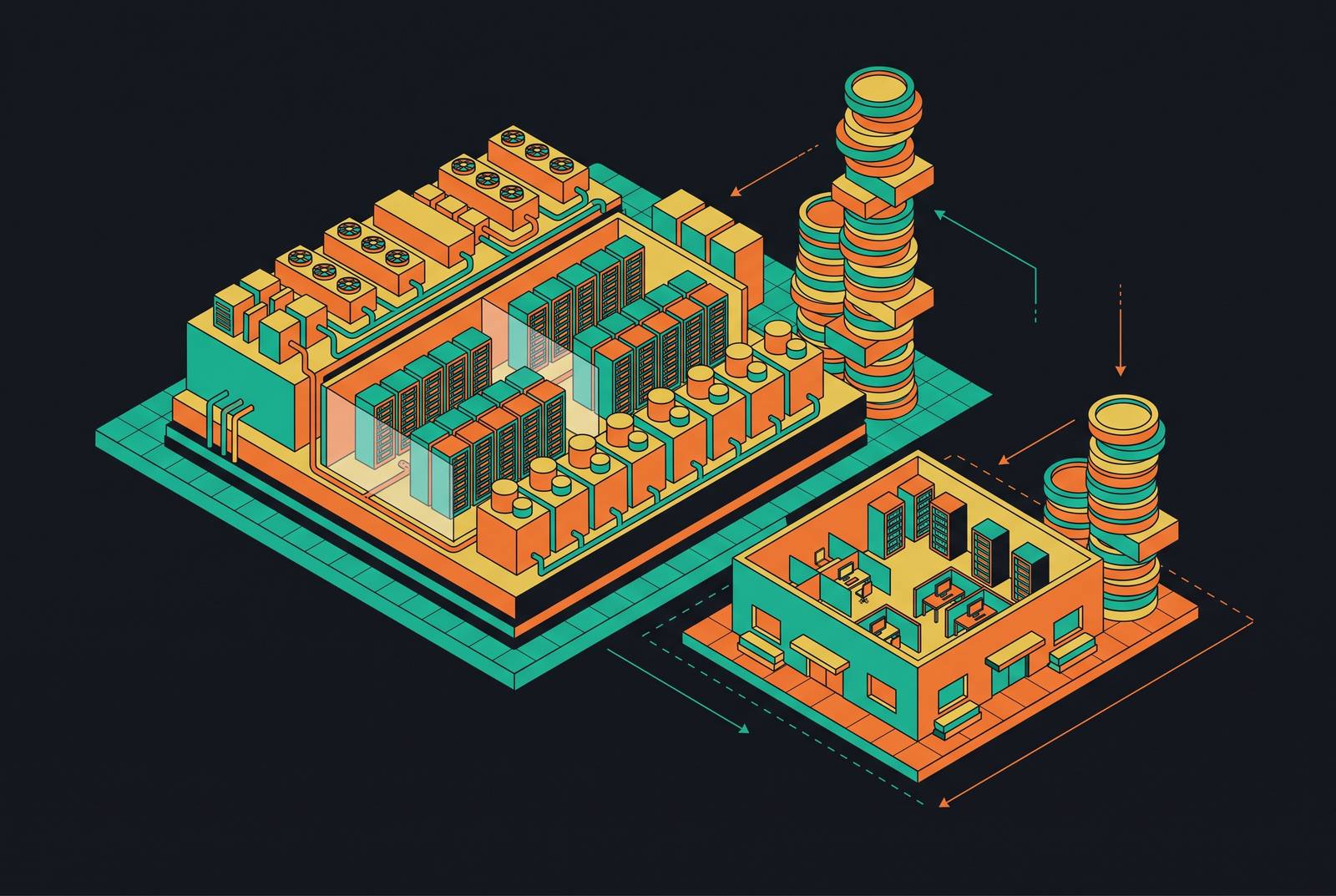
An AI-optimized data center costs roughly double a standard enterprise build for shell-and-core construction alone, and that gap widens further once full tenant fit-out and liquid cooling are priced in. Standard enterprise and colocation facilities run materially less per megawatt than AI-optimized facilities, and the extra cost comes almost entirely from AI-specific electrical distribution and liquid-cooling fit-out. The baseline itself is not standing still either: global average shell-and-core costs have risen substantially since 2020, compounding annually at a meaningful rate. For a large facility, the gap between a standard build and an AI-ready build is not something a contingency line can absorb. It functions as a separate project scope, built around a different physical premise, and the driver behind that premise is almost entirely mechanical and electrical: liquid cooling infrastructure and the higher-voltage power distribution that GPU racks require at multiples of what conventional server racks ever drew. Everything that follows in this piece traces that mechanism in detail, because the cost premium is the output of specific, identifiable engineering decisions, not an abstract market condition.
How GPU Rack Density Changes the Building's Engineering Premise
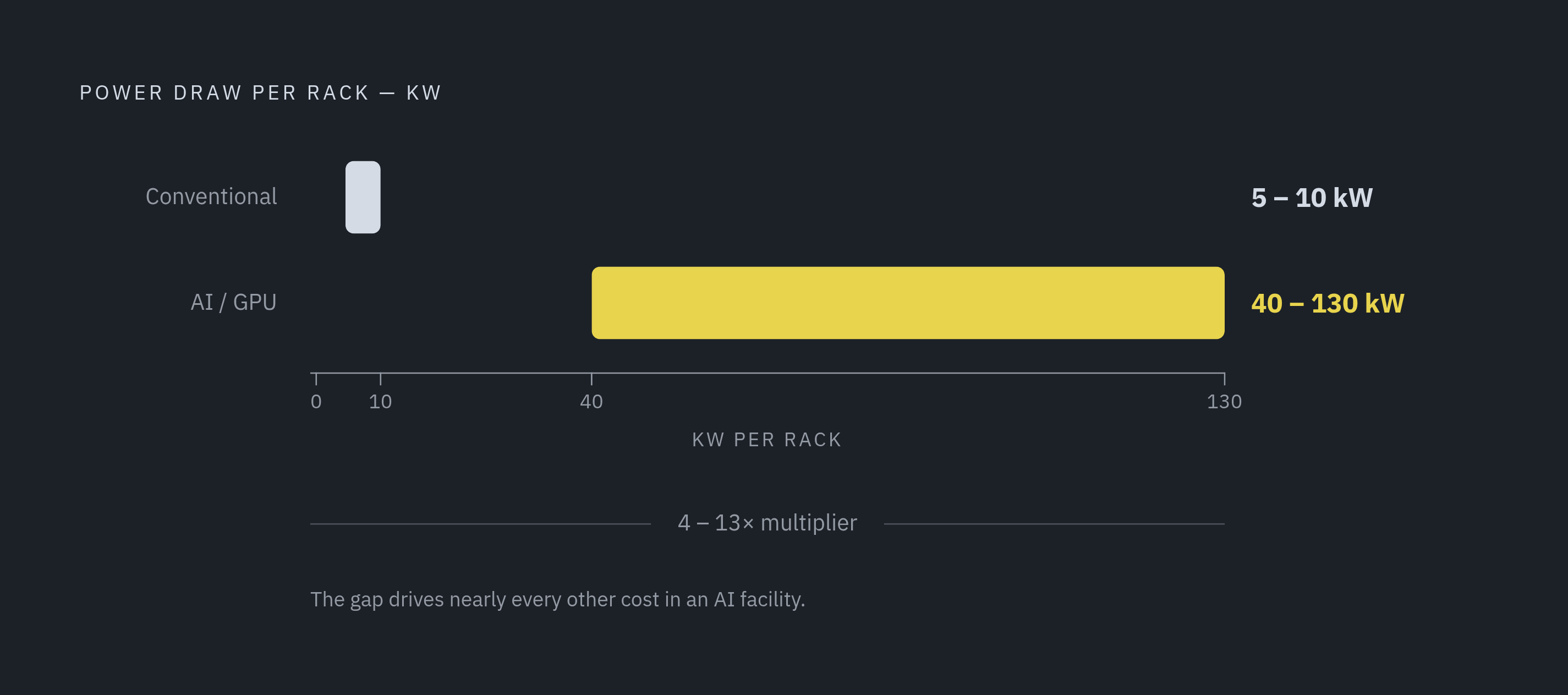
GPU clusters draw 40 to 130 kW per rack. Conventional server racks draw 5 to 10 kW. That single difference in density is the forcing function behind nearly every other cost driver in an AI facility, because it propagates through structural design, spatial planning, and every mechanical and electrical system in the building.
Air cooling cannot move heat fast enough at 40 to 130 kW per rack without fan power so large it becomes its own energy and infrastructure problem. At that density, liquid cooling is a baseline engineering requirement, not a performance upgrade. The building also has to carry the physical load of that shift: liquid manifolds, leak-detection systems, higher-amperage busbar and power distribution units, and denser cable management all compete for the same floor and ceiling space a standard enterprise build allocates far more loosely.
This is why AI facility design starts from a different set of rules of thumb than a standard enterprise build. The density shift demands that every system in the building, mechanical, electrical, plumbing, and cable routing, be re-engineered as an integrated whole. Design automation platforms like Archil Labs, which connect layout automation, critical-systems coordination, and routing within a single workflow, help teams make sure a change in GPU rack density or cooling strategy cascades correctly across power distribution, cable paths, and spatial planning before the design is locked. The re-engineering has to happen from the slab up, not after the shell is already drawn.
Liquid Cooling Infrastructure Costs
Liquid cooling is one of the largest cost differentiators between a standard build and an AI-optimized one, and its budget impact is large enough to shift the entire project's cost structure.
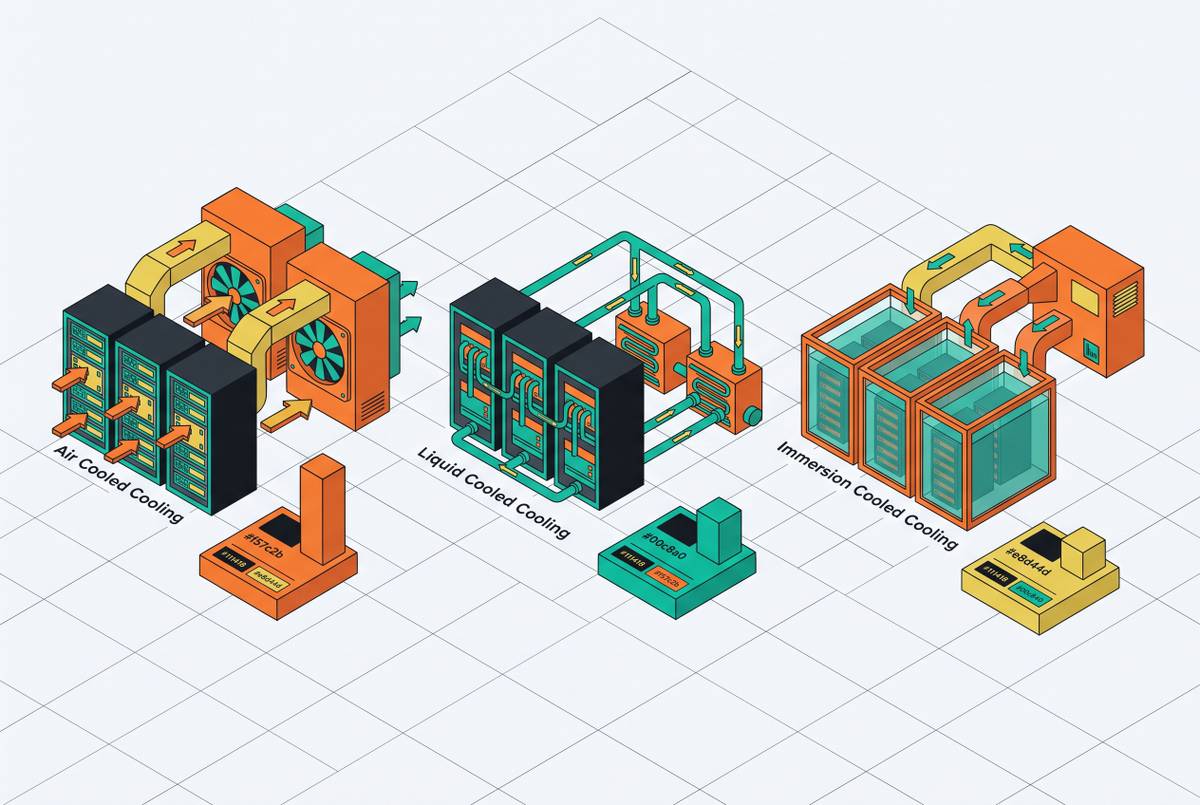
Three liquid cooling architectures dominate current builds: direct-to-chip, immersion, and rear-door heat exchangers. Each one has its own unit cost, its own installation complexity, and its own maintenance profile. None of the three is a drop-in substitute for another. The choice made early determines downstream budgeting for piping, leak detection, and secondary cooling loops for the life of the facility.
That is why the cooling decision has to be made before the building design is locked in. Retrofitting liquid cooling into a shell that was designed around air is one of the clearest, most documented ways an AI facility budget runs past its initial estimate. Because the cooling choice locks in downstream budgets for piping, leak detection, and secondary loops, it needs to be set early and held consistent across structural, mechanical, and electrical teams. Connected design automation can enforce that consistency, so a liquid cooling specification flows directly into cable routing, power load calculations, and site logistics, and no one has to re-enter the same data by hand in separate tools. Liquid cooling components also carry their own procurement risk: like transformers, they sit on constrained supply chains that have to be engaged early in the schedule, not after the design is finished.
Power distribution: why electrical systems absorb the largest single share of the AI build budget
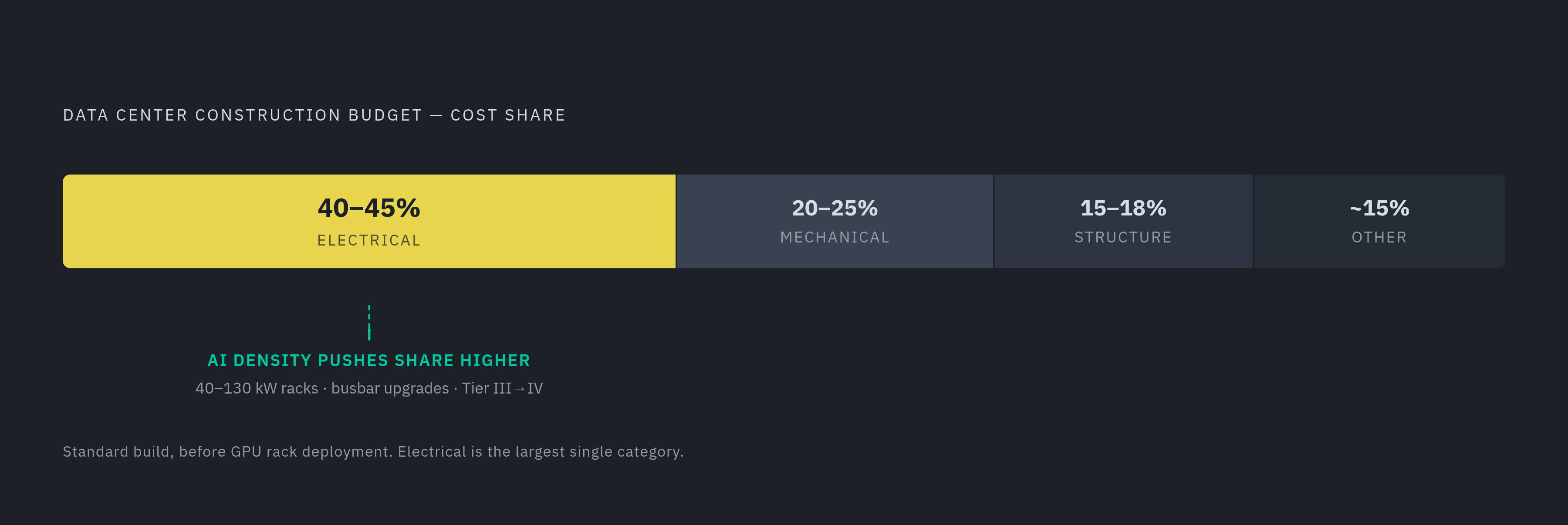
Electrical systems absorb 40 to 45% of the total data center construction budget, so power distribution is already the single largest cost category in any facility before AI density enters the picture. AI density pushes that share higher still, through voltage tier changes, busbar upgrades, and added redundancy requirements.
GPU racks drawing 40 to 130 kW need higher-amperage distribution paths running from the utility transformer through switchgear, UPS, and power distribution units all the way to the rack. Every link in that chain has to be sized for peak AI load, not the average load that governed standard enterprise design for the past two decades. Redundancy tiers add to that cost directly: Tier III architecture is becoming the standard for AI campuses, and Tier IV, reserved for select workloads where downtime cost is extreme, adds materially to the electrical budget on its own through duplicated power paths.
Transformer lead times stretching up to 60 months in 2026 mean electrical procurement can no longer wait for the later stages of a project. It has to be among the first decisions a project team makes, because a delay here cascades into every phase that follows. Utility interconnection queues in constrained markets now stretch past 2028 in some regions. Power availability, not concrete or steel, has become the primary constraint on how fast new AI capacity gets energized. AI-optimized electrical systems represent a complete re-specification of every component from the transformer through the final power distribution unit, not a modular upgrade bolted onto a standard enterprise design. When a power distribution change happens late in design without a connected workflow linking the disciplines, teams end up recalculating cable schedules, thermal models, and coordination drawings by hand, which compounds schedule risk and leaves each discipline uncertain which assumptions the others are working from.
Supply-chain and labor pressures that are accelerating costs beyond the engineering premium
AI facility construction costs are rising faster than general commercial construction inflation, because demand for specialized components and skilled trades is outrunning supply in every major market at once.
Material costs overall are climbing at a modest pace, but the bottlenecks that actually matter, transformers, switchgear, and liquid cooling components, carry delivery timelines measured in years rather than months, which delays procurement schedules across the whole project. That lag turns into carrying cost and delayed revenue for owners who assumed a conventional construction schedule. Skilled electrical and mechanical trades are stretched thin across major markets too: large campus builds require thousands of workers at peak, and data center projects now compete for that same labor pool against semiconductor fabs and EV manufacturing plants.
Regional cost variation compounds the pressure. Tokyo, Singapore, and Zurich run well above the global average for data center construction cost per watt, so site selection functions as a cost decision in its own right, not only a power or land decision. Power availability has overtaken fiber connectivity, tax incentives, and land cost as the primary site selection factor in 2026. The cheapest available land is rarely where power is easiest to get, and the reverse holds just as often.
The Amortization Mismatch and Envelope Decisions
A physical data center is amortized over 15 to 20 years. New generations of AI accelerators arrive roughly every 12 months. That mismatch means the building will outlast several hardware generations and has to be designed to accommodate successors that have not been announced yet, let alone specified.
This is the mismatch that forces project teams to engineer for a density envelope beyond what the current GPU cluster actually requires. Overbuilding cooling capacity, power distribution headroom, and structural loading is the economically correct response to a known hardware trajectory. Designing to the current GPU generation's spec produces a facility that is functionally obsolete before its construction debt is retired, forcing expensive retrofits or capping the operator's ability to run next-generation workloads. The envelope decision, in other words, gets made at the design stage, years before the hardware that will fully use that headroom exists.
Why critical-systems coordination is where AI build costs most often escape the budget
When power, cooling, and controls systems need to be coordinated, that is where AI facility budgets most often overrun. The density and interdependence of these systems mean a gap in any single one produces cascading rework across the others.
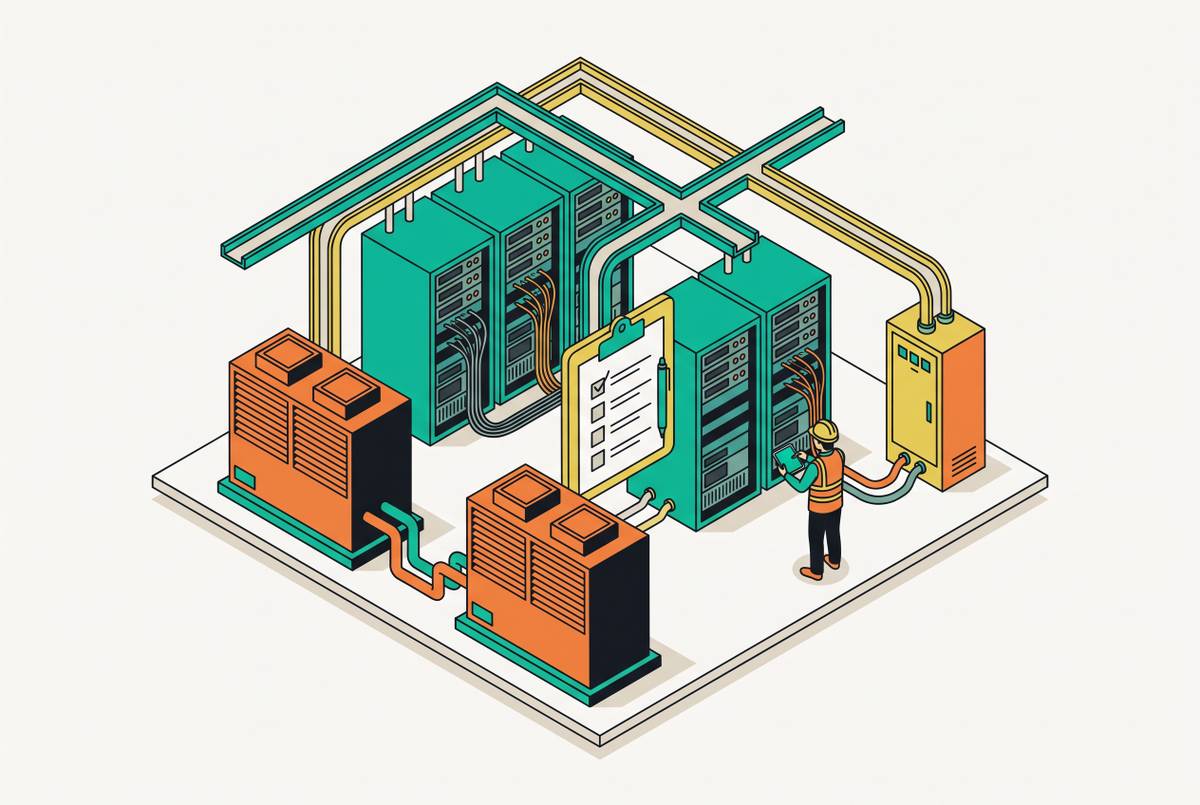
BIM serves as the coordination backbone for this work: it enables clash detection, MEP coordination, and prefabrication support on projects where system density makes field conflicts extremely expensive to fix after the fact. Standard BIM workflows, though, were not built for the degree of interdependency that AI-density facilities now demand. A rack move in an AI facility is never an isolated change. It cascades into power path recalculation, cooling loop rebalancing, cable schedule updates, and documentation revision, and if each of those updates happens manually across separate tools, every one of them is a fresh opportunity for error and rework.
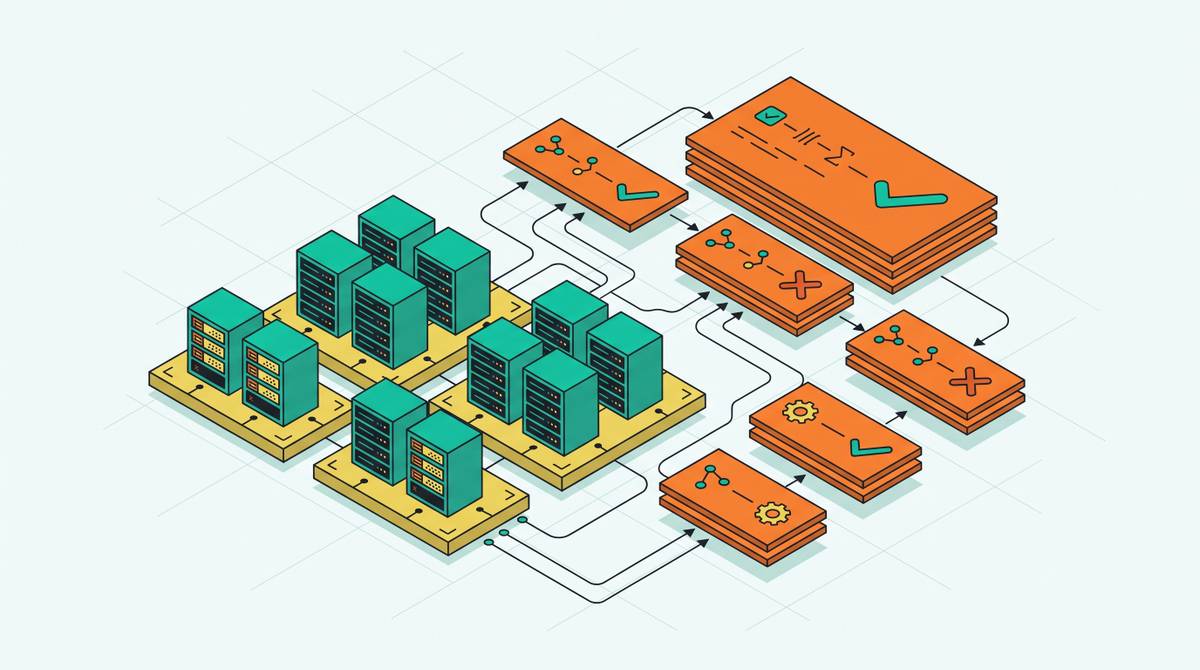
RFIs are a leading indicator of exactly this kind of coordination failure. If a small gap in drawing coordination triggers even a single RFI, it can block procurement, installation, and commissioning on a facility where every day of delay carries real cost. The fragmentation that produces AI facility cost overruns, information rebuilt by hand in every tool, changes that turn into hours of rework, handoff data that reaches operations incomplete, is a solvable engineering problem. It is not an inherent feature of complex construction, which is the premise the next section builds on.
The Economics of Connected Design Automation
ArchiLabs Studio Mode is a design automation platform built specifically for data center delivery. It connects layouts, power and cooling coordination, cable routing, documentation, RFIs, and operations-ready handoff inside a single workflow, so a rack move cascades changes automatically across power, cooling, cable, and sheets instead of triggering a round of manual updates in each tool separately.
The platform splits its work by task type. Deterministic rules govern precision-critical tasks such as power path validation, cooling load calculation, and code compliance, where a wrong answer can cost you safety or reliability. AI handles the responsive and creative side of the work instead, layout generation, design variation exploration, RFI drafting, where speed and flexibility are more valuable than a single fixed rule. Structured data flows through the entire project under this model, from early planning through construction handoff into DCIM, EPMS, and BMS integration, so nothing gets lost at turnover. Operations-ready handoff is not a task that happens after construction wraps. Structured asset data populates operational systems starting at the design stage, so DCIM, EPMS, and BMS integration becomes the finish line of the design workflow rather than a reconciliation project that starts after energization.
Other approaches to this problem exist and serve real purposes. Design coordination tools, BIM authoring environments, and DCIM platforms each address a segment of the same workflow, clash detection here, asset tracking there, controls integration somewhere else. Each one does its segment well, but each needs manual integration at the seams between segments, and that is precisely where ArchiLabs connects natively instead of handing data off between separate systems.
Lessons for Project Teams, Owners, and Design Engineers
Understanding the line-item drivers behind the AI build cost premium lets you budget accurately, sequence procurement in the right order, and avoid the coordination failures that make actual costs diverge from planned costs. The sequencing implications follow directly from everything laid out above. Power has to be secured before architectural design even starts, because utility interconnection timelines now govern project schedules more tightly than construction timelines do. Cooling architecture needs a decision before the building design is locked, because the mechanical-to-electrical cost ratio shift is a design decision in its own right, not a specification detail to settle later, and retrofitting the wrong choice is one of the clearest documented paths to a blown budget. You should start transformer and switchgear procurement at or before schematic design, because lead times measured in years make waiting until construction documents are finished to place electrical orders unworkable.
Design should target the density envelope of the GPU generations that come after the current one, since the amortization mismatch between a 15-to-20-year building and a 12-month accelerator cycle makes overbuilding headroom the economically sound choice. Critical-systems documentation deserves connection from day one of the project, so that every RFI, every equipment parameter, and every design decision can be traced back to the information that supports it, and so that traceability survives the handoff into operations.
Teams that treat the AI build cost premium as a fixed condition of the market will keep encountering it as a surprise. The premium is made up of specific, identifiable physical and coordination requirements: power density, cooling architecture, redundancy tier, procurement lead time, and the degree to which systems are coordinated upfront. Scoped and sequenced correctly from the start, that premium becomes a plan.