Commissioning Engineer Responsibilities in Data Center Project Turnover
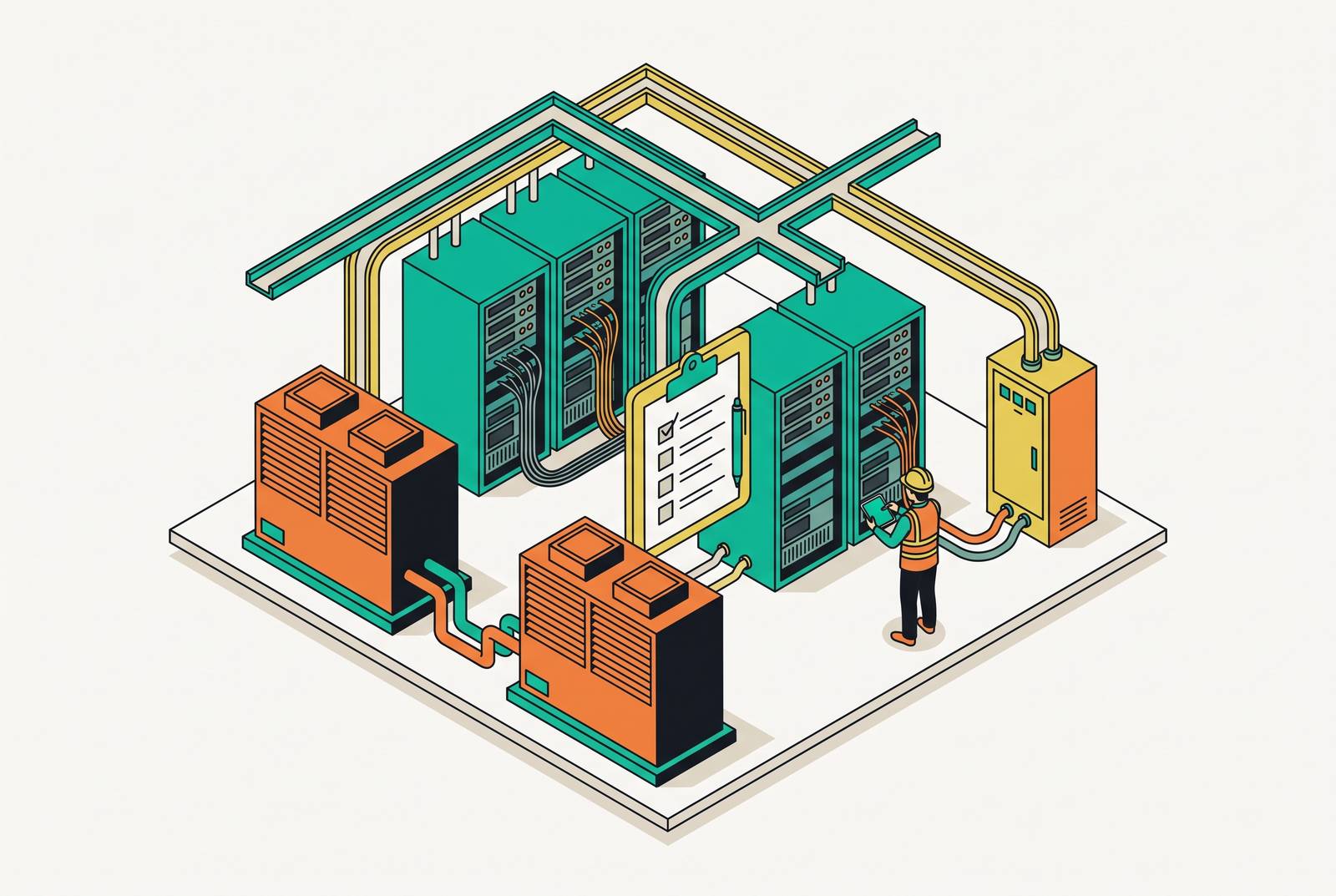
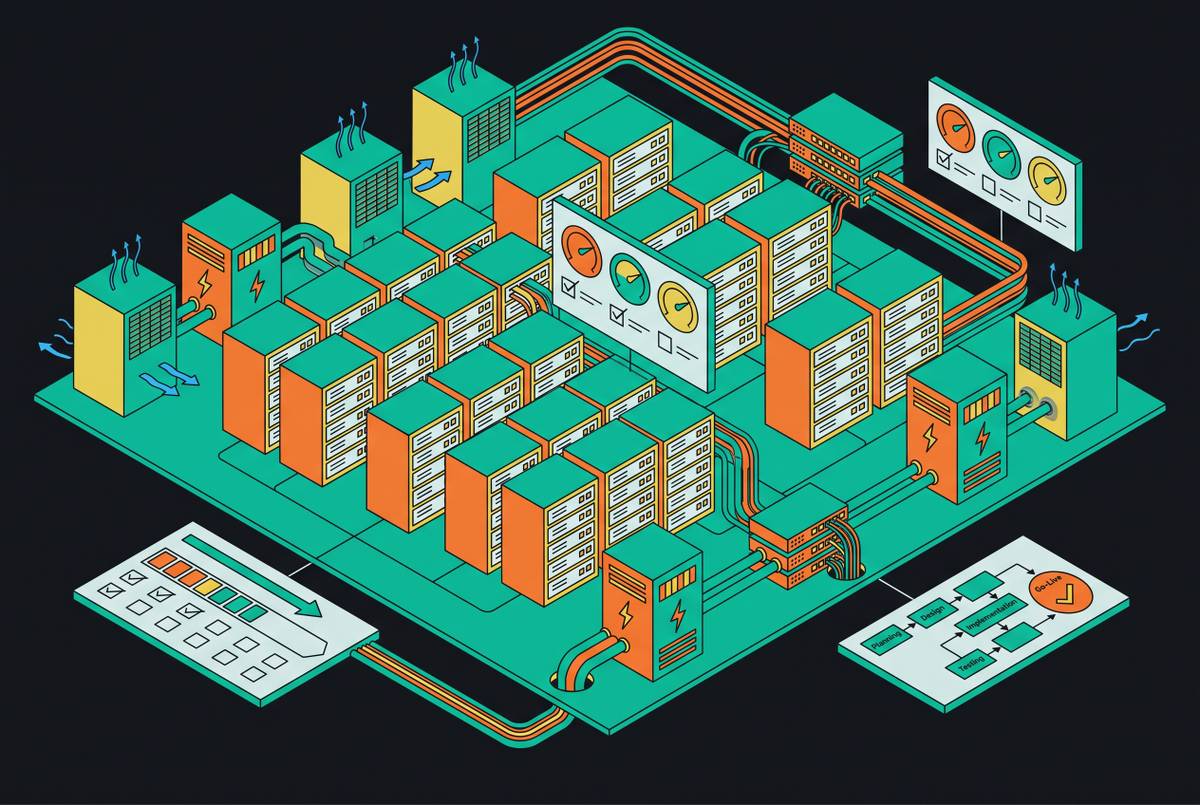
A commissioning engineer carries one job that never lets up: proving that a data center's systems will actually work the way they were designed to, under the pressure of construction, which wants completion, and operations, which wants reliability, pulling in opposite directions. Construction wants the project finished and handed off. That span is the whole point of the role. A CxE reviews design documents, leads Factory Witness Testing, manages third-party commissioning vendors through pre-functional, functional, and integrated systems testing, helps build test scripts and schedules, and raises a flag the moment turnover looks at risk. Day to day, that means walking drawings against installed equipment, validating installation quality, supporting energization, running electrical and mechanical tests, checking startup and shutdown sequences, chasing down deficiencies, and keeping contractors, vendors, and operations staff talking to each other through the handoff to live production. No one else on a data center project holds that full arc of information, from the first spec sheet to the final sign-off, in one head. That's what makes the CxE's record the one the rest of the project ends up depending on.
Why commissioning begins long before any equipment is tested on site
The instinct to treat commissioning as a late-stage checklist, something that starts once equipment shows up on site, misses where most turnover problems actually originate. Most commissioning failures trace back to a gap that existed from the start, sitting unreconciled in the Owner's Project Requirements, the Basis of Design, or an early factory test. The OPR is the document that sets the terms for everything that follows: target load, redundancy, rack density, cooling strategy, generator runtime, acceptance criteria. When that document is vague, commissioning turns into guesswork, and a generator can pass its electrical test while still falling short of what the business actually needed. Construct & Commission's 2026 checklist lays out how this plays out: a tenant's density assumption changes after equipment has already been procured, so the cooling design stays compliant with a program that no longer matches the live requirement. That mismatch sits visible in the paperwork from day one. Nobody catches it until integrated testing, months later, when it's far more expensive to fix.
Reconciling the Basis of Design against the OPR isn't a paperwork exercise, it's where redundancy assumptions get checked across electrical and mechanical systems together, and where commissioning responsibilities get assigned to named people before anyone breaks ground on fieldwork. OPAL-RT's 2025 guide treats planning and scope definition as the first real job on a commissioning timeline: writing down which systems are in scope, what the pass/fail thresholds are, who needs to witness what, when outages are planned, and what evidence will count as proof. That early clarity is what lets an owner actually measure "ready" instead of arguing about it later. Factory Witness Testing fits into this same early window. It isn't a box to check off, it's the start of an evidence chain, where every asset needs its own test record, its own open-item log, and a closeout trail that shows not just that a test ran, but what changed because of it.
How the CxE coordinates across design, construction, and operations before a single integrated test runs
Once the early documents are reconciled, the CxE's job shifts into active coordination, and that coordination is structured work, not soft diplomacy. It's a defined set of workflows built to catch mismatches between drawings, installed equipment, and operating procedures before those mismatches turn into failures during integrated testing. OPAL-RT's 2025 guide spells out what that coordination looks like in practice: early workshops to lock down sequences, interlocks, and naming conventions; making sure controls points are exposed and trend lists get built; confirming setpoints are version-controlled; and clearing field constraints like lifts, access paths, and permits well before test week arrives.
Part of what makes this work is that the CxE isn't on anyone's side. Not the contractor's advocate, not the operator's advocate, the CxE acts as a neutral party whose job is turning technical detail into acceptance criteria that every party can measure against. Submittal review is one of the clearest examples of this coordination at work. CAI's 2026 description of the mechanical CxE role lists reviewing project submittals against design intent, the Basis of Design, and the OPR as a core responsibility, right alongside QA/QC on every mechanical test procedure. The AWS CxE role description goes further, building in multi-discipline input on scheduling and test script development, so the CxE isn't just running a plan someone else wrote. The CxE is shaping how electrical, mechanical, and controls disciplines sequence their work together.
The reason this coordination matters so much comes down to where facilities actually break. One system runs the environmental plant, another watches the electrical path, a third tracks IT assets, and the gaps between those systems are where outages start. A CxE's coordination work exists to find those gaps and close them before the facility ever carries live load.
Why Integrated Systems Testing Is the Real Gate
Pre-functional checks confirm that equipment is installed correctly and settings are right. Functional tests confirm that individual systems perform on their own. Integrated systems testing puts the whole facility through realistic conditions, together, as one system. That third level is where the real proof lives, because a facility built from parts that each pass their own test can still fail the moment those parts have to work together under stress.
Build's 2026 checklist lists the integrated systems test scenarios that matter most at this stage. None of these are theoretical stress tests invented for the sake of testing. They're the conditions operations will eventually face in the field, run now, on purpose, while a CxE is watching closely enough to catch what goes wrong.
What the CxE is actually watching for during these tests is behavior during the transition, beyond how a system looks once it settles back into steady state. That means confirming permissives, interlocks, timers, alarm routing, and failover sequences across power, cooling, and life safety systems all behave correctly in the moment things change. Redundancy only counts if it works under these live conditions, not just on a drawing, so sequences, failover behavior, controls logic, and power transitions all need to be validated while running, not just reviewed on paper. High-density deployments need particular scrutiny here too: a room can meet its nameplate cooling capacity on paper and still fail to pull heat away from individual racks, so the test has to prove actual airflow, liquid cooling loop performance, or hybrid cooling behavior at the density the facility will really carry.
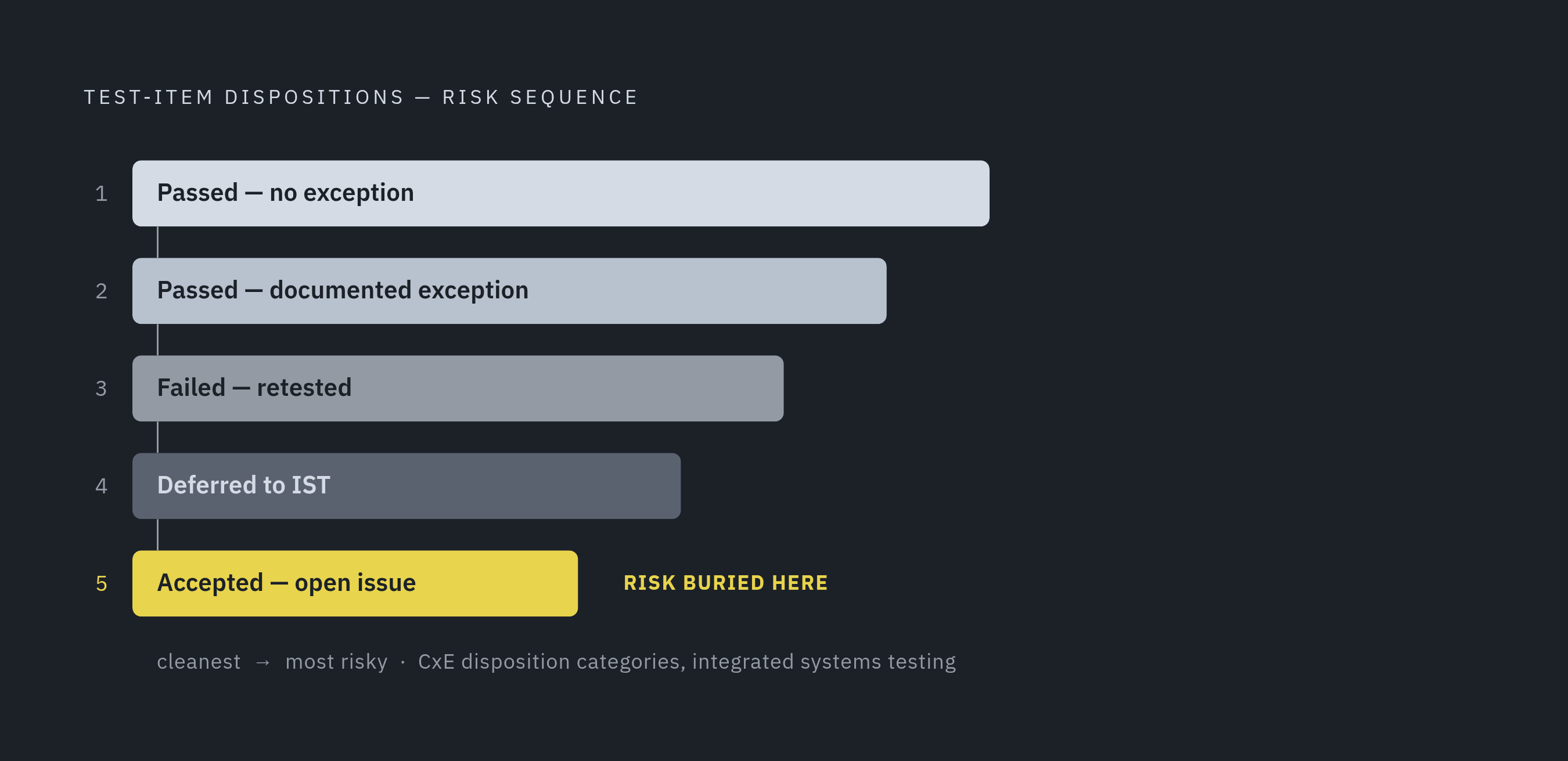
Every test item that comes out of this process gets a disposition, and the categories matter: passed with no exception, passed with a documented exception, failed and retested, deferred to integrated systems testing, or accepted by the owner despite an open issue. That last category is the one to watch closely. It's where operational risk quietly gets buried under a signature, and keeping it visible rather than letting it disappear into a closeout binder is one of the CxE's most important jobs.
What "Documentation" Means in Practice
Every test, every reconciled requirement, every coordination workshop produces a record, and that record is the actual product commissioning hands to operations. CAI's 2026 description of the mechanical CxE role is specific about what this documentation has to confirm: not just that equipment was tested, but that it was delivered, installed, tested, and set to function properly for the customer. The AWS CxE role treats this the same way, requiring comprehensive weekly status reporting across every ongoing project along with lessons learned, which turns documentation into something closer to a running instrument than a file cabinet of old test results.
Change management lives inside this same documentation discipline. Design changes, setpoint revisions, and as-built deviations have to get captured the moment they happen, because a change that goes unrecorded during construction is simply invisible to the operations team later, and that gap between the design-of-record and what actually got installed is exactly where handoff problems start. Traceability is the standard that holds all of this together: every RFI answer, every design decision, every equipment parameter needs a clear line back to the information that supports it. A commissioning record that can't be audited doesn't function as a commissioning record at all.
The handoff between BIM and DCIM is where this digital trail most often snaps. Getting that handoff right takes explicit schema alignment and a shared asset identifier strategy decided before construction even starts. Wait until occupancy to provision the DCIM platform, and the integration team never gets a way to capture as-built conditions as they happen. This is the real argument for treating commissioning data as something built to connect, not something assembled after the fact. A structured, connected documentation workflow, one that keeps design intent, test results, and as-built conditions traceable in the same place as they're produced, is what lets tested performance actually become usable knowledge for the people running the building. That continuity, maintained from design through commissioning into operational handoff, is what lets operations trust a documentation package instead of having to double-check it from scratch.
How Fragmented Tools and Manual Handoffs Create Compounding Risk as Turnover Approaches
Even a well-run commissioning process operates inside an environment that works against it: a commissioning record only helps as much as the systems behind it are actually connected. When test data, equipment parameters, RFI responses, and as-built conditions each live in a separate tool with no structured link between them, the operations team at turnover is left reassembling a finished record from scratch rather than inheriting one.
That fragmentation follows a predictable pattern. Test results sit in PDF reports. Equipment data sits in manufacturer submittals. RFI responses sit inside a project management platform. BIM lives in its own tool. DCIM configuration starts over from zero, rebuilt by hand from everything that came before it. Provisioning DCIM late makes this worse, not better: by the time the platform finally gets stood up, the construction team has already demobilized, the submittals needed to populate it are scattered, and the window for capturing accurate as-built data has closed. Operations doesn't inherit a handoff at that point. It inherits a gap.
RFIs show how fast this kind of fragmentation adds up in dollars and time. Contractors report that individual RFI delays cost real daily productivity, and across the life of a project, poorly managed RFIs can eat up a meaningful share of total project cost. A widely cited Navigant Construction Forum analysis found that roughly one in five RFIs never gets a formal answer at all. Schedule pressure makes all of this more dangerous, not less: a commissioning delay on a large data center project carries real monthly revenue exposure, and that's exactly the moment when manual, disconnected workflows tend to break down in ways everyone can see. The CxE's responsibility to escalate when turnover is at risk is itself a symptom of this condition. Escalation only happens after something has already broken, and a structured, connected workflow is what should have caught the problem before it ever reached that point.
What operations-ready handoff actually requires the CxE to deliver
Operations-ready handoff means the operations team can pick up every system in the facility and run it without having to reconstruct work that commissioning already did. That requires a specific set of deliverables beyond a signature on a punch list. It means closed test scripts that carry actual results, not just pass or fail marks. It means a deficiency log where every corrective action is confirmed and closed, or where any open item left on purpose carries the owner's sign-off in writing. It means as-built equipment records that reflect what was actually installed rather than what was originally specified, down to setpoints, firmware versions, and current configuration states. It means alarm and controls documentation that spells out what each alarm means and what the response procedure actually is. It means operational procedures, covering startup, shutdown, maintenance bypass, and emergency sequences, that were built and tested during commissioning rather than written after the fact.
One more requirement follows directly from all of that: structured asset data that DCIM, EPMS, and BMS can consume directly, without someone re-entering it by hand. That only works if DCIM gets provisioned and partially configured before construction wraps up, not after occupancy begins, with the CxE's documentation workflow feeding it incrementally as the project moves rather than dumping it all in at the end. Every section of this process, the early reconciliation of the OPR, the coordination across disciplines, the integrated systems tests, the documentation built in real time, points toward this single outcome. A data center is only as ready as the record the CxE hands off, and that record is either built to connect from the start or rebuilt by someone else under pressure, after the people who knew the answers have already left the site.
Sources
- Commissioning Engineer, AWS Data Center Commissioning - Job ID: 3145839
- 9 Roles and Responsibilities of a Data Center Commissioning Engineer
- What Does a Data Center Commissioning Engineer Do?
- Mechanical Commissioning Engineer (Data Centers)
- Data Center Commissioning Checklist: What Developers Need to Verify Before Turnover
- 1 Data Center Commissioning Guideline [Project] Document Number: xxx-xxx-xxx