Data Center CapEx Breakdown by System Category
Electrical systems, not servers, hold up data center construction.
Data center capital does not buy one thing. It buys two fundamentally different things, and the line between them determines where your delivery risk actually sits. Most attention goes to the servers. Most delivery risk sits in the concrete, copper, and pipework that energizes and cools them.
How CapEx is divided across IT, electrical, mechanical, and facility systems
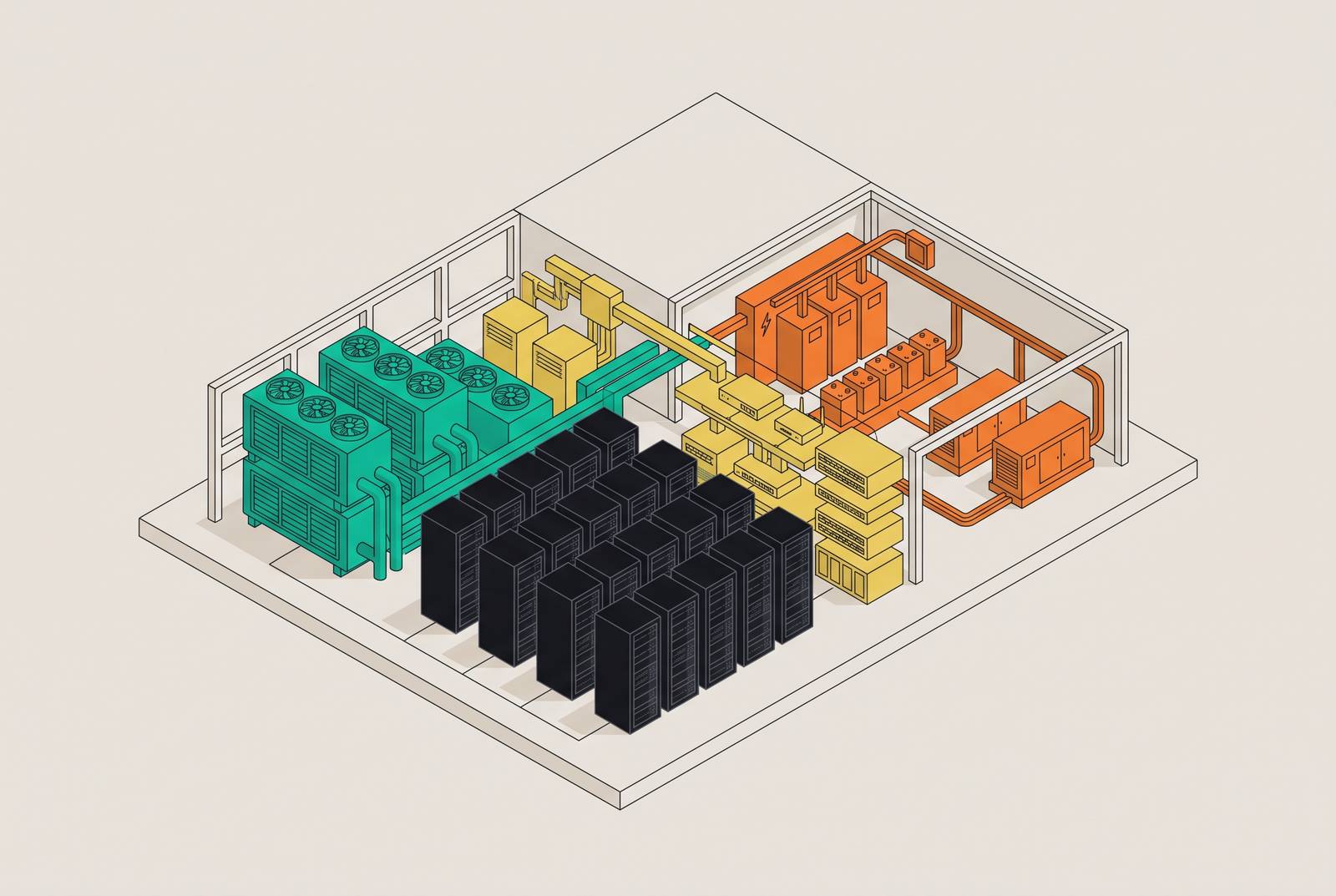
Data center CapEx divides into two structurally distinct halves. The first is IT infrastructure, dominated by servers. The second is physical infrastructure: electrical, mechanical, and facility systems. Understanding which half you are financing determines how you think about delivery risk, because the two halves move at different speeds and fail in different ways.
The 2025 IoT Analytics report breaks total data center equipment spending into IT infrastructure at roughly 78% of the total, with facility infrastructure making up a smaller share and other services making up the remainder. That headline number is not the whole picture. The Global Data Center Hub 2026 breakdown draws the developer's line clearly: servers sit on the tenant's balance sheet. What gets financed and amortized is power, cooling, and the shell.
The physical half splits further into recognizable cost lines. Power infrastructure covers the substation, switchgear, generators, UPS, distribution, and busway, and accounts for a large share of hard construction costs. Cooling covers chillers, cooling towers, pumping skids, air handlers, and coolant distribution units, and carries a substantial share that rises with liquid cooling adoption. Shell and site account for another share, plus site preparation.
The remainder of the physical budget is absorbed by fit-out, soft costs, and commissioning. Design and permitting, white space containment, fire suppression and security, and commissioning each claim their own slice. None is discretionary in practice. Each is a line item that a schedule will halt without.
Why electrical systems carry disproportionate delivery weight relative to their cost share
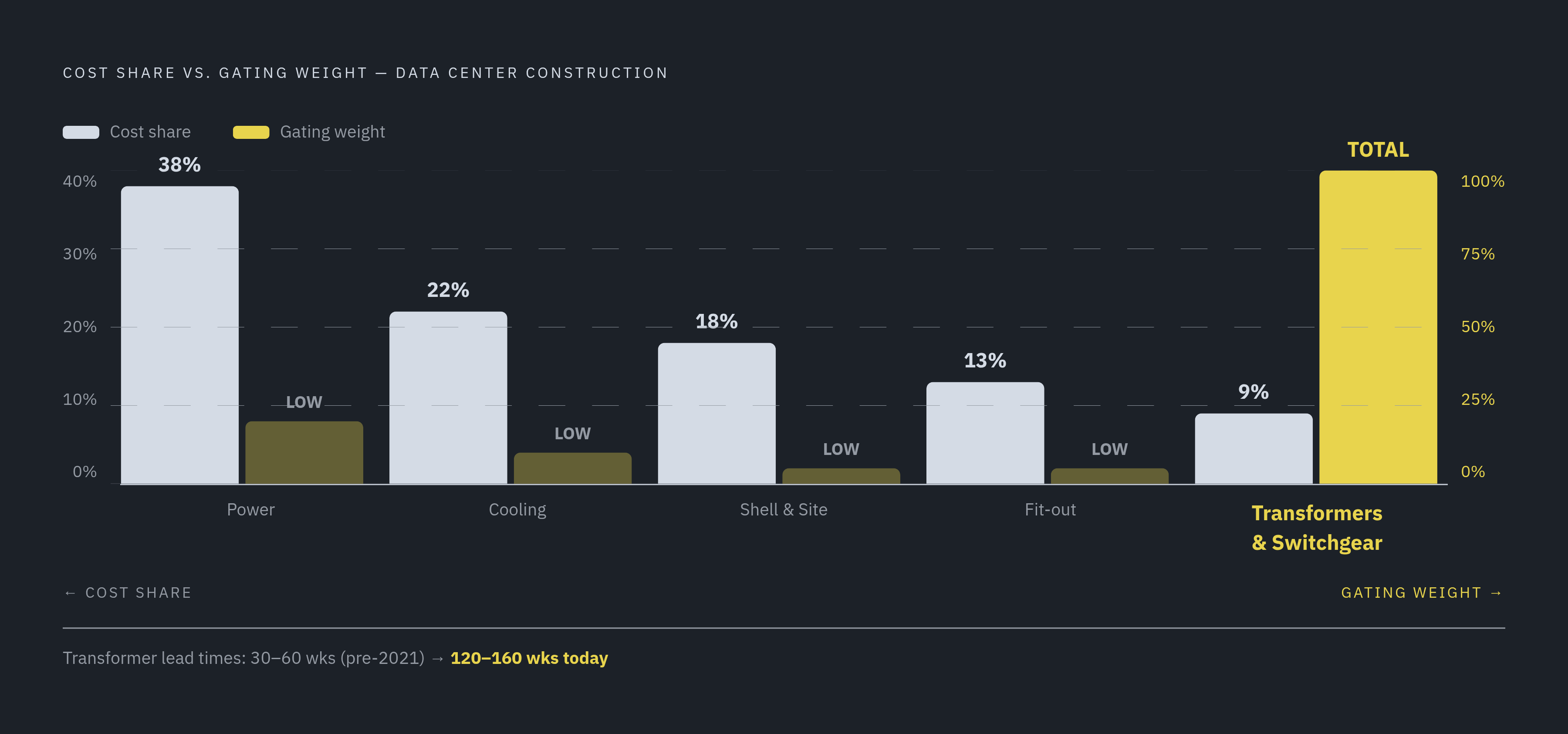
Electrical systems are the gating dependency for every other construction category. A facility where power infrastructure is incomplete cannot be commissioned, no matter how much has been spent on cooling, shell, or IT equipment. That single fact reorganizes how a developer should read the entire CapEx stack.
The Global Data Center Hub 2026 analysis states the point directly: power infrastructure scales directly with capacity. It is the category that sets the electrical scale behind every cooling and density decision. You cannot select chillers without knowing the electrical service that will feed them. You can't finalize rack layouts without first confirming the distribution that will reach each row.
Supply chains have turned that structural dependency into a hard constraint. Large power transformer lead times have grown from 30 to 60 weeks before 2021 to 120 to 160 weeks today, and that's against a structural supply deficit and substantially higher costs. Interconnection work, meaning the substation, switchyard, transmission extensions, and protection relays, often sits outside headline benchmarks and can reach tens of millions of dollars per campus.
The research brief puts the scale of the problem in stark terms. Batteries, transformers, switchgear, and circuit breakers represent less than 10% of total construction cost. Today they are the components holding up the entire pipeline. Without them, the remaining majority of capital spent on shells, cooling, racks, and compute cannot be energized.
Meanwhile, Alphabet, Amazon, Meta, and Microsoft are expected to spend well over half a trillion dollars on AI infrastructure in 2026. The binding constraint is not capital. It is physical supply chain in the electrical category. OpenAI's Stargate Project, announced with a multi-hundred-billion-dollar price tag and planned for Texas, is the most visible example. As of April 2026, industry observers report active physical construction progress across US data center buildout sites, with 0.3 GW already operational in Abilene.
The cost of electrical delay compounds in ways that standard budgets do not anticipate. A lengthy delay on a large campus adds substantial capitalized interest. Contingencies push well above standard levels, and every month of undrawn capital costs more than the last.
How power density and cooling choice reshape the cost relationships between categories
The relationships between cost categories are not fixed. As rack power density rises with AI workloads, the cost share of mechanical systems grows relative to electrical and shell. Cooling architecture and electrical scale have become one decision, not two, and the coupling is structural.
The Global Data Center Hub 2026 analysis gives the shift concrete form. A GB200 NVL72 rack draws very high power per rack. Next-generation silicon is projected to reach several times that figure per rack. Global shell-and-core costs per megawatt rose substantially between 2020 and 2026. The days of treating density as an IT decision and shell as a construction decision are over.
Liquid cooling changes the arithmetic in both directions. It cuts white space footprint substantially per megawatt. But busway, stainless piping, leak detection, and slab reinforcement consume much of that saving. Turner & Townsend puts the construction premium for liquid-cooled capacity at 7% to 10%. Rack-level hardware, including coolant distribution units, manifolds, and cold plates, adds tens of thousands of dollars per rack on top of that.
The 2025 TrendForce analysis adds a useful clarifying detail. Computer Room Air Handlers are better suited for large-scale data centers because of lower energy consumption and better PUE. UPS takes the largest share of facility capital after building structure. Those figures matter because AI workloads sustain peak load far longer than enterprise applications. They introduce resource coupling across compute, power, cooling, and physical space that traditional capacity planning models were not designed for. The probabilistic averaging that once justified sparing assumptions no longer holds.
Why fragmented workflows make coupled systems expensive to coordinate
The cost categories in a data center budget are coupled at the physics level. The teams, tools, and workflows responsible for them are organized by discipline. That mismatch is where real delivery risk accumulates.
MEP coordination is heavier on data center projects than on most other project types. Cooling, power distribution, and cable management all carry significant spatial demands, and no discipline can be sequenced in isolation from the others. A routing decision for chilled water is also a clearance decision for busway. A cable tray move is a fire suppression question.
Version control is the persistent failure mode beneath all of it. When teams rely on different drawing revisions or unstructured communication threads to manage RFIs, errors compound across trades. The problem is most expensive during commissioning, when time pressure is highest and fixing a mistake requires reopening resolved sequences.
A clash in a data center is not an inconvenience. It is a threat to the commissioning timeline. The research brief is explicit: mature clash detection and resolution is core risk management, not a quality-control step. It exists to prevent RFIs before they are written.
Modular prefabrication is one structural response to coordination risk. Highly modularized projects achieve meaningful schedule reductions compared to conventional builds. They come at a cost. Modular delivery requires design lock-in far earlier in the project lifecycle, which means coordination failures discovered late are more expensive to resolve, not less. The earlier you freeze the design, the more each unfrozen decision costs.
What coordination across the CapEx stack requires at the information layer
Coordinating coupled systems across electrical, mechanical, and IT categories is not primarily a process problem. It is an information problem. The same equipment parameter, spatial constraint, and load assumption needs to be authoritative in every model, schedule, and sheet that depends on it. Today it is manually rebuilt in each one.
Modeling power distribution as a one-line diagram is insufficient for data center delivery. The model must be detailed enough to support installation sequencing and to verify that redundant A/B power paths are physically separate. That information must be consistent across electrical, mechanical, and cable routing disciplines simultaneously. Three teams, three tools, one truth that must not drift.
BIM is the coordination backbone for data center construction. It enables clash detection and MEP coordination. But model-to-reality divergence is a structural problem on fast-track schedules. Late design changes, product substitutions, and site discoveries drift from model assumptions, and each lag compounds. A model is only as good as its last synchronization with the field.
Equipment data trapped in manufacturer PDFs is wasted intelligence. Spec parameters that should flow directly into models, schedules, and validation rules instead require manual re-entry at every handoff point. Each handoff introduces the possibility of inconsistency, and each inconsistency is a future RFI.
The rack move is the clearest example of cascading manual rework. A single location change touches power path assignments, cooling load distribution, cable routing, schedules, and sheets. Each lives in a different tool owned by a different discipline. Each requires a manual update that introduces its own error surface. One rack, five systems, five chances to get it wrong.
The stronger objection to BIM as the coordination answer is organizational. BIM objects are organized around construction disciplines and drawing sets. Operational management domains organize assets differently. A mechanical unit can have detailed duct routing in the model but no structured data fields for rated capacity, maintenance intervals, firmware version, or monitoring point identifiers. What serves the builder does not automatically serve the operator.
Where the CapEx stack's information gaps become operations problems at handoff
The information gaps that accumulate during delivery do not close at handover. They arrive at the operations team as missing, inconsistent, or operationally unusable data. The cost of reconstructing that data is borne by the people running the facility, not the people who built it.
The 2025 IoT Analytics report identifies facility infrastructure segments including cooling systems as among the categories where spending is growing fastest. Electrical systems are highlighted for innovation, not fastest growth. Those are precisely the categories where operational data quality at handoff matters most for DCIM, EPMS, and BMS integration. The fastest-growing systems are the ones most likely to arrive with incomplete records.
The timing problem is concrete. Waiting until occupancy to begin DCIM configuration means the integration team has no mechanism to capture as-built conditions incrementally. By the time the system is stood up, the construction team has demobilized, submittals are scattered across project management platforms, and the window for accurate data capture has closed. The people who knew what was built are gone.
The challenge is not technical. Most DCIM platforms can ingest the data that construction and commissioning teams produce. The challenge is governance: defining what data must be captured, in what format, at what milestone, by whom, and to what standard of completeness before turnover is accepted. None of that is a software limitation. All of it is a decision that someone has to make early and hold everyone to.
If operational BIM is a project objective, the model format, asset tagging structure, and data requirements for the operator's CMMS and DCIM systems need to be defined at project kickoff, not at handover. A discipline-organized construction model cannot be retroactively mapped to operations-domain asset structures without significant rework. Schneider Electric and Caterpillar both illustrate the point. Each offers electrical solutions that span from infrastructure to operations management. The electrical category, the largest cost line in the construction budget, is also the category with the most complex data requirements at the operations interface.
Where in the delivery workflow fragmentation actually has to be addressed
Fixing the coordination and handoff failures that the CapEx breakdown makes visible requires addressing fragmentation at the delivery workflow level. The answer is not replacing the tools that disciplines already rely on. It is connecting them through shared structured data so that a change in one system propagates correctly to every system that depends on it.
The research brief identifies a governance parallel on the operations side. At the scale of gigawatt-class AI campuses, probabilistic operational assumptions collide with hard physical constraints, so you need a deterministic control layer. It must be pre-authorized, enforced, and audited. AI systems behave nothing like enterprise applications, and traditional planning models cannot account for the resource coupling they introduce.
The same logic applies to design. AI and automation belong where flexibility and language accelerate work. Deterministic rules belong where precision, compliance, and safety are non-negotiable. Electrical and power path coordination are the clearest examples of where rules-based validation must be the mechanism, not probabilistic estimation.
Traceability is the thread that holds it together. Every RFI answer, design decision, and equipment parameter should be traceable back to the information that supports it. That is not a documentation preference. It is a risk management requirement when a single coordination mistake can cascade across trades on a commissioning timeline.
ArchiLabs Studio is built for exactly this problem. It connects layouts, critical-system coordination, cable routing, documentation, RFI management, and operations-ready handoff inside a single workflow. A rack move cascades automatically across power, cooling, cable, schedules, and sheets rather than requiring manual rework in each discipline's tool. The change happens once, in one structured place, and every dependent system updates from the same source.
The structured handoff to DCIM, EPMS, and BMS is the finish line for delivery. Not the model. Not the commissioning certificate. The finish line is the point at which the information that was built during design and construction is usable by the people running the facility, in the format those systems require. Everything before that point is preparation.