Design Automation API Integration with Existing Engineering Tools
Connecting design tools automatically cuts data reentry errors on costly projects.
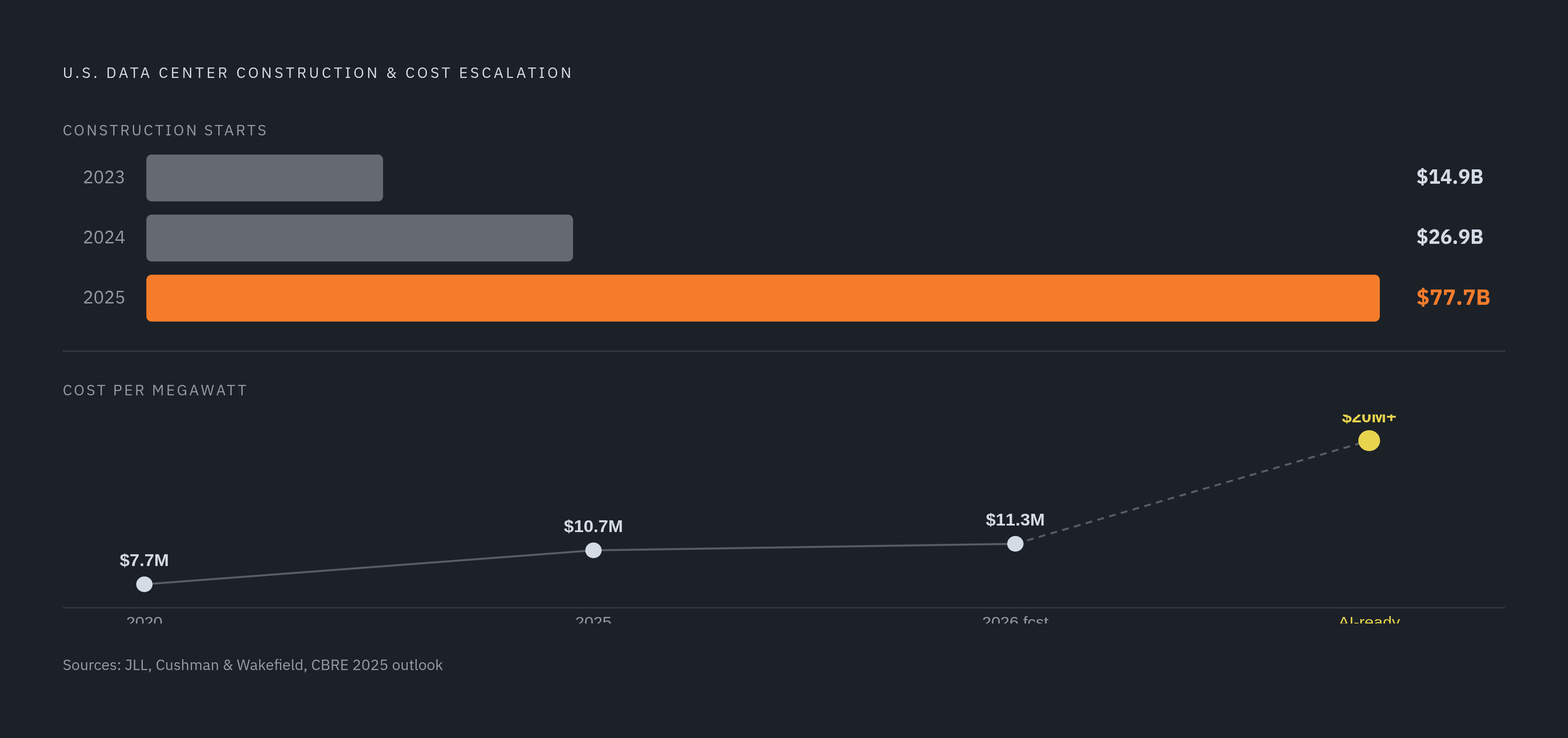
U.S. data center construction starts jumped from $14.9 billion in 2023 to $26.9 billion in 2024, then to $77.7 billion in 2025. Cost per megawatt climbed alongside it, from $7.7 million in 2020 to $10.7 million in 2025, with $11.3 million forecast for 2026, and AI-ready facilities already running $20 million or more per megawatt. At that price, a data reentry error between design tools is a line item that doesn't get patched on a Friday afternoon.
Eliminating data reentry errors between electrical and documentation systems on large data center projects requires three layers working in sequence. First, every tool's objects, racks, circuits, cables, zones, must be mapped to a shared schema with consistent identifiers before any API connection is built; without that, even well-built APIs move mismatched data faithfully and fast. Second, an event-driven integration layer sits above that schema, so a change in one system fires an event that automatically updates every connected system downstream, power circuit reassignment, cable route recalculation, schedule updates, documentation refresh, without a person retyping values across tools. Third, a governance layer decides which changes trigger which cascades, who can override an automated update, and how traceability is preserved when multiple systems touch the same value; skip that layer and the first two still move data cleanly right up until two updates collide and nobody can say which one was correct.
Electrical systems alone can eat 40 to 50% of a project's total budget. When a power model error doesn't make it into the documentation that gets built from, the mistake compounds through every downstream trade that trusted the drawing. Projects are getting denser, faster, and pricier all at once, and the design workflow behind them hasn't kept pace. When a single rack move forces manual updates across power, cooling, cable, and spec sheets, the real question is how much the miss costs once it shows up in the field.
What "API integration" actually means in a data center design context
This is about the APIs that connect the tools used to design and engineer a facility before a single rack gets bolted down: BIM authoring platforms, cable management systems, power modeling software, DCIM, EPMS, BMS. Infrastructure tools like Ansible or Puppet, which spin up servers and manage configs at runtime, sit outside that scope entirely.
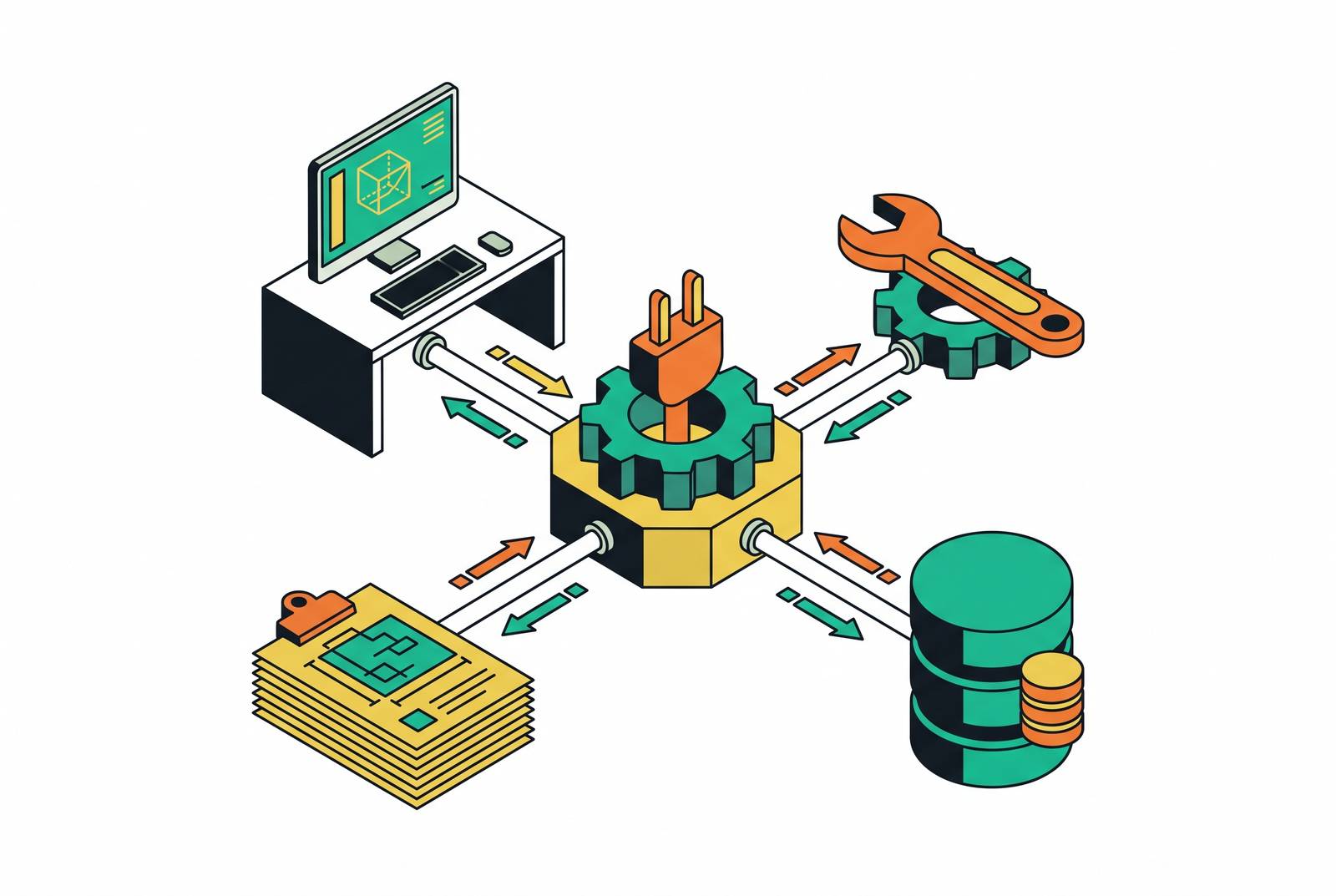
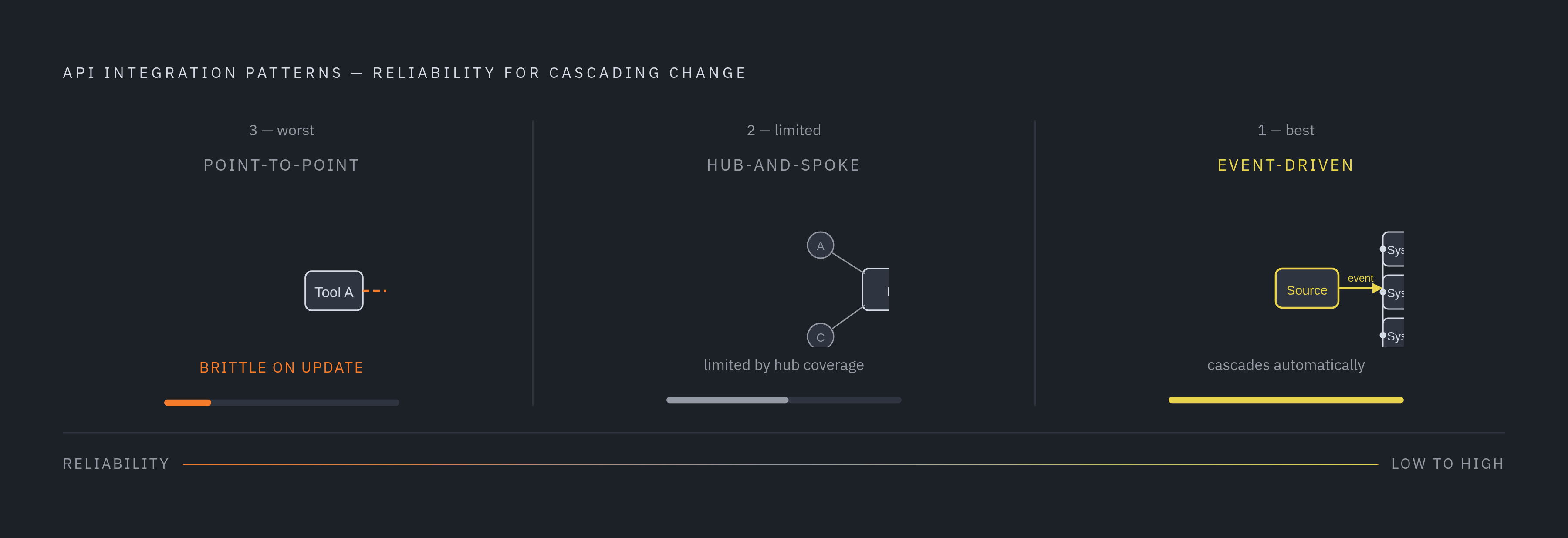
API integration, here, means structured data exchange between tools, so a change made in one system gets read, checked, and reflected in another without a person retyping it. Three patterns show up across data center delivery, and one of them should stay off the table whenever the other two are on the menu. Point-to-point connects two tools directly, say, a BIM model feeding a cable management system, but it's brittle; update either tool and the connection snaps. Hub-and-spoke routes everything through a central platform, which holds up better but only works as well as that hub's coverage. Event-driven integration beats both: a change in one system fires an event that automatically updates every connected system downstream, which is what cascading changes actually need.
Point-to-point is the easiest to stand up on a tight schedule, and that's the trap worth naming plainly. Teams pick it because it ships this quarter, and they buy a maintenance headache that shows up eighteen months later, right when nobody remembers how the connection was wired. If the schedule forces a choice between point-to-point and shipping nothing, shipping nothing is often the cheaper mistake.
The data that has to move across this layer includes rack IDs and positions, power load assignments, cable routes and circuit IDs, equipment parameters, RFI outcomes, and asset metadata. Enterprises automating more than half their network activities are projected to grow from under 10% in mid-2023 to 30% by 2026, and most of that gap traces back to integration architecture that was never built right the first time.
Worth saying plainly: an API can't fix a bad data model. If the source system holds messy, inconsistent, or unstructured data, the API just moves that mess somewhere else, fast and faithfully.
The fragmentation pattern that makes manual reentry the default
Walk through a typical data center project's tool stack. BIM handles geometry and modeling. Power modeling tools run load calculations and single-line diagrams. Cable management tracks routing, patching, and circuit records. DCIM holds the asset registry and capacity data. EPMS handles metering, BMS runs environmental controls, and RFI and submittal platforms sit on top of all of it. Every one of these tools got built by a different vendor, for a different job, with no shared plan for how its data would ever leave the building.
The result: the same rack, same power draw, same cables, gets described independently in at least four systems, kept in sync by hand.
The breaks happen at predictable seams. BIM geometry rarely carries circuit IDs or patch records, so the cable team ends up rebuilding that data from scratch. Load calculations often live in a spreadsheet, disconnected from BIM, so the model's schedules don't match the current load scenario. At turnover, asset data gets exported to a PDF or spreadsheet and then keyed back into DCIM by hand, and metadata, commissioning results, and equipment parameters get lost or degraded somewhere in that shuffle. RFI answers that change the design rarely propagate to connected systems either, so the coordination work happens twice.
BIM maturity decides how bad this gets, and this is where most post-mortems point the finger at the wrong thing. A model that's just geometry, with no structured metadata attached, has nothing worth exporting even if an API sits right there waiting. The model never had anything worth moving in the first place; the API only exposed that gap. Blaming the integration for it misses the actual failure. The MEP coordination layer makes things worse still. Cooling infrastructure, electrical busways, and cable trays all fight for the same overhead space, and when none of those systems share a common data structure, clash detection misses conflicts that later show up as field problems: on-site, expensive, and past the point of easy fixing.
What a connected integration layer needs to preserve: precision, traceability, and cascade logic
Data center systems don't forgive rounding. Rack power assignments, cable lengths, breaker ratings, cooling load calculations: these run at tolerances where a stale or approximate value is a real engineering risk, not a technicality.
Traceability matters just as much. Every value that crosses a tool boundary should carry its history: what design decision set it, which RFI changed it, which submittal confirmed it. Skip that, and the integration just builds a faster pipe for information nobody can check.
Then there's cascade logic. Move a rack two rows over, and the integration layer needs to know every record that touches that decision: power circuit reassignment, cable route recalculation, schedule updates, documentation refresh. Pushing the new position to one system and calling it done leaves the update partial, however much it looks finished.
This is exactly where deterministic rules belong, and getting that split backward is where a lot of these architectures fall apart. A rack move triggers a cascade governed by physical and electrical constraints that are non-negotiable; circuit continuity either holds or it doesn't. AI earns its place elsewhere: parsing equipment spec PDFs, flagging anomalies in load data, drafting RFI responses, work involving language, ambiguity, or pattern recognition. Where the answer has to be correct by definition, rules should run the show rather than a model guessing at the likeliest fit. Handing that decision to a model instead of a rule set is where a lot of teams get this backward.
Schema alignment has to happen before any of this works. Two tools can each have a perfectly working API and still fail to talk to each other if they use different identifiers, units, or naming conventions for the same rack or circuit. Resolving that mismatch is the integration layer's job, not something to leave for whoever's stuck reconciling spreadsheets at 6 p.m. And not every connection should run both ways. DCIM pulling asset data from a design model is a one-way read; operations data feeding back into design during a phased build needs to flow both directions. The architecture should decide which is which on purpose, not by accident.
How BIM becomes the structured data source the integration layer depends on
BIM sits at the center of design-side integration because it's the one system holding geometry, equipment identity, spatial relationships, and, when it's built well, equipment parameters and system associations, all in one place. That value only exists if the model actually carries structured metadata. A geometrically perfect model with nothing attached to it functions as a picture rather than a data source, and no API changes that.
A few practices separate a model that's ready to feed an API from one that isn't. Equipment objects need manufacturer parameters, model numbers, power ratings, and system associations stored as structured fields, not typed into a notes box as a sentence. Cable and conduit runs need to tie back to actual circuit records, not just get drawn as lines. Metadata needs checking against project requirements while the model is being built, not after, at export time. CFD and heat map data needs to link back to specific model zones, so a cooling assumption can be traced to the layout decision that produced it.
Higher BIM maturity produces API output worth trusting. Teams with rich, validated models expose endpoints that downstream tools actually use; teams with thin models expose noise, and that noise doesn't get better just because it's flowing through an API instead of an email attachment.
One gap worth naming directly: equipment data from manufacturer spec sheets almost never flows into BIM automatically. An engineer reads the PDF and types the numbers in by hand, and that's the moment values get rounded, misattributed, or dropped entirely. Extracting structured parameters directly from submittals and data sheets into model objects functions as a data quality gate, and everything downstream depends on it holding.
Connecting power and cooling models to the BIM layer without losing engineering fidelity
Power modeling tools and BIM speak different languages. One's built around circuits, the other around geometry and space, so connecting them takes real mapping, not just a wire between two ports. From the power model, BIM needs circuit assignments per rack, load values per panel, UPS and PDU headroom, and phase balance data. From BIM, the power model needs physical rack positions, submittal-confirmed power ratings, and the spatial zone assignments that determine which distribution path serves which rack.
Here's the scenario that tests whether an integration actually works: a rack gets moved two rows over. The power model needs to know its new circuit, the cable management system needs updated run lengths, and the single-line diagram needs the new panel assignment reflected. None of that should require a meeting; it should already be done by the time anyone thinks to schedule one.
Cooling adds a second layer of physical constraint on top of this. Chilled water piping and CRAH units compete with electrical busways for the same ceiling real estate, so a rack layout change touches power routing and cooling coverage at the same time. A 2025 study looking at 65 MEP clashes on a single project found unresolved conflicts generated significant added cost, and that number only grows as density climbs. Rack densities have gone from around 15kW in 2022 to 40kW in new AI halls, which makes these clashes both more frequent and more expensive when they slip through.
Liquid cooling raises the stakes further. Direct-to-chip and rear-door heat exchanger systems bring piping models that interact with structural and electrical models at the same time, and standard BIM-to-MEP integration patterns haven't caught up to that yet.
One more thing the integration layer has to respect: design intent. If an engineer deliberately left headroom in a power budget for future load, an automated update shouldn't see unused capacity and "correct" it away. The system has to carry not just the current value, but why it's set where it's set.
Cable and fiber routing as an integration domain that breaks under manual management
Cable management systems hold circuit records, patch panel assignments, port-level connectivity, and physical routing: data that operations teams depend on daily but that rarely originates from, or flows back to, the BIM model.
Generative AI data centers need roughly ten times more fiber than conventional facilities, to support GPU clusters and the low-latency interconnects those clusters demand. The documentation burden has grown right alongside it. The shift from 15kW to 40kW racks has roughly doubled horizontal cable runs per rack, and the overhead routing patterns that high-density AI halls require look nothing like the raised-floor conventions most cable tools were originally built around.
A cable-to-BIM integration that actually holds needs to carry cable type, length, and routing path tied to real model geometry; circuit origin and destination with port-level detail; and patch records that survive an equipment swap instead of turning into orphaned entries nobody can trace.
The operations handoff is where this breaks hardest. Cable records that live only inside a project-phase tool don't automatically show up in the DCIM asset record at turnover, which leaves technicians doing moves, adds, and changes off documentation that's stale or missing outright. AI-driven cable diagnostic tools that detect and map cable issues automatically are starting to show up on the market, but their value depends entirely on having a structured record to compare against. If the design-phase data was never exported properly, the AI is matching patterns against a blank page.
The operations handoff as the integration layer's final checkpoint
DCIM, EPMS, and BMS inherit whatever the design phase hands them, and what arrives at turnover decides how long it takes the facility to actually run the way it was designed to. BMS handles facility-level HVAC and environmental controls, building-oriented rather than asset-oriented. EPMS covers electrical distribution and metering at the circuit and meter level. DCIM sits above both, unifying IT and facility data and pulling together power chain telemetry, cooling data, and asset lifecycle information across sites.
BMS-to-DCIM integration isn't plug-and-play. The two systems have different priorities, different protocol layers like BACnet and OPC DA, and different object models, so the connection needs deliberate mapping, not a hopeful cable plugged into both ends.
Second-generation DCIM platforms now come with bidirectional APIs and connectors built in, which means the operational side can finally receive structured handoff data, provided the design side actually delivers it in a format DCIM can read. Good handoff looks like this: every asset in DCIM pre-populated with parameters pulled from the design model and confirmed submittals. Circuit assignments and power budgets get imported straight from the power model instead of re-typed from as-built drawings; cable records get mapped to DCIM's port-level asset entries; commissioning data, test results, and acceptance parameters get linked to the asset record instead of buried in a separate PDF nobody opens again.
Standardized integration schemas make repeatable BMS, BAS, and EPMS architectures possible across multiple sites, which cuts variability and shortens timelines project over project. Bespoke integrations, rebuilt from zero every time, kill that repeatability outright, and teams that keep choosing bespoke are trading a one-time convenience for a recurring cost. Digital twin functionality, DCIM platforms running what-if simulations against a 3D model of the facility, only works if the model arriving at turnover is the same structured model built during design. A degraded export defeats the purpose before the simulation even starts.
What does an integration architecture that actually eliminates data reentry errors look like in practice?
Three layers have to work together, not just sit next to each other. The data model layer comes first: every tool's objects, racks, circuits, cables, zones, mapped to a shared schema with consistent identifiers. Skip this and nothing built on top of it will hold, no matter how good the APIs look on paper.
The integration layer sits above that: the APIs, event triggers, and transformation logic that actually move data between tools when something changes, translating one tool's schema into another's without a person doing the translating by hand.
The governance layer sits on top of both, and it's the one teams skip most often, to their own cost. It decides which changes trigger which cascades, who's authorized to override an automated update, and how traceability survives when three systems all touch the same value in the same afternoon. Skip governance and the first two layers still move data fast and clean, right up until two updates collide and nobody can say which one was correct. That collision is the failure the whole architecture exists to prevent.